Correspondence from Karlan to Ganucheau (Clerk); Brief for Plaintiffs-Appellants Ronald Chisom, et al.; Record Excerpts
Public Court Documents
September 19, 1986 - July 8, 1987
This item is featured in:
-
Case Files, Chisom Hardbacks. Correspondence from Karlan to Ganucheau (Clerk); Brief for Plaintiffs-Appellants Ronald Chisom, et al.; Record Excerpts, 1986. d44db730-f211-ef11-9f89-0022482f7547. LDF Archives, Thurgood Marshall Institute. https://ldfrecollection.org/archives/archives-search/archives-item/df3a6f67-d12f-4dd8-9351-58bd93611c98/correspondence-from-karlan-to-ganucheau-clerk-brief-for-plaintiffs-appellants-ronald-chisom-et-al-record-excerpts. Accessed September 13, 2026.
Copied!
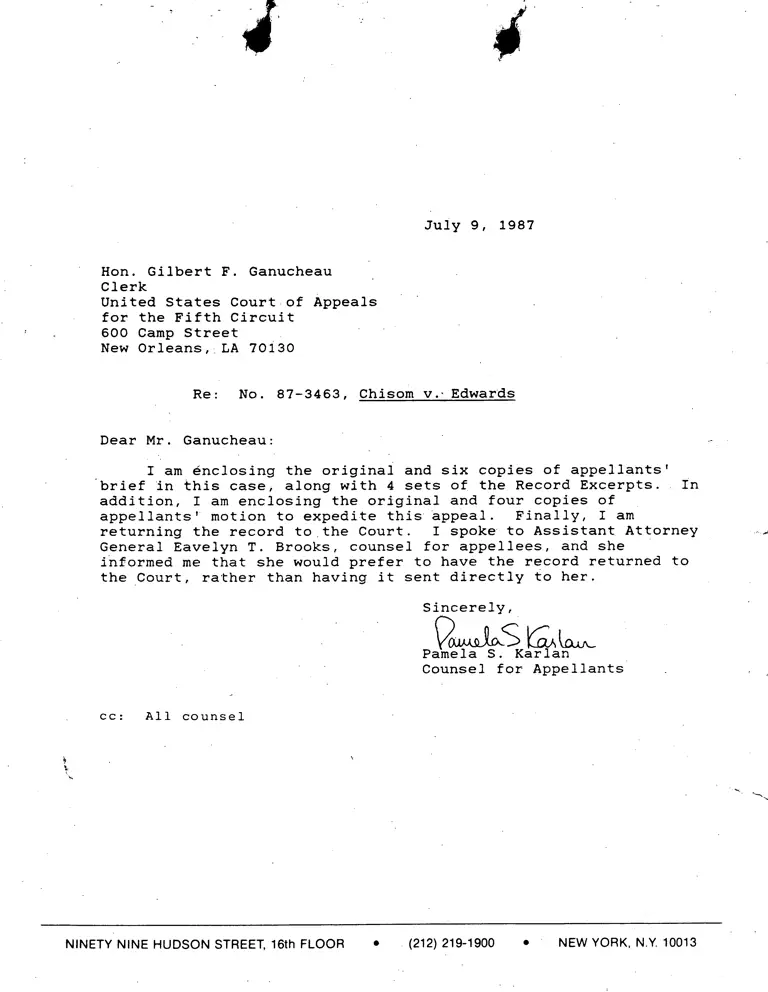
    July 9, 1987

Hon. Gilbert F. Ganucheau
Clerk
United States Court of Appeals
for the Fifth Circuit
600 Camp Street
New Orleans, LA 70130

Re: No. 87-3463, Chisom v.. Edwards

Dear Mr. Ganucheau:

I am enclosing the original and six copies of appellants'
brief in this case, along with 4 sets of the Record Excerpts. In
addition, I am enclosing the original and four copies of
appellants' motion to expedite this appeal. Finally, I am
returning the record to the Court. I spoke to Assistant Attorney
General Eavelyn T. Brooks, counsel for appellees, and she
informed me that she would prefer to have the record returned to
the Court, rather than having it sent directly to her.

Sincerely,

auuloS
Pamela S. Karlan
Counsel for Appellants

cc: All counsel

NINETY NINE HUDSON STREET, 16th FLOOR • (212) 219-1900 • NEW YORK, N.Y. 10013


710

IN THE
UNITED STATES COURT OF APPEALS

FOR THE FIFTH CIRCUIT

No. 87-3463

RONALD CHISOM, et al.,

Plaintiffs-Appellants,
V .

EDWIN EDWARDS, et al.,

Defendants-Appellees.

BRIEF FOR PLAINTIFFS-APPELLANTS
RONALD CHISOM. et al.

WILLIAM P. QUIGLEY
631 St. Charles Avenue
New Orleans, LA 70130
(504) 524-0016

ROY RODNEY
643 Camp Street
New Orleans, LA 70130
(504) 586-1200

JULIUS L. CHAMBERS
CHARLES STEPHEN RALSTON
C. LANI GUINIER
PAMELA S. KARLAN

99 Hudson Street, 16th Floor
New York, New York 10013
(212) 219-1900

RON WILSON
Richards Building, Suite 310
837 Gravier Street
New Orleans, LA 70112
(504) 525-4361

Counsel for Plaintiffs-
Appellants


IN THE
UNITED STATES COURT OF APPEALS

FOR THE FIFTH CIRCUIT

No. 87-3463

RONALD CHISOM, et al.,

Plaintiffs-Appellants,
V.

EDWIN EDWARDS, et al.,

Defendants-Appellees.

CERTIFICATE OF INTERESTED PERSONS

• The undersigned counsel of record certifies that the

following listed persons have an interest in the outcome of this

case. These representations are made in order that Judges of

this Court may evaluate possible disqualification or recusal.

Plaintiffs: Ronald Chisom

Marie Bookman

Walter Willard

Marc Morial

Louisiana Voter Registration/Education
• Crusade

• Henry A. Dillon, III

Defendants: There are no nongovernmental defendants

Attorneys Julius L. Chambers
for
Plaintiffs: Charles Stephen Ralston

C. Lani Guinier


Pamela S. Karlan

•

NAACP Legal Defense and Educational
Fund, Inc.

William P. Quigley

Ron Wilson

Roy Rodney

Attorneys William J. Guste, J.
for
Defendants: Kendall L. Vick

Eavelyn T. Brooks

M. Truman Woodward, Jr.

Blake G. Arata

A. R. Christovich

A 'Noise M. Dennery

Attorney of Record for
Plaintiffs-Appellants


STATEMENT REGARDING ORAL ARGUMENT

Plaintiffs-appellants request that this case be set for oral

argument. This appeal involves a legal issue of national

importance, namely, whether the Voting Rights Act of 1965, as

amended, covers elections for judicial office, and represents the

first time that a court of appeals has been asked to address this

question.


TABLE OF CONTENTS

Page

Certificate of Interested Persons

Statement Regarding Oral Argument   iii

Table of Authorities   •vi

Statement of Jurisdiction   1

Statement of the Issues Presented   1

Statement of the Case   2

I. Proceedings Below   2

II. Statement of the Facts   3

Summary of Argument   4

Argument   6

I. Section 2 of the Voting Rights Act Outlaws
Racial Discrimination in All Elections,
Including Elections for Judicial Positions   6

A. By Its Terms, Section 2 Covers All Elections  6

B. The Relationship of Section 2 to the Fifteenth
Amendment and to Section 5 Shows that Section 2
Should Apply to Judicial Elections   7

1. Section 2 and the Fifteenth Amendment   8

2. Section 2 and Section 5   10

C. The Legislative History of the Voting Rights
Act Shows Congress' Intention to Bar Racial
Discrimination in All Elections, Including
Judicial Elections   12

iv


D. The 1982 Amendments to the Voting Rights Act
Were Intended To Restore the Broad Scope of
Section 2's Protection, and Thus Cannot Justify
Excluding Judicial Elections   15

E. The Unique Nature of the Judicial Function Is
Irrelevant to the Question Whether Section 2
Covers Judicial Elections   18

II. The District Court Erred in Dismissing Appellants'
Constitutional Claims   23

Conclusion   28

Certificate of Service   29

Appendices


TABLE OF AUTHORITIES

Cases

Allen v. State Board of Elections,
393 U.S. 544 (1969)

American Nurses' Ass'n V. State of Illinois,
783 F.2d 716 (7th Cir. 1986)

Pages

12,13

25

Brown v. Dean, 555 F. Supp. 502 (D.R.I. 1982)   20

City of Mobile V. Bolden, 446 U.S. 55 (1980)   8,24

City of Rome v. United States, 446 U.S. 156 (1980) 12

Conley V. Gibson, 355 U.S. 41 (1957)   25

Dillard V. Crenshaw County, 640 F. Supp. 1347
(M.D. Ala. 1986)   9,25

Fortson V. Dorsey, 379 U.S. 433 (1965)   19

Goodloe V. Madison County Board of Election Commis-
sioners', 610 F. Supp. 240 (S.D. Miss. 1985)  21

Haith V. Martin, 618 F. Supp. 410 (E.D.N.C. 1985)
(three-judge court), aff'd, U.S.
91 L.Ed.2d 559 (1986)   11,12,15

Harris v. Graddick, 615 F. Supp. 239
Ala. 1985)   21

Illinois State Board of Elections V. Socialist
Workers Party, 440 U.S. 173 (1979)   20

Kirksey V. Allain, 635 F. Supp. 347 (S.D. Miss.
1986) (three-judge court)   10

Major v. Treen, 574 F. Supp. 325 (E.D.La.
1983) (three-judge court)   9,21,23

•Martin V. Allain, Civ. Act. No. J84-0708(B)
(S.D. Miss., Apr. 1, 1987)   17,23

Morial V. Judiciary Commission of the State
of Louisiana, 565 F.2d 295 (5th Cir. 1977)
(en banc), cert. denied, 435 U.S. 1013 (1978) • • • • 22

vi


Cases Pages

Nevitt V. Sides, 571 F.2d 209, 215-16 (5th Cir.
1978), cert. denied, •446 U.S. 951 (1980)   21

Reynolds V. Sims, 377 U.S. 533 (1964)   20,21

Rubin V. O'Koren, 621 F.2d 114 (5th Cir. 1980)   26

Thornburg V. Gingles, 478 U.S. , 92 L.Ed.2d
25 (1986)   8

Toney v. White, 476 F.2d 203 (5th Cir.), modified
and aff'd, 488 F.2d 310 (5th Cir. 1973)
(en banc)   20

United States v. Sheffield Board of Commissioners,
435 U.S. 110 (1978)   13

Voter Information Project v. City. of Baton Rouge,
612 F.2d 208 (1980)  passim

Wells v. Edwards, 347 F. Supp. 453 (M.D. La. 1972)
(three-judge court), aff'd, 409 U.S. 1095
(1973)   18,19,20

Statutes, Rules, and Regulations

28 U.S.C. § 1291   1

42 U.S.C. § 1971(e)   13

42 U.S.C. § 1973   7, passim

42 U.S.C. § 19731(c)(1)   7

La. Const. art. V, § 4   3

La. Rev. Stat. Ann. § 13-101 (West 1983)

Fed R. Civ. P. 8(a)(2)

Fed. R. Civ. P. 9(b)

52 Fed. Reg. 498 (1987)

3

25

26

11

Vii


Legislative History Paaes

H.R. Rep. No. 97-227 (1982)   11, passim

S. Rep. No. 94-295 (1975)   17

S. Rep. No. 97-417 (1982)   8, passim

Voting Rights: Hearings Before Subcommittee
No. 5 of the House Judiciary Comm., 89th Cong.,
1st Sess. (1965)

Voting Rights Act: Proposed Section 5 Regulations,
Report of the Subcomm. on Civil and Constitutional
Rights of the House Judiciary Comm., 99th Cong.,
2d Sess. (1986)

13,14

11

128 Cong. Rec. S7095 (daily ed., June 16, 1982)   11

128 Cong. Rec. H3841 (daily ed. June 16, 1982)•   11

Other Authorities

H.R. 6400, § 11(c)   13

Joint Center for Political Studies, Black
Elected Officials: A National Roster, 1980 (1980) 17

Nomination of William Bradford Reynolds to be
Associate Attorney General of the United States:
Hearings Before the Sen. Judiciary Comm.
Judiciary Comm., 99th Cong., 1st Sess.'(1985)   11

U.S. Commission on Civil Rights, The Voting
Rights Act: Ten Years After (1965)   18

U.S. Comm'n on Civil Rights, The Voting Rights
Act: Unfulfilled Goals (1981)   18

U.S. Dept. of Commerce, Bureau of the Census,
Statistical Abstract of the United States 1986

(106th ed. 1985)   18

5 C. Wright & A. Miller, Federal Practice and
Procedure § 1301 (1969)   26

viii


IN THE
UNITED STATES COURT OF APPEALS

FOR THE FIFTH CIRCUIT

No. 87-3463

RONALD CHISOM, et al.,

Plaintiffs-Appellants,
V.

EDWIN EDWARDS, et al.,

Defendants-Appellees.

On Appeal from the United States District Court
for the Eastern District of Louisiana

BRIEF FOR APPELLANTS

STATEMENT OF JURISDICTION

The judgment of the district court dismissing the complaint

was entered on June 8, 1987. Plaintiffs-appellants' notice of

appeal was filed on June 17, 1987. This Court's jurisdiction is

invoked under 28 U.S.C. § 1291.

STATEMENT OF THE ISSUES PRESENTED

(1) Did the district court err in holding that judicial

elections are not covered by section 2 of the Voting Rights Act

of 1965, as amended, 42 U.S.C. § 1973?

(2) Did plaintiffs sufficiently allege discriminatory

intent?


(3) Did the district court err in imposing a requirement

•that allegations of discriminatory intent be pleaded with

particular specificity in cases raising claims under the

Fourteenth and Fifteenth Amendments to the United States

Constitut,ion?

STATEMENT OF THE CASE

I. Proceeding Below

This action was commenced in September 1986 by five black

individuals registered to vote in Orleans Parish, Louisiana, and

a nonprofit corporation active in the field of voting rights

whose members are black registered voters in Orleans Parish.

Plaintiffs sought to represent a class consisting of all black

registered voters in Orleans Parish.

The complaint alleges that the system under which Justices

of the Louisiana Supreme Court are elected impermissibly dilutes

the voting strength of the black voters of Orleans Parish, in

• violation of the Voting Rights Act of 1965 and the Fourteenth and

Fifteenth Amendments to the United States Constitution. Record

Excerpts ("RE") 17-23. Defendants moved to dismiss the complaint

for failure to state either a statutory or a constitutional

claim. On May 1, 1987, the district court (Charles Schwartz,

Jr., J.), issued an opinion holding that section 2 of the Voting

Rights Act does not apply to the election of judges and that

plaintiffs had failed to plead an intent to discriminate with

sufficient specificity to support their constitutional claims.

2


RE 5-16. On June 8, 1987, the district court entered a judgment

dismissing plaintiffs' complaint. RE 4.

II. Statement of the Facts

This case concerns the district court's dismissal of

plaintiffs-appellants' complaint. The following facts were

alleged in the complaint, see RE 17-23, and must therefore be

taken as true.

The Supreme Court of Louisiana consists of seven elected

Justices. Pursuant to La. Const. art. V, § 4, and La. Rev. Stat.

Ann. § 13-101 (West 1983), the Justices are elected from six

judicial districts. Each of the judicial districts elects one

Justice, except for the First Supreme Court District, which

elects two Justices at large. Thus, the First Supreme Court

District, which consists of four parishes--Orleans, St. Bernard,

Plaquemines, and Jefferson--is the only multimember judicial

district.

The total population of the First Supreme Court District is

approximately 1,102,253. Of this total, 379,101 persons (34.4%)

are black. There are 515,103 registered voters in the First

District, of whom 162,810 (31.61%) are black.

• Although the First Supreme Court District contains four

parishes, over half of the district's residents and over half its

registered voters live in Orleans Parish. The majority of

Orleans Parish's residents (55.3%) and of its registered voters

(51.6%) are black.

Louisiana has a long history of purposeful official

3


discrimination on the basis of race, including, in particular,

purposeful discrimination touching upon

black citizens

this pervasive

of Louisiana continue to

official discrimination.

for offices in jurisdictions within the

the right to vote. The

suffer the effects of

In addition, elections

First Supreme Court

District, including elections for judicial office, are

characterized by widespread racial polarization: in races

involving black and white candidates, black voters vote

overwhelmingly for black candidates, while white voters vote

overwhelmingly for white candidates. White voters refuse to

support black candidates. The combination of demographic,

historical, and socio-economic•factors results in black voters in

the First Supreme Court District being unable to participate

equally in the processes leading to the nomination ind election

of Supreme Court Justices and therefore to elect the candidate of

their choice. No black person has ever been elected to the

Louisiana Supreme Court, either from the First Supreme Court

District or from any other district.

SUMMARY OF ARGUMENT

Section 2 of the Voting Rights Act of 1965, as amended,

prohibits states from using electoral schemes that result in the

dilution of minority voting power. First, the Voting Rights Act

expressly defines "voting" to encompass "any . . . election" at

which votes are cast for "candidates for public . . office"

and thus, by its terms, applies to judicial elections. Moreover,

4


the structure of the Voting Rights Act and its relationship to

the Fifteenth Amendment show that section 2 reaches judicial

elections. The Supreme Court has already held that section 5 of

the Act, which prohibits states from implementing new electoral

schemes that have the effect of discriminating against minority

voters, applies to judicial elections. Since section 2 and

section 5 were intended to provide complementary tools for

combating electoral discrimination, section 2 should also be

construed to reach judicial elections. This Court has already

held that the Fifteenth Amendment prohibits discrimination in

judicial elections. Since section 2 represents Congress' use of

its enforcement power under the Fifteenth Amendment, section 2

should also prohibit discrimination in judicial elections.

The legislative history of the Voting Rights Act and its

amendments strengthens the conclusion that section 2 should cover

judicial elections. It shows a clear congressional purpose to

eliminate discrimination from every election in which registered

voters participate.

In light of these factors, the district court erred in

holding that the Voting Rights Act does not cover judicial

elections. The linchpin of the district court's analysis is its

observation that judges perform a different function from other

elected officials. With respect to claims under the Voting

Rights Act, that observation is legally irrelevant. Once a state

has made the decision to use an elected judiciary, it cannot

grant the right to choose judges to white citizens while

5


effectively denying that right to black citizens.

The district court also erred in dismissing appellants'

constitutional claims. The heart of the district court's holding

is its misinterpretation of this Court's opinion in Voter

Information Project v. City of Baton Rouge, 612 F.2d 208 (1980).

Contrary to the district court's assumption, that case does not

stand for the proposition that the evidence underlying a claim of

discriminatory intent must be pleaded with specificity in the

complaint. Rather, that case, and the complaint in this case,

are fully consonant with the general principles of the Federal

Rules of Civil Procedure that a complaint contain a short and

plain statement of the claim and that intent need be pleaded only

generally.

ARGUMENT

I. Section 2 of the Voting Rights Act Outlaws Racial
Discrimination in All Elections, Including Elections
for Judicial Positions

The fundamental error in the district court's analysis is

that it focuses exclusively on what judges do after they are

elected. Only by virtually ignoring the language, structure, and

• legislative history of the Voting Rights Act was the district

court able to conclude that the nature of the judicial function

renders an electoral system that dilutes the votes of black

citizens immune from attack.

6


A. By its Terms, Section 2 Covers All Elections

Section 2(a) of the Voting Rights Act, as amended, contains

an absolute prohibition of racial discrimination in voting:

No voting qualification or prerequisite to voting or
standard, practice, or procedure shall be imposed or applied
by any State ... in a manner which results in a denial or
abridgement of the right of any citizen of the United States
to vote on account of race or color . . . .

42 U.S.C. § 1973 (emphasis added). Section 14(c)(1), which

defines"voting" for purposes of the Act, further shows that this

absolute ban is not restricted to particular types of elections:

The terms "vote" or "voting" shall include all action
necessary to make a vote effective in any primary,
special, or general election, including, but not
limited to, registration, listing pursuant to this
subchapter, or other action prerequisite to voting,
casting a ballot, and having such ballot counted
properly and included in the appropriate totals of
votes cast with respect to candidates for public or
party office and propositions for which votes are
received in an election.

42 U.S.C. .§ 19731(c)(1) (emphasis added). Thus, neither the

substantive nor the definitional sections of the Act provides any

exclusion from the Act's coverage for particular types of

elections.' Aspirants for elective judicial positions are

undeniably "candidates for public ... office," and the process by

which they attain those offices are undeniably "elections."

Thus, section 2 by its terms outlaws schemes for electing judges

that impair the ability of black citizens to participate

'Indeed, the application of the act to candidates for
"party" office further undercuts the district court's contention
that the particular functions performed by judges render
discriminatory election systems immune from attack under section
2.

7


effectively.

B. The Relationship of Section 2 to the
Fifteenth Amendment and to Section 5 Shows
that Section 2 Should Apply to Judicial
Elections

This Court and the Supreme Court have already held that the

Fifteenth Amendment and section 5 of the Voting Rights Act apply

to judicial elections. Because section 2 was intended to enforce

the Fifteenth Amendment and to complement section 5 as a tool for

eradicating discriminatory electoral practices, the decisions in

those earlier cases support the conclusion that section 2 also

applies to judicial elections.

1. Section 2 and the Fifteenth Amendment

Section 2 "protect[s] citizens against the risk that the

right to vote will be denied in violation of the Fifteenth

Amendment." S. Rep. 94-417, p. 40 (1982) ("Senate Report") •2

This Court has already held that suits challenging discrimination

in judicial elections may be maintained under the Fifteenth

Amendment. Voter Information Project v. City of Baton Rouge, 612

F.2d 208 (5th Cir. 1980). In City of Mobile v. Bolden, 446 U.S.

55 (1980), the Supreme Court held that section 2 "simply restated

the prohibitions already contained in the Fifteenth Amendment .

at 61 (plurality opinion); see also Senate Report at

17-19. Thus, prior to the amendment of section 2 in 1982, a

2The Supreme Court has termed the Senate Report an
"authoritative source" concerning Congress' intent in amending
section 2. Thornburg v. Gingles, 478 U.S. , 92 L.Ed.2d 25, 42
n. 7 (1986).

8


plaintiff clearly could have stated a cause of action under

section i with regard to discriminatory systems for electing

judges. Nothing in the 1982 amendments can be read to remove

judicial elections from the scope of the Voting Rights Act. See

infra pp. 15-17.

Moreover, to reach the conclusion adopted by the district

court would require making the illogical assumption that Congress

used its enforcement power under the second section of the

Fifteenth Amendment to enact a statute that gives minority

citizens less protection than they enjoy under the Amendment

standing alone. Cf. Senate Report at 39-40 (discussing how the

proposed amendments to section 2 represent a legitimate use of

Congress' power to "enact measures going beyond the direct

requirements of the Fifteenth Amendment"). The district court

provided no reason for assuming that section 2's prohibition of

intentional racial vote dilution3 is narrower than the Fifteenth

Amendment's prohibition. If the nature of the judicial function

is irrelevant to the constitutional prohibition of intentional

racial vote dilution, it is equally irrelevant to the statutory

prohibition. Thus, since the Fifteenth Amendment reaches

intentional vote dilution in judicial elections, section 2 also

reaches such discrimination.

3Although section 2 no longer requires a showing of
discriminatory intent, it still prohibits the adoption or
maintenance of intentionally discriminatory systems. See Dillard
v. Crenshaw County, 640 F. Supp. 1347, 1353 (M.D. Ala. 1986);
Ma'or V. Treen, 574 F. Supp. 325, 344 (E.D.La. 1983) (three-judge
court); Senate Report at 27.


But if section 2 reaches intentional vote dilution in

judicial elections, then it necessarily also reaches dilution

even when such dilution is merely the result of a particular

system. Congress stated that making the presence or absence of

discriminatory intent a dispositive issue in a section 2 suit

"asks the wrong question." Senate Report at 36. Coverage of

judicial elections simply cannot turn on the intention of the

state officials who enacted or maintain the practices being

challenged. Therefore, section 2 covers all discrimination in

judicial elections.

2. Section 2 and Section 5

The relationship between sections 2 and 5 of the Voting

Rights Act similarly' compels the conclusion that section 2

applies to judicial elections. Sections 4 and 5 of the Act

suspend the use of various devices historically used to

disenfranchise minority voters and require certain jurisdictions

with a history of depressed political participation to seek

federal approval of electoral changes before those changes go

into effect. Congress has made clear that these provisions are

intended to work in tandem with the more generalized prohibitions

of section 2 to form a concerted plan of attack on practices,

standards, and devices that discriminate against minority voters.

Senate Report at 5-6.

It is undisputed that judicial elections are subject to the

preclearance provisions of section 5 of the Voting Rights Act.

Kirksem V. Allain, 635 F. Supp. 347 (S.D. Miss. 1986) (three-

10


judge court); Haith V. Martin, 618 F. Supp. 410 (E.D.N.C. 1985)

(three-judge court), aff'd, U.S. , 91 L.Ed.2d 559 (1986).

Congress has squarely rejected the proposition that a violation

of section 5 is not necessarily a violation of section 2:

Under the Voting Rights Act, whether a discriminatory
practice or procedure is of recent origin affects only
the mechanism that triggers relief, i.e., litigation
[under section 2] or preclearance [under section 5].
The lawfulness of such a practice should not vary
depending on when it was adopted, i.e., whether it is a
change.

H.R. Rep. No. 97-227, p. 28 (1982) ("House Report]. 4 Section 5

provides an additional procedural mechanism for protecting voters

in areas with an egregious history of voting discrimination; it
^

does not, however, use an inconsistent standard of review. The

district court's analysis thus essentially creates a Voting

Rights Act "grandfather clause," by permitting Louisiana to

continue using a discriminatory system the Act would not permit

it to enact today.

4Both Congress and the Attorney General• have interpreted the
protections of sections 5 and 2 as coextensive with respect to
the closely related question whether the Attorney General must
object under section 5 to practices that also violate section 2.
See, e.g., S. Rep. No. 97-417, p. 12 n. 31 (1982); 128 Cong. Rec.
S7095 (daily ed., June 16, 1982) (remarks of Sen. Kennedy); 128
Cong. Rec. H3841 (daily ed. June 16, 1982) (remarks of Rep.
Sensenbrenner and Rep. Edwards); Voting Rights Act: Proposed
Section 5 Regulations, Report of the Subcomm. on Civil and
Constitutional Rights of the House Judiciary Comm., 99th Cong.,
2d Sess. 5 (1986); Nomination of William Bradford Reynolds to be
Associate Attorney General of the United States: Hearings Before
the Sen. Judiciary Comm., 99th Cong., 1st Sess. 119 (1985); 52
Fed. Reg. 498 (1987) (to be codified at 28 C.F.R. § 51.55(b) (the
Attorney General will withhold § 5 preclearance from changes that
violate § 2); 52 Fed. Reg. 487 (1987) (when facts available at
preclearance proceeding show that the change "will result in a
Section 2 violation, an objection will be entered.")

11


Moreover, the analysis of the three-judge court in Haith

clearly supports applying section 2 as well as section 5 to

judicial elections. Haith expressly relied on the language of

section 2 to support its conclusion that "the Act applies to all

voting without any limitation as to who, or what, is the object

of the vote." Haith V. Martin, 618 F. Supp. at 413 (emphasis in

original). Thus, no basis exists in the structure of the Act

itself for concluding that only section 5 applies to judicial

elections.

C. The Legislative History of the Voting Rights
Act Shows Congress' Intention To Bar Racial
Discrimination in All Elections, Includina
Judicial Elections

In light of the reasons for including judicial elections

within section 2, the decision to exclude them should be made

only on the basis of an explicit congressional intention to do

so. But nothing in the legislative history of the Act suggests

that Congress somehow intended to permit continued racial

discrimination against minority voters as long as that

discrimination involved only judicial elections. To the

contrary, the legislative history confirms the conclusion that

Congress intended that section 2 cover judicial elections.

The Supreme Court has frequently noted Congress' "intention

to give the Act the broadest possible scope," Allen v. State

Board of Elections, 393 U.S. 544, 566-67 (1969). Congress sought

"to counter the perpetuation of 95 years of pervasive voting

discrimination," City of Rome v. United States, 446 U.S. , 156, 182

12


(1980), and to "create a set of mechanisms for dealing with

continued voting discrimination, not step by step, but

comprehensively and finally," Senate Report at 5.

The Voting Rights Act originated as H.R. 6400, a bill

drafted by the Johnson Administration. The House Judiciary

Committee conducted extensive hearings with respect to that bill.

See Voting Rights: Hearings Before Subcommittee No. 5 of the

House Judiciary Comm., 89th Cong., 1st Sess. (1965) ("House

Hearings"]. At those hearings, Attorney General Katzenbach

testified at length as to the bill's scope. The Supreme Court

has held that, "in light of the extensive role [he] played in

drafting the statute and explaining its operation to Congress,"

Katzenbach's construction of the Act is entitled to great weight.

United States v. Sheffield Board of Commissioners, 435 U.S. 110,

131 & n. 20 (1978); see Allen v. Board of Elections, 393 U.S. at

566-69; Senate Report at 17 & n. 51.

H.R. 6400 adopted the definition of "voting" employed by the

Civil Rights Act of 1960, see H.R. 6400, § 11(c), reprinted in

House Hearings at 865, which guaranteed the right to cast an

effective ballot "with respect to candidates for public or party

office and propositions for which votes are received in an

election," 42 U.S.C. § 1971(e). In response to questions from

Members of Congress as to the intended scope of H.R. 6400, the

Attorney General made clear that "[e]very election in which

registered electors are permitted to vote would be covered" by

13


the Act. House Hearings at 21 (emphasis added) .5 The clear

5Rep. Kastenmeier noted that one alternative bill had
defined "election" to include

"any general, special, primary election held in any
State or political subdivision thereof solely or
partially for the purpose of electing or selecting a
candidate to public office, and any election held in
any State or political subdivision thereof solely or
partially to decide a proposition or issue of public
law."

The following exchange then occurred:

"Mr. KASTENMEIER. First, I am wondering if you
would accept that definition.

Mr. KATZENBACH. Yes.
Mr. KASTENMEIER. Secondly, I am wondering if you

feel it might aid to put a definition of that sort in
the administration bill or whether it is unnecessary.

Mr. KATZENBACH. I don't think it is necessary.
Congressman, but I cannot think of any objection that I
would have to using that definition or something very
similar to it."

House Hearings at 67 (emphasis added). Katzenbach had a similar
colloquy with Rep. Gilbert:

"Mr. GILBERT. ... You refer in section 3 of the
bill [which dealt with tests and devices] to Federal,
State and local elections. Now, would that include
election for a bond issue?

Mr. KATZENBACH. Yes.
Mr. GILBERT. Now, my bill, H.R. 4427. I have a

definition. I spell out the word 'election' on page 5,
subdivision (b). I say:

"Election" means all elections, including
those for Federal, State, or local office and
including primary elections or any other
voting process at which candidates or
officials are chosen. "Election" shall also
include any election at which a proposition
or issue is to be decided.
Now, I have no pride of authorship but don't you

think we should define in H.R. 6400 [the
Administration's bill] the term 'election'?

Mr. KATZENBACH. I would certainly have no
objection to it and I think it should be broadly
defined.

14


focus of the Act was on the right of all citizens to participate

in the electoral process, rather than on the particular question

to be determined at a given election. As one court has noted,

"the Act applies to all voting without any limitation as to who,

or what, is the object of the vote." Haith v. Martin, 618 F.

Supp. 410 (E.D.N.C. 1985) (three-judge court) (emphasis in

original) (holding that section 5 of the Act covers judicial

elections), aff'd, U.S. , 91 L.Ed.2d 559 (1986). In light

of Congress' sweeping determination to eliminate the blight of

racial discrimination in voting, it is hard to imagine that

Congress intended, sub silentio, to permit the continued

disenfranchisement of black voters as long as the elections in

which they were barred from participating effectively involved

choosing judges.

D. The 1982 Amendments to the Voting Rights Act
2 Were Intended To Restore the Broad Scope of
Section 2's Protection, and Thus Cannot
Justify Excluding Judicial Elections

In 1982, section 2 was amended to reinstate the "results"

test, and thereby to provide broader protection under the Voting

Rights Act than the Fifteenth Amendment gives. Senate Report at

15. Ultimately, the district court's entire holding rests on the

paradoxical claim that the very act of broadening section 2

constricted its coverage because of the use of one word,

"representatives," in section 2(b). Section 2(b) provides, in

pertinent part, that

House Hearings at 121 (emphasis added).

15


A violation of subsection (a) of this section is
established if, based on the totality of circumstances,
it is shown that the political processes leading to
nomination or election . . . are not equally open to
participation by members of a class of citizens
protected by subsection (a) of this section in that its
members have less opportunity than other members of the
electorate to participate in the political process and
to elect representatives of their choice. The extent
to which members of a protected class have been elected
to office . . . is one circumstance which may be
considered: Provided, That nothing in this section
establishes a right to have members of a protected
class elected in numbers equal to their proportion in
the population.

Section 2(b) was added to the Act not to restrict the kind

of elections to which the Act applies, but to make clear that the

mere fact that a minority group had not achieved "proportional

representation" (on any particular elected body) would not

constitute a violation of section 2. See Senate Report at 2.

Nothing in the statute or legislative history supports the claim

that section 2(b) •was meant to restrict section 2's protection to

a subset of elections. The choice of the word "representatives,"

as opposed to, for example, the words "candidate" or "elected

official," which are used extensively in the legislative history,

see, e.g., id. at 16, 28, 29, 30, 31, and 67, 6 simply cannot

carry the weight the district court places on it. The only other

district court to have addressed the applicability of section 2

to judicial elections recognized that the word "representative"

was not used in any restrictive sense:

6The House Report uses similar terminology. See, e.g., H.R.
Rep. No. 97-227, p. 4 (1982) ("electoral process"); id. at 18
(condemning practices that deprive minorities of the chance to
elect the "candidate of their choice").

16


There is no legislative history of the Voting Rights
Act or any racial dilution case law which distinguishes
state judicial elections from any other types of
elections. Judges do not "represent" those who elect
them in the same context as legislators represent their
constituents. [However, t]he use of the word
"representatives" in Section 2 is not restricted to
legislative representatives but denotes anyone selected
or chosen by popular election from among a field of
candidates to fill an office, including judges.

Martin v. Allain, Civ. Act. No. J84-0708(B), slip op. at 35-36

(S.D. Miss., Apr. 1, 1987).

In light of the reason why section 2(b) was added, there was

absolutely no reason to believe that it would have had any effect

on the Act's coverage of judicial elections. To the contrary,

Congress' discussion of the increasing presence of minority

elected officials suggests that the ability of minority voters to

elect the judges of their choice was one of the purposes of the

Act. For example, the House Report relied on figures mgarding

the number of black elected officials provided in a report that

explicitly included, as relevant elected officials, elected black

judges. See House Report at 7-9; Joint Center for Political

Studies, Black Elected Officials: A National Roster, 1980, at 4-

5, 14-15 (1980). Of particular salience to this case, the report

on which Congress relied included black elected judges in

Louisiana within its total of black elected officials within the

state. See id. at 123 and 132. 7

7Congress has consistently relied on data concerning black
elected officials that explicitly include judges. In 1975, for
example,. Congress relied for its figures regarding the number of
black elected officials on a report prepared by the U.S.
Commission on Civil Rights. See, e.g., S. Rep. No. 94-295, p. 14
(1975). That report explicitly included judges in its summaries

17


E. The Unique Nature of the Judicial Function Is
Irrelevant to the Question Whether Section 2 Covers
Judicial Elections

Rather than relying on the language, structure, and

legislative history of the Act, the district court assumed that

Wells v. Edwards, 347 F. Supp. 453 (M.D. La. 1972) (three-judge

court), aff'd, 409 U.S. 1095 (1973) (per curiam), had addressed

and rejected the claim that section 2 prohibits discriminatory

judicial elections. It then used Wells' reasoning to explain why

the nonrepresentative nature of the judicial function renders

discriminatory judicial elections immune from attack.

The district court's assumption that Wells concerned the

Voting Rights Act is, quite simply, wrong. First, the complaint

in Wells never mentions the Voting Rights Act. 8 Rather, the

complaint makes clear that the basis of Wells' claim was the

population deviation among Louisiana's Supreme Court Districts,

of the number of black elected officials. See, e.g., U.S.
Commission on Civil Rights, The Voting Rights Act: Ten Years
After 377 (table containing the number of black elected county
officials in counties with 25% or more black populations, column
listing "Law Enforcement Officials" includes, among others,
"judges" and "justices of the peace").

Similarly, the Civil Rights Commission and the Census Bureau
include elected minority jurists within their descriptions of
black elected officials. See, e.g., U.S. Comm'n on Civil Rights,
The Voting Rights Act: Unfulfilled Goals 27-28 (1981) (stating
that blacks were rarely elected to "law enforcement positions
(including sheriffs and iudges)") (emphasis added); id. at 31,
34, 35, 37; U.S. Dept. of Commerce, Bureau of the Census,
Statistical Abstract of the United States 1986, at 252 (106th ed.
1985).

8A copy. of that complaint appears in Appendix A to this
brief.

18


and the consequent failure to comply with the principle of one-

person, one-vote. 9

The three-judge district court in Wells understood the case

to concern solely whether the Fourteenth Amendment required equal

population apportionment for judicial districts. Its opinion

makes absolutely no mention of either the Fifteenth Amendment or

the Voting Rights Act. That court described its holding in these

terms: "we hold that the concept of one-man, one-vote

apportionment does not apply to the judicial branch of the

government." 347 F. Suppe at 454. Thus, neither the pleadings

nor the opinion in Wells supports the assertion by the court

below that "Wells clearly states section 2 is not applicable to

judicial elections." RE 12.

It is even clearer that the Supreme Court's summary

affirmance in Wells provides no basis for excluding judicial

elections. "The precedential effect of a summary affirmance can

extend no farther than 'the precise issues presented and

9The only statement in the entire complaint which even
mentions racial discrimination is 116(e), which alleges that the
apportionment scheme "lacks uniformity, consistency and
rationalization and, in many instances, operates to minimize or
cancel out the voting strength of racial or political elements in
the election districts." It is clear from the context of the
complaint as a whole that this allegation was not intended to
state a cause of action separate from the plaintiffs'
straightforward malapportionment claim. Cf. Fortson V. Dorsey,
379 U.S. 433, 439 (1965) (although plaintiffs "asserted in one
short paragraph of their brief" that Georgia's system of electing
state senators was used to dilute the electoral strength of black
voters, they "never seriously pressed this point below" and the
district court "did not consider or rule on its merits";
therefore, the Supreme Court addressed only the one-person, one-
vote claim).

19


necessarily decided," and thus "[q]uestions which 'merely lurk

in the record,' are not resolved and no resolution of them may be

inferred." Illinois State Board of Elections v. Socialist

Workers Party, 440 U.S. 173, 182-83 (1979) (internal citations

omitted). The sole issue presented in Wells' jurisdictional

statement was

Does a state constitutional provision which provides
for the election of state Supreme Court Justices by
districts violate the Equal Protection Clause of the
Fourteenth Amendment when those districts do not
conform to the one-man, one-vote rule?

Juris. Statement at 4, Wells v. Edwards, No. 72-621. 10 Since

neither the opinion of the three-judge court nor the

jurisdictional statement made any mention of the Fifteenth

Amendment, the Voting Rights Act, or, indeed, discrimination on

the basis of race, the Supreme Court's summary affirmance in

Wells simply has no precedential weight on the question whether

section 2 applies to judicial elections.

Nor should the opinion in Wells carry any analytical weight.

The fact that the Constitution does not require strict population

equality among judicial districts says virtually nothing about

whether the Voting Rights Act prohibits judicial apportionment

schemes that result in black voters being denied an equal

opportunity to participate effectively.

First, the protections mandated by Reynolds v. Sims, 377

U.S. 533 (1964), are not identical to those provided by the

10A copy of the jurisdictional statement appears in Appendix
B to this brief.

20


Voting Rights Act. The Voting Rights Act has always been

interpreted as providing protection beyond that afforded by the

principle of one-person, one-vote. For example, the Act reaches

practices wholly unrelated to the effects of apportionment. 11

But even with respect to questions of apportionment, Congress

intended that the Voting Rights Act be interpreted more broadly

than Reynolds, because it knew that "population differences were

not the only way in which a facially neutral districting plan

might unconstitutionally undervalue the votes of some." Senate

Report at 20; cf. Voter Information Project v. City of Baton

Rouge, 612 F.2d at 211 (discussing distinction between one-

person, one-vote theory and claims of racial vote dilution);

Nevitt v. Sides, 571 F.2d 209, 215-16 (5th Cir. 1978)

(distinguishing between "quantitative" and "qualitative" vote

dilution), cert. denied, 446 U.S. 951 (1980). Thus, for example,

Ma or V. Treen, 574 F.Supp. 325, 349-55 (E.D. La. 1983) (three-

judge court), rejected a congressional districting plan that

fractured New Orleans' large black community into two districts

despite the plan's compliance with the one-person, one-vote

standard. The plan submerged concentrations of black voters

within white majorities, thereby making it impossible for blacks

11See, e.g., Toney v. White, 476 F.2d 203, 207-08 (5th Cir.)
(use of voter purge statute), modified and aff'd, 488 F.2d 310
(5th Cir. 1973) (en banc); Harris v. Graddick, 615 F. Supp. 239
(M.D. Ala. 1985) (appointment of polling officials); Goodloe v.
Madison County Board of Election Commissioners, 610 F. Supp. 240
(S.D. Miss. 1985) (invalidation of absentee ballots); Brown v.
Dean, 555 F. Supp. 502 (D.R.I. 1982) (location of polling
places).

21


to elect the candidates of their choice. This result itself was

prohibited by the Voting Rights Act.

The fact that judges are not supposed to represent directly

the will of a constituency also is irrelevant to the scope of

section 2. The district court's reliance on Morial v. Judiciary

Commission of the State of Louisiana, 565 F.2d 295 (5th dr.

1977) (en banc), cert. denied, 435 U.S. 1013 (1978), is therefore

misplaced. In Morial, this Court held that the duties of judges

and the duties of more political officials differed in ways that

justified placing restrictions on candidates for judicial office

that were not imposed on candidates for other offices. But the

question of how ludges and candidates for judicial office should

conduct themselves differs significantly from the question of

what rights should be accorded to voters given a state's decision

to make judicial positions elective. The Voting Rights Act

focuses on the rights of black voters, not the interests of black

candidates. 12 Neither the scope of )official duties nor the level

of official performance has any bearing on whether black voters

can be denied an equal voice in electing those officials. Both

Houses of Congress have expressly rejected the concept that a

voting rights plaintiff must show unresponsiveness on the part of

elected officials to establish a violation of section 2. See

Senate Report at 29, n. 116 ("Unresponsiveness is not an

essential part of plaintiff's case."); House Report at 30 (same).

12The Morial Court explicitly stated that the challenged
statute had only a negligible impact on the constitutional
interests of voters. See 565 F.2d at 301-02.

22


In light of Congress' decision that responsiveness or its absence

is not the touchstone of a section 2 violation, it makes no sense

to suggest, as the court below did, that section 2 should not

cover judicial elections because a judge is not supposed to

represent the views of the electorate. Ma or V. Treen, 574

F.Supp. at 337-38, implicitly recognized that the interests and

rights of black voters in judicial and nonjudicial elections are

identical when it relied on an analysis of polarized voting which

included, among the 39 elections studied, at least 13 involving

judicial positions.

In deciding to make positions on its Supreme Court elective,

the State of Louisiana has decided that the people shall choose

the justices. Having made this decision, the State lacks the

power to structure its judicial elections in a fashion that

results in black citizens having a lesser opportunity to elect

the judicial candidates of their choice than white citizens

enjoy. See also Martin v. Allain, slip op. at 35-36. 13

13Even though an office need not be representative, in the
sense that a State is not required in the first place to permit
citizens to choose the person who fills it, the Voting Rights Act
prohibits practices that diminish the opportunity of minority
citizens to decide who fills it once the decision has been made
that it should be elective. See Senate Report at 6-7 (abolishing
elective posts may "infringe the right of minority citizens to
vote and to have their vote fully count").

23.


II. The District Court Erred in Dismissing Appellants'
Constitutional Claims

In essence, the district court rested its decision to

dismiss plaintiffs' constitutional claims on two grounds. First,

it believed that the complaint had failed to advance a claim of

intentional discrimination: "plaintiffs intend to prove [their

constitutional] claim on a theory of 'discriminatory effect' and

not on a theory of 'discriminatory intent . . ." RE 16.

Second, it held that, even assuming that the complaint does

advance a claim of intentional discrimination, it failed to do so

with sufficient specificity: "plaintiffs'- complaint does not

allege the system by which the Louisiana Supreme Court Justices

are elected was instituted with specific intent to discriminate.

This contrasts with the specific allegations in Voter Information

Pro ect • • • " RE 16. 14

The district court's first ground for dismissing the

complaint ignores the plain language of the complaint, which

explicitly alleges that:

The defendant's actions are in violation of the
Fourteenth and Fifteenth Amendments to the United
States Constitution and 42 USC Section 1983 in that the
purpose and effect of their actions is to dilute,
minimize, and cancel the voting strength of the
plaintiffs.

RE 22 (emphasis added). Appellants clearly did not propose to

proceed upon a constitutional "theory of 'discriminatory

14The district court's opinion did give plaintiffs an
opportunity to replead their constitutional allegations to
conform with its reading of Voter Information Project.

24


effect," RE 16, in light of City of Mobile v. Bolden, 446 U.S.

55 (1980). Cf. Plaintiffs' Motion in Opposition to Motion to

Dismiss at 12 (discussing the Fifteenth Amendment's intent

requirement) •15

Second, the district court erred in holding that the

complaint's allegation of purpose was insufficient. Its

conclusion fails to give proper weight to the standards

established by the Federal Rules of Civil Procedure and rests on

a misreading of this Court's decision in Voter Information

Pro ect v. City of Baton Rouge, 612 F.2d 208 (5th Cir. 1980).

Rule 8 governs general rules of pleading. It requires that

a pleading setting forth a claim for relief must contain "a short

and plain statement of the claim, " Fed R. Civ. P. 8(a)(2), "that

will give the defendant fair notice of what the claim is and the

grounds upon which it rests." Conley v. Gibson, 355 U.S. 41, 47

(1957). Thus, for example, the Seventh Circuit held, in American

Nurses' Ass'n v. State of Illinois, 783 F.2d 716 (7th Cir. 1986),

that a charge of intentional sexual discrimination, "standing

alone, would be quite enough to state a claim under Title VII."

Id. at 724. Similarly, this Court's decision in Voter

Information Project makes clear that complaints in constitutional

voting rights cases must be construed liberally. 612 F.2d at

15Even in cases involving claims of intentional
discrimination, plaintiffs must plead and prove some level of
discriminatory effect. Cf. Dillard v. Crenshaw County, 640 F.
Supp. 1347 (M.D. Ala. 1986) (section 2 intent case). Thus, that
the complaint pleaded "purpose and effect" cannot be taken as an
indication of an intent to advance an "effects theory" only.

25


210; cf. Rubin V. O'Koren, 621 F.2d 114 (5th Cir. 1980).

Certainly, the complaint in this case meets the standards of Rule

8: defendants are on notice that plaintiffs intend to prove that

the system of electing Supreme Court Justices from the First

District violates the United States Constitution.

Moreover, Rule 9, which governs pleading of special matters,

further supports appellants' position:

In all averments of fraud or mistake, the circumstances
constituting fraud or mistake shall be stated with
particularity. Malice, intent, knowledge, and other
condition of mind of a person may be averred generally.

Fed. R. Civ. P. 9(b) (emphasis added). The drafters of Rule 9(b)

felt that to require specificity of pleading with regard to

intent would be counterproductive since conditions of the mind

are inherently difficult to describe with exactitude in the short

and plain statement foreseen by Rule 8. 5 C. Wright & A. Miller,

Federal Practice and Procedure § 1301 (1969).

The rationale for Rule 9(b)'s approval of general

allegations of intent is, if anything, stronger in a case

involving group intent. The problem of analyzing intent is

compounded when the intent to be discerned is the product of a

group of individuals acting over a long period of time. In light

of the dual commands of Rules 8(a) and 9(b), the complaint in

this case was clearly sufficient to survive a motion to dismiss.

Read properly, Voter Information Project reaches the same

conclusion. First, that case simply does not stand for the

proposition that complaints in constitutional voting rights cases

require some form of heightened specificity. It is clear from

26


the context of this Court's quotation of several paragraphs of

the Voter Information Project complaint that the reason for that

quotation was not to set a special rule for pleadings; rather, it

was intended to differentiate the claim of constitutional racial

vote dilution raised, by Voter Information Project from a claim of

constitutional one-person, one-vote vote dilution. See 612 F.2d

at 211.

In addition, the allegations on which this Court relied in

Voter Information Project are no more "specific" than the

allegations made in the complaint in this case. Voter

Information Project alleged: (1) that the "sole purpose" of the

existing electoral system was to ensure the preservation of an

all-white judiciary; (2) that the system had been adopted "as a

reaction to increasing black voter registration"; and (3) that

Baton Rouge had a "continuing history of 'bloc voting," 612

F.2d at 211. In this case, the complaint alleges that the

challenged scheme represents: (1) an intention to "dilute,

minimize, and cancel the voting strength of the plaintiffs," who

are black; (2) an official history of racial discrimination; (3)

"widespread prevalence of racially polarized voting"; and (4) the

"lack of any justifiable reason to continue" the current

electoral scheme. RE 6, 5. It is hard to fathom any legally

significant difference between these two sets of allegations

great enough to justify dismissing the complaint.

27


CONCLUSION

The judgment of the district court dismissing appellants'

complaint for failure to state a claim should be reversed.

Respectfully submitted,

WILLIAM P. QUIGLEY
631 St. Charles Avenue
New Orleans, LA 70130
(504) 524-0016

ROY RODNEY
643 Camp Street
New Orleans, LA 70130
(504) 586-1200

July 8, 1987

•

JULIUS L. CHAMBERS
CHARLES STEPHEN RALSTON
C. LANI GUINIER
PAMELA S. KARLAN

99 Hudson Street, 16th Floor
New York, New York 10013
(212) 219-1900

RON WILSON
Richards Building, Suite 310
837 Gravier Street
New Orleans, LA 70112
(504) 525-4361

Counsel for Plaintiffs-
Appellants


CERTIFICATE OF SERVICE

I, Pamela S. Karlan, hereby certify that on July , 1987,

I served copies of the foregoing brief upon the attorneys listed

below via United States mail, first class, postage prepaid:

Kendall L. Vick, Esq.
Asst. Atty. General
La. Dept. of Justice
234 Loyola Ave., Suite 700
New Orleans, LA 70112-2096

M. Truman Woodward, Jr., Esq.
1100 Whitney Building
New Orleans, LA 70130

Blake G. •Arata, Esq.
210 St. Charles Avenue
Suite 4000
New Orleans, LA 70170

A. R. Christovich, Esq.
1900 American Bank Building
New Orleans, LA 70130

Noise W. Dennery, Esq.
21st Floor Pan American Life Center
601 Poydras Street
New Orleans, LA 70130

(2„,s Gi1/4
Pamela S. Karlan
Counsel for Plaintiffs-
Appellants

29


APPENDIX A


••_•

2ivil Action Num]oer

UNITED STATES DIST7ICT COURT

2 0 0

MIDDLE DISTRICT OF LOUISIANA, BATON ROUGE DIVISION

I U. LASTR!CT
!

MRS. BETTY 'TELLS

Petitioner 3

! C'riA;LES ki

THE GOVERNOR OF LOUISIANA - THE HONORABLE- EDWIN-EDWV

THE SECRETARY OF STATE FOR THE STATE OF LOUISIANA -
THE HONORABLE 1:7ADE O. MARTIN, JR., THE ATTORNEY GENERAL

OF LOUISIANA - THE HONORABLE WILLIAM GUSTE, THE STATE

CUSTODIAN OF VOTING MACHINES FOR LOUISIANA - THE

HONORABLE DOUGLAS FOWLER, THE DEMOCRATIC STATE

CENTRAL COMMITTEE OF LOUISIANA and THE
REPUBLICAN STATE CENTRAL COMMITTEE OF LOUISIANA

Defendants

FILED:   DY. CLK.

COMPLAINT

1.

Petitioner herein is Mrs .. Betty a citizeil,and. resident and

:elector of Jefferson Parish, Louisiana. " •

2.

The defendants herein are:

(a) The Governor of Louisiana - The Honorable Edwin

Edwards, whose_office is at the State Capitol,

Baton Rouge, Louisiana;

(b) The Secretary of State for the State of Louisiana .-

The Honorable Wade 0. Martin, Jr., whose office is
at the State Capitol, Baton Rouge, Louisiana;

(c) The Attorney General of Louisiana - The Honorable

William Guste, whose office is at the State Capitol,

Baton Rouge, Louisiana;

(d) The State Custodian of Voting Machines for Louisiana -
The Honorable Douglas Fowler, whose office is at the

State Capitol, Baton Rouge, Louisiana;

(e) The Democratic State Central Committee - Its Chairman

is the Honorable Arthur C. Natson, whose office is

located in the City of Natchitoches, Natchitoches

Parish, Louisiana, and;

.•
.17

••••••,-,-


4

• (f) The .epublican State Central Committee - Its Chairman
is the Honorable Charles C. deGravelles, whose office
is located in the City of Lafayette, Lafayette Parish,
Louisiana. _

3.

Jurisdiction:

(a) Jurisdiction here is based on Article 3, Section 2
of the Constitution of the United States and under
the Constitution's Fourteenth Amendment Equal
Protection clause;

(b) Jurisdiction of this Court is also invoked under the
provisions of Title 28, United States Code, Section
1331 (this being a civil action in equity arising
under the Constitution and Laws of the United States)
and Title 42, United States Code, Sections 1983 and
1988; petitioner contends that she has been, is now
being, and will continue to be denied rights, privi-
leges, and immunities secured to her, and others
similarly situated, by the Constitution of the United
States and that she is being denied the full and equal
benefit of pertinent laws. As a consequence, she has
been, is now being and will continue to be, deprived
of her civil rights as a citizen of Louisiana and of
the United States in violation of the Constitution
and Laws of the United States;

(c) . Jurisdiction of this Court-is further invoked undei•
the provisions of Title 23, United States Code, Section
1343 (3) .; this being an action by petitioner for the
redress of the aforesaid deprivation, under color of
law, of her rights, privileges and immunities and the
equal protection of the laws, secured to her as a
citizen of the United States by the Constitution and
laws of the United States;

(d) Jurisdiction of this Court is additionally invoked
under the provisions of 23 United States Code 2201
and 2202 for a Declaratory Judgment decreeing the
rights of plaintiff herein in that the present laws
apportioning the Louisiana Supreme Court are uncon-
stitutional upon their face, or, alternatively, are
unconstitutional because of the manner in which they
have been, are being, or will be administered; and

(e) Complainant further proceeds herein pursuant to Title
28, United States Code, Sections 2201 and 2202, for
a Declaratory Judgment to determine and define the
legal rights, status and relations of plaintiff, and
those similarly situated, in the subject matter of
this controversy, and for a final adjudication of all
matters in actual controversy between the parties to

this cause.


-Article 7, section 9 of the Constitution of the State of Louisiana,
adopted June 13, 1921, established the composition of the Supreme
Court of Louisiana, designated Supreme Court districts numbering
six (6) together with the number of justices to be elected from
. each district. That constitutional provision is presently in
effect and is, by reference, incorporated herein and made part
hereof.

5.

;Article 7, section 9 of the Louisiana Constitution, adopted in 1921
referred to in the preceding article which is presently in effect '
is arbitrary, capricious, discriminatory -and unreasonable; it does:
not respond to the "one man, one vote" principle and contains multi-
ple infirmities, defects and irregularities which are not constitu-
tionally permissible.

s.

'Article 7, section 9 of the Louisiana Constitution, adOcted in 1921
[should be declared unconstitutional, illegal, null andlvoid for the

11following, among other, reasons:

(a) The article and section contains copulation deviations
by districts which are not justified on any legal basis
and which do not occur as the result of a rational state.
policy;

(b) Thevarious.district created by Article.7,.section 9,i-
of the Louisiana Constitution, adopted June 18, 1921,
have not been changed or redistricted since their
creation in 1921 nor has there been any effort to
reapportion said districts in accord with population
changes, or designate proper representation from each;

(c) The population deviation, reflected by the U. S. Census,
1970, State of Louisiana, shows a variance of represen-

tation on th? Lui5iarla Sunreme Court of 312,582 as.
between District 1,4 (369,490) and District (532,072)
and further variances between the remaining districts;

(d) The composition of District 1 of the Louisiana Sunreme
Court effectively and practically eliminates: represen-
tation on the Louisiana Supreme Court for the Parishes
of Jefferson, St. 3ernard and Plaguemines since said
parishes are lumped with Orleans Parish and said Orleans

Parish has a greater population than all other parishes
in said district combined.

(e) The constitutional provision referred to in Article 4
lacks uniformity, consistency and rationalization and,
in manyinstances, operates to minimize or cancel out
the voting strength of racial or political elements

in the election districts.


. , .

7.

,Petitioner alleges that she is an adult citizen of the United States
and of the State of Louisiana and is a duly qualified and registered
voter for the State of Louisiana; she appears herein individually
and as a qualified voter of this State in her own behalf and on
behalf of all qualified voters of Louisiana Who are similar%rsitu-
ated and who also are aggrieved by the malapportionment, present
and contemplated, of the Louisiana Constitution Article 7, section
9; more specifically, petitioner alleges that her right to vote for
Louisiana Supreme Court justices and her representation through and
by her Supreme Court justices is constitutionally impaired because
. the weight and force of her vote is, in a substantial fashion,
diluted when compared with the weight and force of the votes of

:.citizens living in other parts of the State.

8.

P Petitioner further alleges that there are no distinctive, special ,
or justifiable circumstances or sanctions of law bearing a reasonabl
relation to the pretended object - equality of representation - of'

!ithe constitutional provisions described in Article 4 and that
ikliscriminations and lack of uniformity result therefrom. Defendants
rare charged, under the laws of Louisiana, with the obligation of :
rcalling and conducting primary, special and general elections for i
'Ptblic officials, including members of the Louisiana Supreme Court.
!Defendants, acting under color of law and with full knowledge of
lithe facts and circumstances as herein related, have been, are, and!
will continue to act pursuant to the laws referred to in Article

4tereinabove in such a manner as will continue and perpetuate the
,LAiscrirdinations against petitioner and those:Similarly sittiated7.
r,if defendants act and are permitted to act under the authority of. t:

and in the implementation of the said laws, their official acts, ,
deeds and omissions will result in arbitrary, capricious, unreason-
able and discriminatory state action which violates the voting
rights, powers and privileges of petitioner and those similarly
situated; such will completely and effectively deny to petitioner
and others the full and equal benefit of pertinent State laws,
1.2ractices, procedures and, particularly, those that relate. to the
election of members of the Louisiana Supreme Court for the forth-
coming term in the primary, special and general elections to be

!iconducted commencing August 19, 1972.

9.

ihetitioner further alleges that defendants herein have previously
Il maintained, do now maintain, and will continue to perpetuate
!! arbitrary and impermissible discriminations as against petitioner
Hand those similarly situated by maintaining, supporting and imple-
menting statutes that have resulted in and will result in malappor-

l!tionment of the Louisiana Supreme Court; petitioner is and will
!continue to be damaged and injured irreparably by such unlawful ane
unconstitutional actions and especially with respect to such actior

insofar as the forthcoming primary elections of August 19, 1972 arE

1,1concerned. ,

4

ij


ft

10.

For the reasons herein set forth, petitioner desires and is entitled
to have this Honorable Court declare the following provision of the
Louisiana Constitution:

(a) Article 7, section 9 of the Louisiana Constitution
of 1921

to be unconstitutional, illegal, null and void.

11.

Petitioner has no plain, adequate or effective remedy at law to
:redress the wrongs emanating from the constitutional provision
:referred to in Article 4 and also has no plain, adequate or effec-
tive remedy at law, to avoid the effect cf said constitutional

Lprovision other than to invoke the equity powers of this Court;
!ishe respectfully requests that she and those similarly situated be
!!granted injunctive relief and that this court, in a manner and fOrM
to be determined by it, fashion and effectuate a plan of reepoor-

htionment for the Louisiana Supreme Court which will accord to
petitioner and those similarly situated, her constitutional rights,

;1!privileges and immunities.

hWHEREFORE, PETITIONER PRAYS THAT:

1. This petition and the requests herein be made heard
and determined by a District Court of three judges
as required by 23 U.S.C. 2234;

. , .
2. Defendants be served with a copy of this complaint;

3. An appropriate order issue herein directed to defendants,
commanding them to appear before this Court, at a time
and on a date designated, to dhow cause why an'intar-
locutory injunction should not issue herein, enjoining,
restraining and prohibiting them from discriminating
against and depriving petitioner of her rights to equal
protection of the laws and, in addition, enjoining,
restraining and prohibiting them from acting under or
in any manner implementing any of the following
constitutional provisions of Louisiana:

(a) Article 7, section 9, Constitution, State of
Louisiana.

4. Upon the final hearing of this cause upon its merits,
!I the interlocutory injunction be made permanent and the

Court declare that Article 7, section 9 of the Constitu-
.tion of State of Louisiana is unconstitutional, illegal,

r. null, void and of no effect;
6
ii i I 5. In a form and manner to be determined by the Court, a
ii plan of reapportionment of the Louisiana Supreme Court

,ge


_
".. .

be fashioned and Put into effect so as to guarantee

to petitioner' in the forthcoming elections her rights
and Privileges as a citizen of the United States, to
equal -,rotection of the laws secured her by the

Constitution and laws of the United States and her

civil rights, secured by law.

!Address

BY:

CHARLZS F. 3ARBZ:P.A, Trial Attorney

Attorney for :Petitioner
2. 0. 3ox 247

Hetairie, - Louisiana 70004
(Area 504) 337-4950

of Petitioner: Mrs. 3etty 31

1S17 Neyrey Drive

-Metairie, Louisiana


•1

Civil Action Number 72-200

UNITED STATES DISTRICT COURT

MIDDLE DISTRICT OF LOUISIANA, BATON ROUGE DIVISION/

MRS. BETTY WELLS
Petitioner

THE GOVERNOR OF LOUIS/ANA - THE HONORABLE EDWIN EDWARDS,
THE SECRETARY OF STATE FOR THE STATE OF LOUISIANA -
THE HONORABLE WADE. 0. MARTIN, R. THE ATTORNEY GENERAL
OF LOUISIANA - THE HONORABLE WILL/AM GUSTE, THE STATE

CUSTODIAN OF VOTING MACHINES FOR LOUISIANA - THE
HONORABLE DOUGLAS FOWLER. THE DEMOCRATIC STATE

CENTRAL COMMITTEE OF LOUISIANA and THE
REPUBLICAN STATE CENTRAL COMMITTEE OF LOUISIANA

Defendants

1
;•FILED:   DY.CLK..
i;

AMENDED COMPLAINT

Comes. now the plaintiff, and as of -course in accordance with

Rule : 15(a)., Federal Rules of Civil Procedure, amends Paragraph 2(f).

..of the complaint in this action so that the same will read as

follows:

(2.

The defendants herein are:

(f) The Republican State Central Committee - Its Chairman
is the Honorable James H. Boyce, whose office is located

in the City of Baton Rouge, East Baton Rouge Parish,

Louisiana.)

CHARLES F. BARBERA, Trial Attorney

Attorney for Petitioner
P. O. Box 247
.Metairie, LA 70004
(Area 504) 837-4950


„
, -

Civil Action Number 72-200

UN/TED STATES DISTRICT COURT

MIDDLE DISTRICT OF LOUISIANA, BATON ROUGE DIVISION

MRS. BETTY WELLS
Petitioner

THE GOVERNOR OF LOUISIANA - THE HONORABLE EDWIN EDWARDS,
THE SECRETARY OF STATE FOR THE STATE OF LOUISIANA -
THE HONORABLE WADE 0. MARTIN. JR., THE ATTORNEY GENERAL
OF •LOUISIANA - THE HONORABLE WILL/AM GUSTE. THE STATE
CUSTODIAN OF VOTING MACHINES FOR LOUIS/ANA - THE
HONORABLE DOUGLAS FOWLER, THE DEMOCRATIC STATE

CENTRAL COMMITTEE OF LOUISIANA and THE
REPUBLICAN STATE CENTRAL COMMITTEE OF LOUISIANA

Defendants

 DY.CLK.:

NOTICE OF AMENDED COMPLAINT

;!

_ , .Please take notice that the within is a. copy of the amended ,
ii
_ . . . . . .. . _ . . . . .. . . . • .

complaint filed in this action as a matter of course pursuant to

:Rule 15(a) Federal Rules of Civil Procedure, on the ez2J- day of

.July, 1972.
h <

CHARLES F. BARBERA, Trial Attorney
Attorney for Petitioner
P. O. Box 247
Metairie, LA 70004
(Area 504) 837-4950


APPENDIX B


;4 .

•

IN THE

MICHAEL RODAK, JR.,CLERK

reme Court of the United States
OCTOBER TERM, 1971

7 2 6 2
No. MOO•

MRS. BETTY WELLS,
Appellant,

versus

EDWIN EDWARDS, ET AL.,
Appellee.

On Appeal From The United States District Court,

Middle District of Louisiana, Baton Rouge Division

JURISDICTIONAL STATEMENT

CHARLES F. BARBERA

Attorney for Appellant

P. 0. Box 247

Metairie, LA. 70004

(Area 504) • 837-4950


•

:

• INDEX

Opinion Below  1, Appendix A

Jurisdiction   1-2

Constitutional Provisions   2-4, Appendix B

Question Presented   4

Statement   4-14

14-15

  la-8a

  8a-9a

  10a-14a

• Certificate of Service   15a-16a

TABLE OF CASES

Avery v. Midlandl County, 390 U.S. 474, 88 S.Ct.

1114, 20 L.Ed.2d 45   6, 18

Baker v. Carr, 369 U.S. 186, 82 S.Ct. 691, 7 L.Ed
2d 663  •  5, 6, 15

Bannister v. Davis, 263 F.Supp. 202   12

Hadley v. Junior College District, 397 U.S. 50, 90
S.Ct. 791, 25 L.Ed.2d 45   6, 8, 9, 10, 15

Kilgarlin v. Hill, 386 U.S. 120, 87 S.Ct  820, 17
L.Ed.2d 771   12, 13

• Radio Corporation of America v. U.S., 95 F.Supp.

Conclusion

Appendix A

Appendix B

• Appendix C

660 2

Reynolds v. Simms, 377 U.S. 533, 84 S.Ct. 1362, 12
• L.Ed.2d 506   5, 6, 10, 11, 12, 15

Swann v. Adams, 385 U.S. 440, 87 S.Ct. 569, 17
L.Ed.2d 501   12, 13, 14


•114 .u1-11i

SUPREME COURT OF THE UNITED STATES
October Term, 1971

No. 72-200

MRS. BETTY WELLS,

versus

EDWIN EDWARDS, ET AL.,

Appellant,

Appellee.

On Appeal From The United States District Court,
Middle District of Louisiana, Baton Rouge Division

JURISDICTION STATEMENT

THE OPINION BELOW

The Memorandum Decision of the United States Dis-

trict Court, Middle District of Louisiana, Baton Rouge
Division is reported at F.Supp  , and appears

herein as Appendix A. No other written opinions have

been delivered.-

STATEMENT OF THE GROUNDS ON WHICH THE

JURISDICTION OF THIS COURT IS INVOKED

This is a civil action wherein the appellant, Mrs.
Betty Wells, sought declaratory and injunctive relief


2. 3

whereby Article VII, Section 9 of the Louisiana Con-
stitution should be declared unconstitutional as viola-
tive of the one-man, •one-vote rule. This suit was

brought pursuant to 28 U.S.C. 2281 wherein it is pro-

vided that a three judge district court should be con-
vened when the constitutionality of a state constitu-

tional provision is in question.

The judgment to be reviewed is that ruling rendered
by the three judge panel appointed for the United States

District Court, Middle District of Louisiana, Baton
Rouge Division for Civil Action Number 72-200. That
ruling was issued on August 16, 1972. No petition for

rehearing was filed. The notice of appeal was filed in
the United States District Court for the Middle District

of Louisiana, Baton Rouge Division, the court possess-
ed of the record, on the 26th day of August, 1972. (Rule

33).

Jurisdiction of the appeal is conferred on this Court

by Title 28 of the United States Code, Section 1253.

The leading case in authority for sustaining the

jurisdiction of this Court is Radio Corporation of A-
merica v. U. S., D. C. Illinois 1950, 95 F.Supp. 660, af-

firmed 71 S.Ct. 806, 341 U.S. 412, 95 L.Ed. 1062.

CONSTITUTIONAL PROVISIONS

The validity of Article VII, Section 9 of the Louisiana

Constitution is here involved. The full text of that arti-
cle is as follows:

7

• - -Art. VII, Section 9. Supreme court districts;

- justices

. Section 9. The State shall be divided into

• - six Supreme Court Districts, and the Supreme

• • Court, except as otherwise provided in this
Constitution, shall always be composed of

Justices from said Districts.

First district.. The The parishes of Orleans, St.

• Bernard, Plaquemines and Jefferson shall

compose the First District, from which two

justices shall be elected.

Second district. The parishes of Caddo, Bos-

• sier, Webster, Claiborne, Bienville, Natchi-
toches, Red River, DeSoto, Winn, Vernon and

Sabine shall compose the Second District, from

which one justice shall be elected.

Third district. The parishes of Rapides,

Grant, Avoyelles, Lafayette, Evangeline, Allen,
Beauregard, Jefferson Davis, Calcasieu, Cam-

, eron, and Acadia shall compose the Third Dis-

trict, from which one Justice shall be elected..

Fourth district. The parishes of Union, Lin-
coln, Jackson, Caldwell, Ouachita, Morehouse,

Richland, Franklin, West Carroll, East Car-
• roll, Madison, Tensas, Concordia, LaSalle, and

Catahoula shall compose the Fourth District,

from which one justice shall be elected.


• • k ;

4

Fifth district. The parishes of East Baton

Rouge, West Baton Rouge, West Feliciana,

East Feliciana, St. Helena, Livingston, Tangi-
pahoa, St. Tammany, Washington, Iberville,

Pointe Coupee and St. Landry shall compose

the Fifth District, from which one Justice shall

be elected.

Sixth district. The parishes of St. Martin,
St. Mary, Iberia, Terrebonne, Lafourche, As-

sumption, Ascension, St. John the Baptist, St.

James, St. Charles and Vermillion shall com-
pose the Sixth District, from which one justice

shall be elected.

QUESTION PRESENTED BY THE APPEAL

The following question is presented by this appeal:

Does a state constitutional provision which provides

for the election of state Supreme Court Justices by

districts violate the Equal Protection Clause of the

Fourteenth Amendment when those districts do not

conform to the one-man, one-vote rule?

STATEMENT

Plaintiff, Mrs. Betty Wells, alleging status as a citi-

zen, resident, and elector of Jefferson Parish, Louisi-

ana prosecuted this action against the Governor, Sec-

retary of State, Attorney General, Custodian of Vot-

ing Machines, Democratic State Central Committee,
and the Republican State Central Committee. The ob-

ject of the suit was injunctive relief thereby declaring
that Article VII, Section 9 of the Louisiana Constitu-

tion was unconstitutional and violative of the one-man,

one-vote rule, alleging that the six Louisiana Supreme
Court Districts were, in fact, malapportioned. Briefs

and exhibits pertaining to the population of the various

judicial districts involved were filed with the Court,

and by agreement of counsel, the pending motions were

• submitted to the Court without oral argument on the

record as it now stands. After consideration of the
briefs of counsel and the applicable law, the three

judge panel rendered judgment in favor of the defend-

ants and against the plaintiff on August 16, 1972.

THE QUESTION PRESENTED IS SUBSTANTIAL

1) Decisions of this Court have made the
Equal Protection Clause of the Fourteenth

Amendment viable as the sentry for the

individual voter's right to participate in

the election process, irregardless of the

purpose of a particular election.

• Beginning with the celebrated case of Baker v. Carr,
369 U.S. 186, 82 S.Ct. 691, 7 L.Ed.2d 663 (1962) and the

equally celebrated Reynolds V. Simms, 377 U.S. 533,

84 S.Ct. 1362, 12 L.Ed.2d. 506 (1964), this Court has con-
sistently indicated that the election process is one of

those rights so paramount in the scheme of Ameri- •

can civil liberty that it should be protected to the ut-

most. In Reynolds it was held that a qualified voter
has a constitutional right to vote in elections without

having his vote wrongfully denied, debased, or dilut-

c


6.

ed. The Court went on to hold that various state ap-
portionment schemes denied some voters the rights
guaranteed by the Fourteenth Amendment to :have

their votes given the same weight as that of other vot-

ers; In 1968 this Court applied that same principle to
the election of county commissioners holding that a
qualified voter in a local election also has a constitu-

tional right to have his vote counted with substantial-
ly the same weight as that of any other voter where
the elected official was to exercise "general govern-

mental powers over the entire geographic area served
by the body." Avery v. Midland County 390 U.S. 474,

88 S.Ct. 1114, 20 L.Ed.2d 45 (1968).

In 1970 this Court decided Hadley v. Junior College

District, 397 U.S. 50, 90 S.Ct. 791, 25 L.Ed.2d. 45 (1970).
In that case Mr. Justice Black, speaking for the ma-
jority, crystallized the "one-man, one-vote" principle

of Baker, Reynolds, Avery and their progeny into the

cornerstone for the election process which has, and
still does, govern all United States citizens. The lan-
guage of that case is broad and sweeping. It is funda-
mental to the appellant's argument for relief and is

quoted at length as follows:

"This Court has consistently held in a long
series of cases, that in situations involving
elections, the states are required to insure that

each person's vote counts as much, insofar as

it is practicable, as any other person's. We
have applied . this principle in congressional
elections, state legislative elections, and local
elections. The consistent theme of these deci-

sions is that the right to vote in an election Is
'protected by the United States Constitution a-
gainst dilution or debasement. While the par-

ticular offices involved in these cases have
varied, in each case a constant factor is the

• decision of the government to have citizens

participate individually by ballot in the selec-
tion of certain people who carry out govern-

mental functions.

"When a court is asked to decide whether a

state is required by the Constitution to give

each qualified voter the same power in an elec-
tion open to all, there is no discernible, valid
reason why constitutional distinctions should

be drawn on the basis of the purpose of the

election.

• • •

"If the purpose of a particular election were

to be the determining factor in deciding wheth-

er voters are entitled to equal voting power,

courts would be faced with the difficult job
of distinguishing between various elections.
We cannot readily perceive judicially manage-

able standards to aid in such a task.

"We therefore hold today that as a general

rule, whenever a state or local government de-


8

cides to select persons by popular election to

perform governmental functions, the Equal
Protection Clause of the Fourteenth Amend-
ment requires that each qualified voter must

be given an equal opportunity to participate
in the election, and when members of an
elected body are chosen from separate dis-
tricts, each district must be established on a
basis that will insure, as far as is practicable,

that equal numbers of voters can vote for pro-
portionally equal numbers of officials."

The Court in Hadley allowed for leeway and excep-
tions to this general rule in cases which involved

"certain functions . . . (which) are so far removed from

normal governmental activities and so disproportion-
ately affect different groups that a popular election

in compliance with the 'one-man, one-vote' rule might

not be required." 397 U.S. 56, 90 S.Ct. 795. Appellant
contends that the election of State Supreme Court
justices does not fit within the Hadley exception. The
decisions of any court, especially a court of last resort,

have broad and far reaching effects on all of the citi-

zens within the jurisdiction of that court. These de-
( cisions are intended to have general application to all

future litigation among the citizens. Indeed, the very

intent of the United States Constitution in providing a
separate but equal judiciary was to allow for a sepa-

rate but equal check and balance on the executive

and legislative branches of government. If, on the one
hand, the election process by which we select the of-
ficials of the executive and legislative branches of
government are subject to the Equal Protection Clause

of the Fourteenth Amendment, why should not the

election process for selection of judges to the third
branch of government, i.e. the judiciary, be subject
to the same guarantees when the State itself has de-

cided to allow the citizens to directly elect their judges

instead of selection by appointment. As noted in Had-
ley, it is not the office which is protected by the Equal
Protection Clause, for if that were so, it would be con-

stitutionally required that all judges — both state and
federal — be selected by popular ballot. Instead, it is

theilection process itself which must be tested against
the constitutional standards as established by this

Court, without regard to "the purpose of a particular

election," Hadley, supra, 397 U.S. 55, 90 S.Ct. 794.

In light of Hadley and the language contained there-
in, it is appropriate that the "one-man, one-vote" rule

should be applied to judicial malap.portionment when

a State has decided, by constitutional provision, to

select its Supreme Court justices by the popular elec-

tion process.

2) Of the fifty (50) states, only two (2) do not
provide for periodic reapportionment of

their judicial election districts.

The method by which Louisiana selects the justices

to sit on its Supreme Court appears to be particularly
unique among the states of the Union. Out of the fifty
states, forty-two . (42). select the justices of their re-

spective courts of last resort by either appointment or
election at large, See: The Book of The States, 1972-73,
Vol. 19, Robert H. Weber, Editor ("The State of the


10 11

4

judiciary", , article by Alan V. Sokolow, at p. 120, et
seq.). Only eight (8) states elect their justices by dis-

trict. They are: Illinois, Kentucky, Louisiana, Maryland,
Mississippi, Nebraska, Oklahoma, and South Dakota.
These eight states have decided, either through their
legislatures or constitutional redactors, to select the
justices through a process of election by district. The
relevant constitutional provisions which provide for
said election's should therefore be subject to the. same
constitutional standards which now control the election

process itself, without regard to the particular purpose
thereof. Hadley v. Junior College District, supra.

Six of these states have built-in provisions for the

periodic reapportionment of their judicial districts,
and therefore, bring them within the constitutional
guidelines of Reynolds v. Simms, supra. See: Illinois
Constitutional Article VI, Section 2; Kentucky Con-

stitution, Section 116; Mississippi Constitution Article

6, Section 145; Nebraska Constitution Article 5, Section
4; Oklahoma Constitution Article 7, Section 3; South

Dakota Constitution Article V, Section 5. Only Mary-

land and Louisiana do not . provide for a periodic re-
apportionment of the judicial districts from which their
justices are selected. See: Maryland Constitution Arti-
cle IV, Section 14; Louisiana Constitution Article VII,
Section 9.

3) Louisiana's judicial election districts do not
measure up to the constitutional standards
as established by this court.

The Supreme Court of Louisiana was established by

the Louisiana Constitution of 1921, Article VII, Section

9.. In that article,. it is provided that the justices of

the Louisiana Supreme Court are to be elected by
the qualified voters of six judicial districts. It is further
provided that seven justices shall be elected, two from

the first district, which is composed of Orleans, St.
Bernard, Plaquemines and Jefferson Parishes, and

one justice from each of the remaining five districts.
The judicial districts vary in size and composition.

The areas that each comprise have, in many instances,
undergone tremendous change and development since

1921. Some few have remained rural and agricultural,
and their populations have not appreciably changed,
while others have undergone tremendous growth. But
notwithstanding the inevitable changes that have taken
place in population distribution, the Constitution of

Louisiana of 1921 provides for no method by which

the judicial districts can be periodically reapportioned.

Appellant has annexed as exhibit "C" a comparative
summary of the population distribution for the indi-
vidual judicial districts according to the 1920 census
and 1970 census. The average number of voters per

district according to the 1920 census was 256,501. The
average number of voters per district according to the
1970 census was. 520,187. As is readily apparent, the
actual number of voters per district varies greatly

from that norm. It is the appellant's contention that
the Louisiana judicial districts were malapportioned
at their inception in 1921 and still are so malapportioned
today.

In Reynolds v. Simms, supra, the Court held that the
right to vote may or may not be debased by weighing

votes differently according to where a citizen happens
to reside. Political subdivisions could be recognized,


12 13

but not at the cost of substantial equality among the
several districts. Consideration of history, economic, or
other group interests in area alone do not justify sub-

stantial deviations from the equal protection concept.
In Reynolds the Court rejected a rigid application of a

mathematical formula but suggested statistical tests
which could be employed by the lower courts in evaluat-

ing a state's honest and good faith effort to construct
districts of nearly as equal population as is practicable.
The appellant has reviewed the cases which followed
the Reynolds lead and has concluded that this court

has observed three different tests which can be used
to determine whether or not malapportionment of dis-
tricts in an election exists. Reynolds v. Simms, supra;

Swann v. Adams, 385 U.S. 440, 87 S.Ct. ,569, 17 L.Ed.2d.
501 (1967); Bannister v. Davis, 263 F.Supp. 202 (1966).
The three tests are the "population variance ratio".
the "maximum deviation from the average" test, and
the "minimum controlling factor" test.

The most frequently referred to and most important
of the three is the "population variance ratio," i.e., the

ratio between the most populous district and the least
populous district of the state. Applying this test to the
judicial districts of the State of Louisiana, the variance
ratio for 1920 would be arrived at by dividing the popu-

lation of District No. 2 (the most populous district of
the state at that time) by one-half of the population

of District No. 1, District,No. 1 being a "multi-member
district" and the average number of voters per justice

'Serious constitutional questions are presented by the fact that
Article VII, Section 9 of the Louisiana Constitution provides
for one multi-member judicial district. Kilgarlin v. Hill, 386,
U.S. at 123, 87 S.Ct. 822; Barrister v. Davis, supra.

from that district being 211,972. The resulting popula-
don variance ratio for 1920 is 1.5 to 1. The population
variance ratio for 1970 would be arrived at by dividing
• the population of District No. 5 by that of District No.
4. The resulting ratio is 1.85 to 1. The ratios for both
1920 and 1970 are far above that allowed by this Court.
• In Swann v. Adams, supra, it was held that a popula-

tion variance ratio of 1.4 to 1 was unconstitutional. It
was later held, in Kilgarlin v. Hill, 386 U.S. 120, 87 S.Ct.
820, 17 L.Ed.2d 771 (1967) that a population variance

ratio as low as 1.31 to 1 was sufficient to invalidate an

apportionment plan.

• The second test which is used is the "maximum de-
trimental deviation from the average percentage." This
test compares the population per elected official in

• the most underrepresented district with the average
• population per elected official for all districts of the
state. Applying this test to the case at bar, the 1920
census indicates that the average number of voters

per judicial district was 256,501. The district with the

greatest deviation from this figure would therefore be

District No. 2, which had a population of 319,704 — a
• difference of 63,203. The deviation from the average,
therefore, was 27%. Turning to the 1970 census, the

maximum deviation would be 35%. The maximum
deviation allowed by this court has been 10%. Swann

V. Adams, 87 S.Ct. at 571.

The third test is the "minimum controlling factor."

This test appears to be the least important of the three
and is, in fact, seldom referred to with authority. It

is computed by 1) finding how many of the overrepre-
sented districts are necessary to elect a majority of


14 15

the candidates, 2) adding the populations of these dis-
tricts, and 3) computing the percentage this figure
bears to the total population of the state. Applying this
third test to the 1920 census figures, the resulting per-
centage is 50.2%. According to the 1970 census figures,
the percentage is 50.7%. In Swann a minimum con-

trolling factor of 47.79% was held to be invalid and
therefore unconstitutional. Appellant submits that al-
though the minimum controlling factor in the case at

bar is a majority, the results of this test could be de-
ceiving. For example, when a minimum controlling
factor is so close to the break even point of 50%, it
would be quite possible for the included number of
people in the majority of electing districts to be only

slightly less and therefore the total number of people
residing in these districts might be below the 50%
population figure without substantially changing the
vast variation of the relative voter power as derived
by the population variance ratio and the maximum de-
trimental deviation tests. Because of the nebulous re-
sults from this test, the courts have been unwilling to
set a definite figure or to determine whether or not
the 50% break even point is a determinative figure.

Bannister v. Davis, supra.

CONCLUSION

Where no provision is made for periodic reapportion-
ment of election districts by the states themselves,
this Court must engage upon that unwelcomed and un-

pleasant task of carefully scrutinizing the particular
election process in question so as to insure that no
citizen's right to vote -is effectively diluted, and he is
thereby denied the equal protection of the law as

guaranteed by the Fourteenth Amendment. Baker v.
Carr, supra; Reynolds v. Simms, supra; Avery v. Mid-
land County, supra; Hadley v. Junior College District,

supra.

This appeal raises an issue of fundamental impor-
tance to all of the citizens of the State of Louisiana.
This Court has not directly considered the applicability
of the Equal Protection Clause and the "one-man, one-
vote" rule to State judicial elections. In light of the
most recent cases on this subject and the fundamental
importance of the popular election process itself, the
issue should be considered by the Court at this time.

Respectfully submitted,

CHARLES F. BARBERA
Attorney for Appellant
P. 0. Box 247
Metairie, La. 70004


IN THE
UNITED STATES COURT OF APPEALS

FOR THE FIFTH CIRCUIT

No. 87-3463

RONALD CHISOM, et al.,

Plaintiffs-Appellants,
V.

EDWIN EDWARDS, et al.,

Defendants-Appellees.

RECORD EXCERPTS

WILLIAM P. QUIGLEY
631 St. Charles Avenue
New Orleans,. LA 70130
(504) 524-0016

ROY RODNEY
643 Camp Street
New Orleans, LA 70130
(504) 586-1200

JULIUS L. CHAMBERS
CHARLES STEPHEN RALSTON
C. LANI GUINIER
PAMELA S. KARLAN

99 Hudson Street, 16th Floor
New York, New York 10013
(212) 219-1900

RON WILSON
Richards Building, Suite 310
837 Gravier Street
New Orleans, LA 70112
(504) 525-4361

Counsel for Plaintiffs-
Appellants


TABLE OF CONTENTS

Page

Docket Entries  0
1

Judgment  0
4

Opinion of the District Court Granting
Defendants' Motion To Dismiss   5

Amended Complaint   17


OFF.

. .
DOCKET

YR. NUMBER
FILING DATE JUDGE/

DEMAND .
MO D YEAR 1 I in, 23 • G. NO.

Nearest $1,000

COUNTY JURY
DEM.

DOCKET
YR. NUMBER

0531 2 86 4075 09 19 86 3 441
sL16

3LBG
PLAINTIFFS

RONALD CHISOM

MARIE BOOKMAN

WALTER WILLARD

MARC MORIAL

86-4075

A '6
LOUISIANA VOTER REGISTRATION/

EDUCATION CRUSADE

HENRY A. DILLON, III
,

3# 16i

424:Z1SC-197 34.1983; 28 USC 1331, 1343: VOTING RIGHTS VIOLATIONS

CLASS ACTION

A CAUSE

22071

DEFENDANTS

86 4075

EDWIN EDWARDS, in his
capacity as Governor of the
State of Louisiana

JAMES H.

capacity
State of

BROWN, in his
as Secretary of the

Louisiana

JERRY M. FOWLER, in his
capacity as Commissioner of
Elections of the State of.
Louisiana

AMENDED,COMPLT 9-30-86

No New Parties Added

(CITE THE U.S. CIVIL STATUTE UNDER WHICH THE CASE
IS FILED AND WRITE A BRIEF STATEMENT OF CAUSE)

-

Wir cleans.Lau.igley, Esq.
1 St. Charles Avenue

New Orleans, LA 70130
(504) 524-0016
For: Plaintiffs

ATTORNEYS

Ron Wilson, Esq.
Richards Building
Suite 310
837 Gravier Street
New Orleans, LA 70112
(504) 525-4361

For: Plaintiffs

Roy Rodney, Esq.
643 Magazine St.
New Orleans, LA 70130
(504) 586-1200
For: Plaintiffs

C. Lani Guinier, Esq./ Pamela S. Karlan, Esq.
99 Hudson Street, 16th Fl.
New York, New York 10013
For: Plaintiffs

CHECK
HERE

IF CASE WAS
FILED IN
FORMA
PAUPERIS

FILING FEES PAID

Eavelyn T. Brooks
Asst. Atty. General
La. Dept. of Justice
234 Loyola Ave., Suite 700
New Orleans, LA 70112-2096
(504) 568-5575
For: Secretary of State

SPECIAL ASSISTANT ATTORNEY GENERALS

M. Truman Woodward, Jr.
1100 Whitney Bldg.
New Orleans, LA 70130

Black G. Arata
210 St. Charles Avenue
Suite 4000
New Orleans, LA 70170

A. R. Christovich
1900 American Bank Bldg.
New Orleans, LA 70130

Noise W. Dennery
21st Floor Pan American Life Center
601 Poydris St.
New Orleans4 LA 70130

STATISTICAL CARDS
DATE RECEIPT NUMBER C.D. NUMBER

.6 7 d 1t16 A 2telr tL- 1-.W4Dg/d1-51-

CARD

JS-5

JS-6

DATE MAILED

UNITED STATES DISTRICT COURT DOCKET
DC-111 (Rev. 9/81)


' DATE NR.
8

9/19/86

9-23-86

9-24-86

9-30-86

9-30-86

10-7-86

10-24-86

11-4-86

11/5/86

11-12-86

12-2-86

12-9-86

12-18-86

.1-20-87

1-28-87

2/4/87

2/4/87

3/18/87

4/6/87

4/13/87

4/10/87

5/1/87

5/7/87

5/8/87

9

1

2

3

4

5

6

7

8

10

11

12

13

.14

15

16

17

18

19

20

21

22

23

XX

Comp1t., 3 sums issd.

Pltfs' req for convening a 3 judge court declines to enter an ex parte order & will
hold a hrg on 10-15-86 at 2:30 p.m. & parties are directed to file memo by 10-10-86
(CSJO dktd 9-24-86.

Ret on S & C to James H. Brown, Jerry M. Fowler & Edwin Edwards svd 9-24-86.

Pltf's amended complt.

Pltf's ntc of amended complt.

Mtn of Sect. of State & ORDER that hrg be CONT to 11-12-86 at 10:00 a.m. w/memos
due by 11-5-86 at 2:30 p.m. (CSJO 10-9-86 dktd 10-14-86.

Mtn of defts & ORDER that ext of time to 11/13/86 to answer is GRANTED. (CSJO
10-27-86 dktd 10-29-86.

Pltfs' memo in re need for 3-judge court.

Memo of Sect. of State in opp to pltfs' req for district dourt of 3 judges.

Hrg to determine if case will be 3 judge court - case will be tried as one court
case. (CSJO dktd 11-14-86.

Ntc of call dkt set for 12-10-86 at 9:45 a.m. bfr Judge. (CLERK) dktd 12-3-86.

Letter from Eavelyn T. Brooks to Judge dated 12-5-86 in re call dkt.

Pltf's mtn & ORDER that Roy Rodney & C. Lani Guinier be entered as additional
counsel. (CSJO 12-20-86 dktd 12-22-86.

Ntc of call dkt set for 2-11-87 @ 9:45 a.m. before Judge. (Clerk) dktd 1-20-87.

Ntc of call dkt set for 2-11-87 is RESET to 2-25-87 at 9:45 a.m. before Judge.
(CLERK) dktd 1-29-87.

M.E.(2/4/87) ORDERED that status conf beheld 2/18/87 at 5:15 pm. (CSjr) dktd 2-4-87

Letter from William Quigley to Ms Nelson in re: conversation on 1/23/87.

Mtn of defts to dismiss for failure to state a claim upon which relief can be
granted pursuant to Rule 12(b)(6); hrg set 4/15/87 at 10:00 a.m. bfr Judge.

1
Pltfs' memo in oppos to defts' mtn to dismiss.

Repy Memo by defts to pltfs' opp.

Pltf's mtn & ORDERED that Pamela S. Karlan be entered as counsel of record for pltf
(CSJr) 4/13/87 dktd 4/15/87.

OPINION that defts' mtn to dismiss for failure to state a claim upon which relief
can be granted is GRANTED;unless pltfs' complt is amended w/in 10 days of entry
of this opinion clerk of Court is directed to enter judg dismissing pltfs' claim
at their costs (CSjr) 5/1/87 dktd 5/1/87.

Pltf's  NOTICE OF APPEAL to 5th Circuit from judg of 5/1/87 granting deft's mtn to
dismiss.

Notice of Appeal forwarded to all parties. (dim)


1

DC 111A
(Rev. 1/75)

CIVIL DOCKET CONTINUATION SHEET

_

PLAINTIFF

RONALD CHISSOM, ET AL

DEFENDANT

EDWIN EDWARDS, ET AL 86-4075 A
DOCKET NO

PAGE_L_OF PAGES

DATE NR.
PROCEEDINGS

5/26/87 24

6-8-87 25

6-17-87 26

6-19-87 XX

Entry of dismissal of appeal on 5/22/87 from the 5th Circuit (GANUCHEAU).

JUDGMENT is ORDERED in favor of defts & agst pltfs, dismissing pltfs' complt
w/prej, pltfs to bear all costs. (CLERK - approved CSJO 6-8-87 dktd 6-8-87.

CLOSED CA5'1F
Pltfs' ntc of avbeal,from judg of 6-8-87.

Ntc of Appeal forwarded to all parties. (JMD)

3


- • 1011
I r.1 :

UNITED STATES DISTRICT COURT

EASTERN DISTRICT OF LOUISIANA
•

RONALD ausom, ET AL CIVIL ACTION

VERSUS NO. 86-4075

EDWIN EDWARDS ET AL SECTION: "A"

§§§§§§§§§§§§

JUDGMENT

Considering the Court's opinion filed herein, accordingly,

IT IS ORDERED, ADJUDGED AND DECREED that there be judgment herein in favor

of defendants, EDWIN EDWARDS, in his capacity as Governor of the State of Louisi-

ana, JAMES H. BROWN, in his capacity as Secretary of State of Louisiana, and

JERRY M. FOWLER, in his capacity as Commissioner of Elections of ..the State of

Louisiana, and against plaintiffs, RONALD CHISOM, MARIE BOOKMAN, WALTER WILLARD,

MARC MCRIAL, LOUISIANA VOTER REGISTER/EDUCATION CRUSADE and }EWA. DILLON, III,

dismissing plaintiffs' complaint, with prejudice, and plaintiffs to bear all

costs.

New Orleans, Louisiana, this  \  day of June, 1987.

APPROVED AS TO FORM:

UNITED STATES DISTRICIr

00190

• • ,
• ,

LCRErTA G. WHYTE
CLERK OF COURT

!';

-
4


RONALD CHISOM, ET AL

VERSUS

EDWIN EDWARDS, ET AL

UNITED STATES DISTRICT COURT
EASTERN DISTRICT OF LOUISIANA

§§§§§§§§§§§§

nv 4 nal

rrf 1 144
CIVIL, AC-40N

•

NO. 86 -4d)

SECTION: "A"

OPINION

This matter is before the Court on defendants' motion to dismiss for failure

to state a claim upon which relief can be granted pursuant to F.R.Civ.P. 12(b)(6).

For the foregoing reasons, defendants' motion is GRANTED.

FACTS AND ALLEGATIONS

Ronald Chisom, four other black plaintiffs and the Louisiana Voter Regis-

tration Education Crusade filed this class action suit on behalf of all blacks

registered to vote in Orleans Parish. Plaintiffs' complaint challenges the

process of electing Louisiana Supreme Court Justices from the First District of

the State Supreme Court. The complaint alleges that the system of electing two

at-large Supreme Court Justices from the Parishes of Orleans, St. Bernard, Plaque-

mines and Jefferson violates the 1965 Voting Rights Act, as amended, 42 U.S.C.

§ 1973, the fourteenth and fifteenth amendments to the United States Federal Con-

stitution and, finally, 42 U.S.C. § 1983. Plaintiffs argue that the election

system impermissibly dilutes, minimizes and cancels the voting strength of

blacks who are registered to vote in Orleans Parish.

More specifically, plaintiffs' original and amended complaint avers that the

First Supreme Court District of Louisiana contains approximately 1,102,253 resi-

dents of which 63.36%, or 698,418 are white, and 379,101, or 34.4% are black.

The First Supreme Court District has 515,103 registered voters, of whicyl 68%

are white, and 31.61% are bdack. Plaintiffs contend ts
—

tiA1
00176rATE OF ENTRY....;.;=.:;momii


Court District of Louisiana should be divided into two single districts. Plain-

tiffs suggest that because Orleans Parigh's present population is 555,515 persons,

roughly half the present First Supreme Court District, the most logical division

is to have Orleans Parish elect one Supreme Court Justice and the Parishes of

Jefferson, St. Bernard and Plaquemine together elect the other Supreme Court

Justice. If plaintiffs' plan were to be carried out, plaintiffs contend the

present First Supreme Court District encompassing only Orleans Parish would then

have a black population and voter registration comprising a majority of the

district's population. More specifically, plaintiffs assert presently 124,881 of

the registered voters in Orleans are white, comprising 47..9% of the plaintiffs'

proposed district's voters, while 134,492 of the registered voters in Orleans

are now black, comprising 51.6% of the envisioned district's voters. The other

district comprised of Jefferson, Plaquemines and St. Bernard Parishes and would

have a substantially greater white population than black, according to plaintiffs'
_

plan.

• Plaintiffs seek class certifiCation of approximately 135 ,000 black residents

of Orleans Parish, wham plaintiffs allege suffer from diluted voting strength as

a result of the present at-large election system. Additionally, plaintiffs seek

a preliminary and permanent injunction against the defendants restraining the

further election of Justices for the First Supreme Court District until this

Court makes a determination on the merits of plaintiffs' challenge. Further,

plaintiffs seek an order requiring defendants to reapportion the First Louisiana

Supreme Court in a manner which "fairly recognizes the voting strengths of minor-

ities in the New Orleans area and completely remedies the present dilution of

minority voting strength." (Plaintiffs' Complaint, p. 7). Plaintiffs also seek

an order requiring compliance with the Voting Rights Act and, finally, a declara-

tion from this Court that the Supreme Court election system violates the Voting

00 • -2-


Rights Act and the fourteenth and fifteenth amendments to the Federal Constitu-

tion. 1/

Defendants do not dispute the figures presented by plaintiffs in their

amended complaint. Instead, they contend that section 2 of the Voting Rights

Act of 1965, as amended, the fourteenth and fifteenth amendments to the United

States Federal Constitution and 42 U.S.C. § 1983 fail to provide plaintiffs grounds

upon which relief can be granted for plaintiffs' allegation of diluted black

voting strength.

SECTION 2 OF THE VOTIM RIGHTS ACT OF 1965 DOES MT APPLY TO THE INSTANT ACTION

Prior to 1982, section 2 of the Voting Rights Act (42 U.S.C. § 1973), "Denial

or Abridgement of Rights to Vote on Account of Race or Color Through Voting

Qualifications or Prerequisites," read as follows:

No voting qualification or prerequisite to voting, or
standard, practice, or procedure, shall be imposed or
applied by any State or political subdivision to deny or
abridge the right of any citizen of the United States to
vote on account of race or color, or in contravention of
the guarantees set forth in section 1973b(f)(2) of
this title.

Section 2 of the Voting Rights Act was amended as a response to City of Mobile,

Alabama v. Bolden, 446 U.S. 55, 100 S.Ct. 1490, 64 L.Ed. 47 (1980), in which the

Supreme Court in a plurality opinion held to establish a violation of section 2

of the Voting Rights Act, minority voters must prove the contested electoral

mechanism was intentionally adopted or maintained by state officials for a

discriminatory purpose. After Bolden, Congress in 1982 revised section 2 to

make clear that a violation of the Voting Rights Act could be proven by showing a

discriminatory effect or result alone. United States v. Marengo County Commis-

sion, 731 F. 2d 1546 n.1 (11th Cir. 1984), appeal dismissed, cert. denied, 105

1/ Plaintiffs earlier, sought a three judge court to. hear this complaint which
was denied by 'this Court as the terms of 28 U.S.C. § 2284 provide for a three
judge court when the constitutionality of the apportionment of congressional
districts or the apportionment of any statewide legislative body is challenged.
Nowhere does § 2284 provide for convening a three judge court when a judicial
apportionment is challenged. .

00175 -3-


S.Ct. 375, 83 L.Ed.2d 311. (1984) 2 Section 2, as amended, 96 Stat. 134, now

reads:

(a) No voting qualification or prerequisite to voting or
standard, practice, or procedure shall be imposed or applied
by any State or political subdivision in a manner which
results in a denial or abridgement of the rights of any
citizen of the United States to vote on account of race or
color, or in contravention of the guarantees set forth in
section 1973b(f)(2), as provided in subsection (lb) of this
section.

(b) AL violation of subsection (a) is established if, based
on the totality of the circumstances, it is shown that the
political processes leading to nomination for election in the
State or political subdivision are not equally open to par-
ticipation by members of a class of citizens protected by
subsection (a) of this section in that its members have less
opportunity than other members of the electorate to partici-
pate in the political process and to elect representatives
of their choice. The extent to which members of a protected
class have been elected to office in the State or political
subdivision is one circumstance which may be considered:
Provided, that nothing in this section establishes a right
to have members of a protective class elected in numbers
equal to their proportion in the population.
42 U.S.C. § 1973 (emillasis added).

Prior to the 1982 amendments to section 2, a three-judge court composed of

Judges Ainsworth, West and Gordon, headed by Judge West, had the opportunity in

Wells v. Edwards, 347 F. Supp. 453 (M.D. La. 1972), aff'd, 409 U.S. 1095, 93

S.Ct. 904, 34 L.Ed4d 679 (1973), to interpret the application of section 2 in

Circumstances quite similar to the case at bar. In Wells, a registered black

voter residing in Jefferson Parish, brought suit seeking a reapportionment of

the judicial districts from which the seven judges of the Supreme Court of Louis-

iana are elected. Ms. Wells sought an injunction enjoining the state from holding

the scheduled Supreme Court Justice elections and an order compelling the Louisiana

Legislature to enact an apportionment plan in accordance with the "one man, one

2/ See S.Rep. 97-417, 97 Cong.2d Sass (1982) pp. 15-43 for a complete discus-
sion CZ— Congress' intent to overturn the section 2 "purposeful discrimination"
requirement imposed by Mobile v. Bolden.

00176
-4-


vote" principle and to reschedule the pending election. On cross motions for

summary judgment, the three-judge court stated, "We hold that the concept of

one-man, one vote apportionment does not apply to the judicial branch of govern-

ment." 342 F. Supp. at 454. The Wells court took notice of Hadley v. Junior

College District, 397 U.S. 50, 90 S.Ct. 791, 25 L.Ed.2d 45 (1970), in which the

Supreme Court held, "Whenever a state or local government decides to select

persons by popular election to perform governmental functions, the equal protec-

tion clause of the fourteenth amendment requires that each qualified voter must

be given an equal opportunity to participate in that election....", 90 S.Ct.

791, 795 (emphasis added), but distinguished its holding by outlining the special

functions of judges.

The Wells court noted many courts' past delineations between elected officials

who performed legislative or executive functions and judges who apply, but not

create., law 3/•and concluded: .

'Judges do not represent people, they serve people.
Thus, the rationale behind the one-man, one-vote
principle, which evolved out of efforts to preserve a
trUly representative form of government, is simply not
relevant to the makeup of the judiciary.

347 F. Supp. at 455.

The Wells opinion interpreted section 2 of the Voting Rights Act prior to

its 1982 amendments, amendments which added the phrase, "[T]o elect representatives

3/ See, e.g., Stokes v. Fortson, 234 F. Supp. 575 (N.D. Ga. 1964) ("Manifestly,
judges and prosecutors are not representative in the same sense as they are
legislators or the executive. Their function is to administer the law, not to
espouse a cause of a particular constituency"); Holshouser v. Scott, 335 F.
Supp. 928 (D.D.C. 1971) ("We hold that the one man, one vote rule does not apply
to state judiciary...."); Buchanan v. Rhodes, 294 F. Supp. 860 0.D. Ohio 1966)
("Judges do not represent people, they serve people"); New York State Assn. of
Trial Lawyers v. Rockefeller, 267 F. Supp. 148, 153 (S.D. N.Y. 1967) ("The state
judiciary, unlike the legislature, is not the the organ responsible for achieving
representative government.")

0 ' 0 f..7 -1)
9 -5-


of their Choice." 4/ (See emphasis in quotation 42 U.S.C. 1973, supra.) The

legislative history of the 1982 Voting Rights Act amendments does not yield a

definitive statement noting why the word "representative" was added to section

2. However, in this case, no such statement is necessary, as "to elect represen-

tatives of their choice" is clear and unambigous.

Judges, by their very definition, do not represent voters but are "appointed

[or elected] to preside and to administer the law." Black's Law Dictionary, 1968.

As statements by Hamilton in the Federalist, No. 78 reflect, the distinction be-

tween Judge and representative has long been established in American legal his-

tory:

If it be said that the legislative body are themselves the
constitutional judges of their own powers, and that the
construction they put upon them is conclusive upon the
other departments, it may be answered, that this cannot be
the natural presumption, where it is not to be collected
from any particular provisions in the constitution. It is
not otherwise to be supposed that the constitution could.
intend to enable the representatives of the people to sdbsti-
tute their will to that of their constituents. It is far
more rational to suppose that the courts were designed to
be an intermediate body between the people and the legisla-
ture, in order, among other things, to keep the latter
within the limits assigned to their authority. The inter-
pretation of the laws is the proper and peculiar province
of the courts....

Indeed, our Federal Constitution recognizes the inherent difference between

representatives and judges by placing the federal judiciary in an entirely

different category from that of other federal elective offices. It is noteworthy

that articles 1 and 2, which establish Congress and the Presidency, are lengthy

and detailed, while Article 3, which establishes the judiciary, is brief and free

of direction, indicating the judiciary is to be free of any instructions. Today,

Fifth Circuit jurisprudence continues to recognize the long established dis-

tinction between judges and other officials. See, e.g., Morial v. Judiciary

4/ This language did not appear in section 2 at the time of the Wells opinion.

0001.7
-6-


Committee of State of Louisiana, 565 F.2d 295 (5th dr. 1977) en banc, cert.

denied, 435 U.S. 1013, 98 S.Ct. 1887 (1978). (See also Footnote 1/, supra.)

The legislative history of the Voting Rights Act Amendments does not address

the issue of section 2 applying to the judiciary, 5/ indeed, most of the discus-

sion concerning the application of the Voting Rights Act refers to legislative

offices. Nevertheless plaintiffs ignore the historical distinction between

representative and judge and the lack of any discernible legislative history in

their favor and argue that the Voting Rights Act is a broad and remedial measure

which must be extended to cover judicial election systems. 6/

5/ The Chairman of the Senate Judiciary Committee's Subcommittee on the Consti-
. tution, Senator Orrin Hatch, in voicing his strong opposition of the Legislative
reversal of Bolden through the section 2 revisions, made a brief reference to
section 2 applying to judicial elections:

Every political subdivision in the United States would be
liable to have its electoral practices and procedures
evaluated by the proposed results test of section 2. It -
important to emphasize at the onset that for the purposes of
Section 2, the term "political subdivision" encompasses -all
governmental units, including city and county councils,
school boards, judicial districts, utility districts, as
well as state legislatures.

S. Rep. 97-417, 97 Cong. 2d Sass. 127, 151, reprinted in 1982 U.S. Code Cong. &
News 298, 323.

Although Senator Hatdh's comment indicates coverage of judicial districts by the
Voting Rights Act, the purpose of the above passage was to illustrate Senator
Hatch's belief that the impact of the section 2 Amendments' "results test" would
be far ranging and in his opinion, detrimental. Senator Hatclh's comments were
included at the end of the Senate report usually reserved for dissenting Senators.
The above passage did not portend to be a definative or even moderate detailed
description of the coverage of the Voting Rights Act, nor does Senator Hatch
provide any authority for his suggestion of the potential scope of section 2.
Rather, this Court finds that the passage was meant to be argumentative and
persuasive, and not as a means to define actual scope of the Act.

6/ See  United Jewish Organization of Williamsburg, Inc. v. Carey, 430
IAW, 97 S.Ct. 996, 51 L.Ed.2d 229 (1977) ("It is apparent from the face of

the Act, from its legislative history, and from our cases of the Act itself was
broadly remedial in the sense that it 'was designed by Congress to banish the
blight of racial discrimination in voting... 1"), 130 U.S. at 156; South Carolina
v. Katzenback, 383 U.S. 301, 86 S.Ct. 803 (1966) (rhe Voting Rights Act "reflects
Congress' firm intention to rid the country of racial discrimination in voting"),
383 U.S. at 315.

-7-


Plaintiffs rely principally on Haith v. Martin, 618 F. Supp. 410 (D.N.C. 1985)

(three-judge court), aff'd, without opinion, 106 S.Ct. 3268, 93 L.Ed.2d 559 (1986)

for the proposition that this Court should ignore Wells v. Edwards, supra, and

apply section 2 to the allegations contained in their complaint. 7/ in Haith,

the district court held that judicial election systems are covered by section 5

of the Voting Rights Act, which requires preclearance by the U.S. Justice

Department of any voting procedures changes in areas with a history of voting

discrimination. Plaintiffs, in essence, argue that because the Supreme Court,

without opinion, affirmed the Haith district court in its application of section

5 to judicial elections, this Court should expand the holding of Haith to include

section 2 of the Voting Rights Act. Plaintiffs' argument fails because section 5

does not specifically restrict its application to election systems pertaining to

representatives, a restriction included in the 1982 amendments to section 2.

Although a potential conflict may develop between the holdings in Wells and

Haith, Wells clearly states section 2 is not applicable to judicial elections.

Further, as stated earlier, Wells was decided prior to Congress adding the "repre-

sentative" restriction. This Court recognizes the long standing principle that

the judiciary, on all levels, exists to interpret and apply the laws, that is,

judge the applicability of laws in specific instances. Representatives of the

people, an the other hand, write laws to encompass a wide range of situations.

Therefore, decisions by representatives must occur in an environment which takes

into account public opinion so that laws promulgated reflect the values of the

represented society, as a whole. Judicial decisions which involve the individual

or individuals must occur in an environment of impartiality so that courts render

7/ Plaintiffs also rely on Kirksey v. Allian, Civ. Act. No. J85-0960(B), slip op.
(S.D. MS. April 1, 1987), in which a district court dismissed the reasoning in
Wells, and held section 2 does apply to the elected judiciary. Wells, supra, has
precedential authority and clearly conflicts with Kirksey, an untested lower
court opinion.

00166 -8-


judgments which reflect the particular facts and circumstances of distinct

cases, and not the sweeping and sometimPs undisciplined winds of public opinion.

PLAINTIFFS' FOURTEENTH AND FIFTEENTH AMENDMENT CLAIMS FAIL TO STATE A CLAIM
UPON WHICH RELIEF CAN BE GRANTED AS PLAINTIFFS DO NOT PLEAD DISCRIMINATORY INTENT

The appropriate constitutional standard for establishing a violation of the

fourteenth amendment in the context of voting rights is "purposeful discrimination."

Village of Arlington Heights v. Metropolitan Housing Corp., 429 U.S. 252, 97

S.Ct. 555, 50 L.Ed.2d 450 (1977); 8/ McMillian v. Escambia City, Fla, 688 F.2d

960 (5th Cir. 1982). 9/ Similarly, City of Mobile, Alabama v. Bolden, supra,

requires a court to establish a finding of discriminatory purpose before declaring

a fifteenth amendment violation of voting rights. 10/

In Voter Information Project, 612 F.2d 208 (5th Cir. 1980) , a panel ccxoposed

of Judges Jones, Brown and Rubin (opinion by Judge Brown) held a suit that alleged

8/ In Village of Arlington Heights v. Metropolitan Housing Corp., purposeful
discrimination was held the standard necessary to establish a violation of the
fourteenth amendment where plaintiff claimed a village rezoning decision was
racially discriminatory.

9/ In McMillian v. Escambia City, Fla., the Fifth Circuit held the Arlington
Heights' "purposeful discrimination" standard is appropriate in fourteenth
amendment voter discrimination claims.

10/ Although there is a conflict between the requirement of "discriminatory
effect" in Section 2, which is intended to enforce the fifteenth amendment, and
the requirement of "purposeful discrimination" for a fifteenth amendment violation
standing alone, the Senate Judiciary Coanittee addressed this point and recognized
Congress' limited ability to adjust the burden of proving Voting Rights Violations
in its 'Voting Rights Act Extension" CommitteeRepart.

Certainly, Congress cannot overturn a substantive inter-
pretation of the Constitution by the Supreme Court. Such
rulings can only be altered under our form of government by
constitutional amendment or by a subsequent decision by the
Supreme Court.

This Congress cannot alter the judicial interpretations
in Bolden of the fourteenth and fifteenth amendments by
simple statute. But the proposed amendment to Section 2
does not seek to reverse the oaurt's constitional inter-
pretation.

(Continued on p. 10)

0018.1_
13


the at-large scheme for electing city judges in Baton Rouge invidiously diluted

the voting strength of black persons in violation of the fourteenth and fifteenth

amendments to the United States Federal Constitution, and 42 U.S.C. § 1983, could

not be dismissed when the complaint alleges purposeful discrimination. At the

trial level, Judge West relied on his reasoning in Wells, supra, that the one

man, one vote principle did not apply to the elections of judges, and dismissed

plaintiffs' suit. Judge Brown reversed, holding that the "one man, one vote"

principle as espoused in Wells, supra, was not enough to dismiss plaintiff's

complaint. The Voter Information Court found:

The problem with the District Court's opinion, however,
is that it assunes the "one man, one vote" principle
was the exclusive theory of plaintiff's complaints. In
• addition to a rather vaguely formulated "one man, one
vote" theory, plaintiffs contend that both in design
and operation, the at-large schemes dilute the voting
strength of black citizens and prevent blacks from
being elected as judges. As the complaint attacking
the city judge election system alleges:

25. The sole purpose of the present at-large
system of election of City Judge is to
insure that the white majority will continue
to elect all white persons for the offices
of City Judge.

26. The present at-large system was insti-
tuted when "Division B" was created as a
reaction to increasing black voter regis-
tration and for the express purpose of ,
diluting and minimizing the effect of the
increased black vote.

27. In Baton Rouge, there is a continuing •
history of "bloc voting" under which when
a black candidate opposes a white candidate,
the white majority consistently casts its
votes for the white candidate, irrespective
of the relative qualifications.

Fri. 10 Continued:

S.Rep. 97-417, 97 Cong. 2d Sess. (1982), p. 41.

The Supreme Court, the only body empowered to interpret the Federal Constitution,
has not seen fit to overrule its repeated determination that the fourteenth and
fifteenth mendments claims require "purposeful discrimination."

0018Z
-10- 14


Plaintiffs contend that since most of the black popula-
tion of Baton Rouge and E. Baton Rouge Parish is concen-
trated in a few geographic areas, black citizens could,
under a single member district plan, elect at least some
black judges.

612 F.2d at 211.

The Voter Information Project Court held the plaintiff's complaint contained

sufficient allegations of intentional discrimination against black voters to

survive a motion to dismiss: "If plaintiffs can prove that the purpose and opera-

tive effect of such purpose of the at-large election schemes in Baton Rouge is to

dilute the voting strength of black citizens, then they are entitled to some form

of relief." 612 F. 2d at 212. Thus, the Voter Information Project requires that

"purpose and operative effect" be pled in a fourteenth and fifteenth amendment

challenge to a judicial apportionment plan.

The complaint in the instant case states, in pertinent part:-.

_Because of _the. _offical_history of_racial-discrimination
in Louisiana's First Supreme Court District, the
wide spread prevalence of racially polarized voting
in the district, the continuing effects of past dis-
crimination on the plaintiffs, the small percentage

• of minorities elected to public office in the
area, the absence of any black elected to the
Louisiana Supreme Court from the First District, and

• the lack of any justifiable reason to continue the
practice of electing two Justices at-large from
the New Orleans area only, plaintiffs contend that
the current election procedures for selecting
Supreme Court justices from the New Orleans area
dilutes minority voting strength and therefore
violates the 1965 Voting Rights Act, as amended.

(See Plaintiffs' Complaint, p.5). Later on, the Complaint alleges:

The defendants actions are in violation of the
Fourteenth and Fifteenth Amendment to the United
States Constitution and 42 U.S.C. § 1983 in that
the purpose and effect of their actions is to
dilute, minimize, and cancel the voting strength
of the plaintiffs.

(Id., p. 6.)

-00185
15

-11-


Although "purpose and effect" language in the second quotation above broadly read

may imply plaintiffs' intention to plead discriminatory intent, it is this Court's

considered opinion, based on the complaint as a whole, that plaintiffs intend to

prove this claim based on a theory of "discriminatory effect" and not on a theory

of "discriminatory intent." City of Mobile Alabama ,v. Bolden, supra. For example,

plaintiffs' complaint does not allege the system by which the Louisiana Supreme

Court Justices are elected was instituted with specific intent to discriminate.

This contrasts with the specific allegations in Voter Information Project, supra.

Accordingly, plaintiffs lack the requisite allegations in order to prove a

violation of the fourteenth or fifteenth amendment to the Federal Constitution.

The Court reserves the right for plaintiffs to reurge its fourteenth and

fifteenth amendment claims as they relate to the Court's ruling that plaintiff's'

complaint only alleges "discriminatory effect."

Accordingly, unless plaintiff's' complaint is amended within ten (10) days of

the date of entry of this opinion, the Clerk of Court is directed to enter judg-

ment DISMISSING plaintiffs' claim at their cost.

New Orleans, Louisiana, this 4.i day of  , 1987.

4

16


UNITED STATES DISTRICT COURT _

EASTERN DISTRICT OF LOUISIANA

RONALD CHISOM, MARIE BOOKMAN,
WALTER WILLARD, MARC MORIAL,
LOUISIANA VOTER REGISTRATION/
EDUCATION CRUSADE, AND HENRY A.
DILLON, III
Plaintiffs

VERSUS

EDWIN EDWARDS, in his capacity
as Governor of the State of
Louisiana; JAMES H. BROWN, in his
capacity as Secretary of the State
of Louisiana; and JERRY M. FOWLER,
in his capacity as Commissioner of
Elections of the State of Louisiana
Defendants

CIVIL ACTION

NUMBER 86-4075

SECTION A

MAGISTRATE 6

CLASS ACTION

THREE JUDGE COURT

AMENDED COMPLAINT

I. PRELIMINARY STATEMENT

This action is brought by the plaintiffs on behalf of all

black registered voters in Orleans parish to challenge the

election of Justices to the Louisiana Supreme Court from the New

Orleans area. Plaintiffs contend that the present system of

electing judges, whereby the parish of Orleans, St. Bernard,

Plaquemines, and Jefferson elect two Justices to the Louisiana

Supreme Court at-large, is a violation of the 1965 Voting Rights

Act, as amended, 42 U.S.C. Section 1973 because it dilutes the

voting strength of plaintiffs.

II. JURISDICTION

This is an action for declaratory and injunctive relief

brought pursuant to 42 U.S.C. Section 1973 and 42 U.S.C. Section

1983. This Court has jurisdiction pursuant to 28 U.S.C. Section
FEE

1331 and Section 1343 as well as 42 U.S.C. SectionpiWk„:-

4.ca_77t-


Plaintiffs also seek declaratory and other appropriate

relief pursuant to 28 U.S.C. Sections 2201 and 2202.

Plaintiffs' claims under the Voting Rights Act and under the,

Fourteenth and Fifteenth Amendments to the U.S. Constitution must

be determined by a district court of three judges pursuant to 28

U.S.C. Sect. 2284 (a).

III. PARTIES

The individual plaintiffs are all black registered voters in

Orleans parish. The organizational plaintiff is a non-profit

corporation comprised of Orleans Parish black registered voters

active in voting rights issues. The plaintiffs sue on behalf of

themselves and all other black registered voters in Orleans

parish.

Edwin Edwards is Governor of the State of Louisiana. He is

sued in his official capacity as Governor. Mr. Edwards has the

duty to support the Constitution and laws of the State of

Louisiana and of the United States and to see that these laws are

faithfully executed.

James H. Browns is Secretary of the State of Louisiana. He

,is sued in that official capacity. As Secretary of State, Mr.

Brown has the duty to prepare and certify the ballots for all

elections, promulgate all election returns and administer the

election laws of Louisiana.

Jerry M. Fowler is Commissioner of Elections of the State of

Louisiana. He is sued in that official capacity. As

Commissioner of Elections, he has the duty to work closely with

2


the office of the Secretary of State to prepare and certify the

ballots for all elections held in Louisiana.

IV. CLASS ACTION ALLEGATIONS

This matter is brought as a class action pursuant to Rule

23(b)(2) of the Federal Rules of Civil Procedure, on behalf of

all black persons who are residents and registered voters of

Orleans parish, State of Louisiana.

The number of persons who would be included in the above-

defined class would be approximately 135,000.

Plaintiffs are adequate representatives of the class in that

they are similarly situated with the rest of the members of the

class. There are no actual or potential conflicts of interest

and the attorneys for plaintiffs are competent and able to handle

the litigation.

The questions of law and fact common to the class are those

implicit in this complaint including whether the defendants

should be ordered to comply with the Voting Rights Act in the

election of Justices to the Louisiana Supreme Court from the New

Orleans area.

V. FACTS

The State of Louisiana elects seven Justices to the

Louisiana Supreme Court.

The method of electing Justices to the Louisiana Supreme

Court is set out at Louisiana Revised Statute 13:101. This

statute orders that the state be divided into six Supreme Court

districts which elect seven Justices. Each of the Supreme Court

3 19


districts elects one Justice, except for the First Supreme Court

district which elects two Justices at-large.

The First Supreme Court district is made up of the parishes

of Orleans, St. Bernard, Plaquemines, and Jefferson, from which

two Justices are elected at-large.

The First District is the only Supreme Court district in

Louisiana that is not a single member district.

The First Supreme Court District of Louisiana contains

approximately 1,102,253 residents of which 63.36% or 698,418 are

white and 379,101 or 34.4% are black. The voter registration

data for the First Supreme Court District of Louisiana indicates

a total registered voter population of 515,103. Of this total,

350,213 or 68% are white and 162,810 or 31.61% are black:

If the _First Supreme Court District of Louisiana were

divided into two single member districts, the average population

would be approximately 551,126 persons in each district. Because

Orleans parish's present population is 555,515, the most logical

division of the district into two single member districts would

have Orleans parish electing one Supreme Court Justice and the

parishes of Jefferson, St. Bernard, and Plaquemines together

electing the other Supreme Court Justice.

If the present First Supreme Court District was divided as

indicated in the preceding paragraph, the Orleans parish district

would have a black population and voter registration majority.

The Orleans parish district would have 236,987 white residents or

42.5% and 308,149 black residents or 55.3%. The voter

4 20


registration figures indicate that the district would have

124,881 white voters or 47.9% and 134,492 black voters or 51.6%.

The Supreme Court district which would be comprised of

Jefferson, Plaquemines, and St. Bernard would have a total

population of 544,738 of which 461,431 or 84.7% would be white

and 70,952 black residents or 13.0%. The voter registration data

indicates that 225,332 registered voters are white or 88.5% while

28,318 black voters are also registered or 11.1%

Because of the official history of racial discrimination in

Louisiana's First Supreme Court District, the wide spread

prevalence of racially polarized voting in the district, the

continuing effects of past discrimination on the plaintiffs, the

small percentage of minorities elected to public office in the

area, the absence of any blacks elected to the Louisiana Supreme

Court from the First District, and the lack of any justifiable

reason to continue the practice of electing two Justices at-large

from the New Orleans area only, plaintiffs contend that the

current election procedures for selecting Supreme Court Justices

from the New Orleans area dilutes minority voting strength and

therefore violates the 1965 Voting Rights Act, as amended.

VI. CAUSES OF ACTION

The defendants are in violation of Section 2 of the 1965

Voting Rights Act, as amended, 42 USC Section 1973 because the

present method of electing two Justices to the Louisiana, Supreme

Court at-large from the New Orleans area impermissibly dilutes

minority voting strength.

- $ . 5
21


The defendant's actions are in violation of the Fourteenth

and Fifteenth Amendments to the United States Constitution and 42

USC Section 1983 in that the purpose and effect of their actions

is to dilute, minimize, and cancel the voting strength of

plaintiffs.

VII. EQUITY

This action is an actual controversy between parties having

adverse legal interests of such immediacy and reality as to

warrant a declaratory judgment.

Plaintiffs have no adequate remedy at law and will suffer

irreparable injury unless injunctive relief is issued.

VIII. PRAYER

WHEREFORE, plaintiffs pray for relief as follows:

1. That a District Court of three judges be convened

pursuant to 28 U.S.C. Sect. 2284 and 42 U.S.C. Sect. 1973 to

adjudicate this matter;

2. That this matter be certified as a class action;

3. That a preliminary and permanent injunction issue

against the defendants as follows:

a. •Restraining defendants from allowing any

further elections of Justices from the First Supreme Court

District in accordance with Louisiana Revised Statute 13:101 Sub-

section 1 until this court makes a decision on the merits of

plaintiff's challenge;

6 2"


b. Ordering the defendants to reapportion the

First Louisiana Supreme Court District in a way that fairly

recognizes the voting strength of minorities in the New Orleans

area and completely remedies the present dilution of minority

voting strength.

c. Ordering the defendants to comply with the

1965 Voting Rights Act, as amended, 42 USC Section 1973;

4. That this court declare and determine that the

present system of electing two Justices at-large from the

parishes of Orleans, St. Bernard, Plaquemines, and Jefferson

pursuant to Louisiana Revised Statute 13:101 Sub-section 1

impermissibly dilutes minority voting strength and violates the

1965 Voting Rights Act, as amended, and also violates the

Fourteenth and Fifthteenth Amendments to the United States

Constitution.

5. That attorney fees be awarded to plaintiff;

6. That there be other such relief as may be necessary

and proper.

Respectfully submitted,

William P.iQuigle
631 St,....Piarles

, New Orleans, LA 70130
(504) 524-0016

Ron Wilson
Richards Building
Suite 310
837 Gravier St.
New Orleans, LA 70112
(504) 525-4361 23


b. Ordering the defendants to reapportion the

First Louisiana Supreme Court District in a way that fairly

recognizes the voting strength of minorities in the New Orleans

area and completely remedies the present dilution of minority

voting strength.

c. Ordering the defendants to comply with the

1965 Voting Rights Act, as amended, 42 USC Section 1973;

4. That this court declare and determine that the

present system of electing two Justices at-large from the

parishes of Orleans, St. Bernard, Plaquemines, and Jefferson

pursuant to Louisiana Revised Statute 13:101 Sub-section 1

impermissibly dilutes minority voting strength and violates the

1965 Voting Rights Act, as laménded,. and also violates the

Fourteenth and Fifthteenth Amendments to the United States

Constitution.

5. That attorney fees be awarded to plaintiff;

6. That there be other such relief as may be necessary

and proper.

Respectfully submitted,

William P./Quigle
631 ‘St,..Sliarles Ax)tezj,
New Orleans, LA 70130

" --(504) 524-0016

Ron Wilson
Richards Building
Suite 310
837 Gravier St.
New Orleans, LA 70112
(504) 525-4361 2

7