Memorandum of Law
Public Court Documents
February 3, 1984
-
Case Files, Thornburg v. Gingles Hardbacks, Briefs, and Trial Transcript. Memorandum of Law, 1984. 5e8f24df-d492-ee11-be37-00224827e97b. LDF Archives, Thurgood Marshall Institute. https://ldfrecollection.org/archives/archives-search/archives-item/f82e022d-5638-4606-8910-71b3766878db/memorandum-of-law. Accessed September 17, 2026.
Copied!
    rN THE UNITED STATES DISTRICT COURT
rOR THE EASTERN DISTRICT OF NORTH CAROLINA

RALEIGH DTVISION

RALPH GINGLES, et a1., )
Plaintiffs, )

)
vs. ) no. 81-803-Crv-5

)
RUFUS EDIIIISTEN, €t tsl. , }

Defendants )
)

I{EMORANDUM OT' LAW

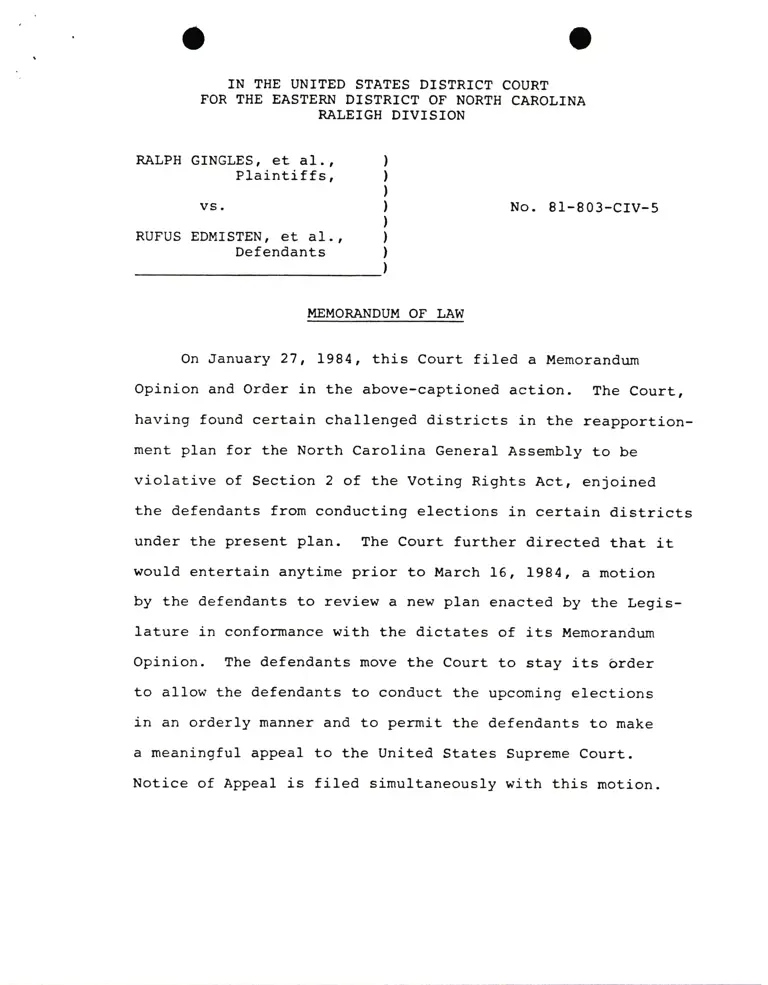
On January 27 , 1984, this Court filed a Memorandum

opinion and order in the above-captioned action. The court,
having found certain charlenged districts in the reapportion-
ment plan for the North Carolina General Assembly to be

violative of Section 2 of the Voting Rights Act, enjoined

the defendants from conducting elections in certain districts
under the present pran. The court further directed that it
would entertain anytime prior to March 15, 1984, a moti.on

by the defendants to review a new plan enacted by the Legis-

Iature in conformance with the dictates of its Memorandum

Opinion. The defendants move the Court to stay its 6rder

to a11ow the defendants to conduct the upcoming elections
in an orderly manner and to permit the defendants to make

a meaningful appeal to the United States Supreme Court.

Notice of Appeal is filed simultaneously with this motion.


o
-2-

I

The court shourd stay its order and injunction so as

to arrow the impending erections to proceed without interrup-
tion and confusion. rf new districts are drawnr.by either
the General AssembLy or the Court, between now and the
primary in May, the Statets election procedures will be

severely disrupted.

This Court has authority to allow the scheduled elections
to take prace under the present district lines even though

the court has found that several of the districts viorate
Section 2 of the Voting Rights Act.

Sims,

In its seminal reapportionment decision, Reynolds v.
377 U.S. 533 (1964) the Supreme Court explained:

[UJnder certain circumstances, such as where an
impending election is imminent and a State's
election machinery is already in progress,
equitable consideration might justify a court
in withholding the granting ot-irnmediately
effective relief in a legislative apportion-
ment case even though the existing apportion-
ment scheme was found invalid. In awarding or
withholding immediate relief, a court is entitled
to and should consider the proximity of a forth-
coming election and the mechanics and complexities
of a state's election Laws, and should act and rely
upon general equitable principles. With respect
to the timing of relief, a court can reasonably
endeavor to avoid a disruption of the election
process which might result from reguiring pre-
cipitate changes that could make unreasonable or
embarassing demands on a State in adjusting to
the reguirements of the court's decree. 377 U.S.
at 585.


-3-

rn the present case, the staters erection machinery

is, in fact, already in progress. The filing period for
candidates opened on January 3, 1984, and are schedured to
close February 6, 1984. (See NC Gen.Stat. 5163-106.) If
the Legisrature adopts or if the court implements a new

plan of apportionment between now and the staters scheduled

primaries, it wilr be nearly impossibre for the state to
conduct orderly primary erections according to its present

schedule.

Further, &Dy changes in the present schedule designed

to deal with the drawing of new districts, such as changes

in election timetables, or other practices or procedures,

to the extent that they affect "covered" areas, must be

submitted to the Attorney General of the united states for
preclearance under Section 5 of the Voting Rights Act,
Al1en v. State Board of Elections, 393 U.S. 544 (1966), and

at least 60 days must be allotted for preclearance to be

obtained. tlost burdensome to the State, however, is the

requirement that any new plan adopted by the Legisrature

which affects any of the covered counties in the state must

also be precleared prior to the primary election. Further,
McDaniel v. Sanchez, 452 U.S. 130 (198I), has c1earJ.y

stated that any red,istricting plan not actually hand-drawn

by the federal judges themselves must be submitted for the

Attorney General's review under Section 5. Thus, it will
be virtually impossible for the State to conduct orderly


-4-

primary erections this year if any changes are made in the
existing precreared districts. rn fact, it appears at this
time that it would be necessary in redrawing Senate District
2 and House Districts g and 39, to cross over into a number

of senate and House districts contiguous to the disLricts
directly affected by the court,s order and injunction. Many

of these other districts are also covered areas for which
any changes require preclearance under section 5 of the
voting Rights Act. surery, the present situation meets

the standard of inequity and impracticarity foreseen by the
Revnolds Court.

Lower courts have on many occasions and upon various
facts allowed a state to hold one election under a constitu-
tionally or statutoriry deficient redistricting p1an. rn
Upham v. Seamon, 45G U.S. 37 (1992), the Supreme Court,
advising the district court to take whatever action appeared

most equitable in view of impending erections, wrote:
[w]e have authorized District courts to order orto permit elections to be herd pursuant to appor-tionment plans that do not in att respect meiiureup to the legal requirements, even constitutionalrequirements. 456 U.S. at 44.

rn accordance with the principles discussed in Reynolds

and upham, the district court in Farnum v. Barnes, 54g F. supp.
769 (D.R.r. ]-gg2l, a110wed a patently unconstitutional
apportionment to stand for one election. The court accepted


-5-

testimony from State officials that it would delay elections
if the state were to try to implement a new apportionment

before the next election. The Farnum court determined that
although the existing plan crearly violated the Fourteenth

Amendment, equitable principles dictated that the court not

interfere with the conduct of impending elections. 549 F.

Supp. at 774. Similarly, in Casner v. Dal,ton, 522 F.Supp.

350, 359 (8.D. va. 1981), the court for the Eastern District
of virginia declared the states 1981 enactment unconsti-
tutional but ordered it into effect for the next election.
(See also Kilgarlen v. HilI, 386 U.S. 120 (1967); Drum v.
Seawell , 249 F.Supp. 87 7 (t'l.D.N.C. 1965), aff 'd 383 U.S.

831. )

In In Re Pennsylvania Congressional District Cases,

535 F.Supp. 191 (M.D. Pa. 1982), the Court discussed some

of the factors which are to be considered before interrunlfns
a state's erection schedule. The court declined to order

the immediate implementation of a new plan because of ',the
expense to the public, the disruption of campaign organLza-

tions, and the confusion which would inevitably result" if
the primary election were delayed. 535 F.Supp. at I94.

Thus, there is ample precedent to support an order of
this Court staying the execution of its January 27 , 1994,

order until after the elections. Courts have opted to
foll-ow this procedure simply to avoid the inconvenience

and confusion of last minute alteration of districts. In
the instant case the eguities weigh much more heavily in


-6-

favor of the State than they did in the cases discussed

above. Here, the added burden of multiple Section 5 sub-

missions render it not merely inconvenient but veritably
impossible to conduct elections as scheduled this year if
the district lines are redrawn now.

II

The Memorandum Opinion of the Court in this action is
one of the most searching and in-depth interpretations of
the newly amended Section 2 of the Voting Rights Act issued

to date. The Supreme Court, however, has not yet construed

this difficult and controversial statute . lf this Court I s

order becomes effective immediately, the State will lose

any meaningful opportunity to appeal the decision. The

Legislature cannot both comply with the Courtrs directive
to enact a new plan and appeal the decision.

On the other hand, if the legislature fails to act by

March 15th, this Court will draw its own plan and order

elections to be held pursuant to the new district boundaries.

This seguence of events would effectively preclude a

meaningful appeal to the United States Supreme Court. Once

an election has been held according to the courtrs p1an,

the political landscape will be irrevocably altered, and

even a reversal by the Supreme Court will not return the

State to the status quo ante.


Reapportionment is essentialry a political task and the

federal courts possess no distinctive mandate to compromise

state poricy unress a regisrature has failed to apportion

according to federal constitutional and statutory requisites
in a timely fashion. White v. Weiser, 4L2 U.S. 783 (1973) .

The touchstone of white v. weiser, supra, whitcombe v. chavis,
403 U.S. 124 (1971), and Upham v. Seamon, supra, is deference

where at all possible to the "political program" embodied in
a legislatively-drafted pran. For this fundamentar reason,

the state shourd be permitted to pursue its appear without an

intervening election pursuant to a court-ordered plan.

should an appear show that the courtrs plan was unnecessary,

the Staters political program would have been needlessly

and irreparably disturbed.

The case for forestalling elections under a nelr appor-

tionment is particurarly compelring in light of the rack of
a Supreme Court construction of Section 2.

In Georgia v. United States, 4II U.S. 526 (1973), after
the Attorney General objected to Georgiars legislative
reapportionment statute, the local federal court enjoined

holding of elections under those p1ans. The United States

Supreme Court entered a stay of the injunction, which per-

mitted the State to conduct one election under the challenged

plan pending appeal.

The Court reasoned that whether redistricting plans

feII within the scope of Section 5 coverage nas an issue


-8-

sguarely decided. ALthough the district court had ruled
that such legisrative enactments required precrearance,

the supreme court decrined to interfere with the staters
elections until the Court itself had determined that Section 5

review of redistricting prans was indeed intended by the

statute.U
The supreme court has not definitively ruled on the

proper interpretation of section 2. rf the state prevairs
on appeal, no adjustment of the existing districts wirr be

necessary. Therefore, this court should stay the implemen-

tation of its order until the state has perfected its appeal

and received the ruJ-ing of the Supreme Court.

WHEREFORE, defendants pray the court to stay the effect
of its order and rnjunction of January 24, 1984, in the above-

captioned matter, pending review of its decision by the

united states supreme court. Defendants further pray that
the Court, considering the exegencies of the matters concerned,

shorten the otherwise arlowable time for the firing of such

response to this Motion as Plaintiffs deem appropriate.

.l/qgg a1so, Oden v. Brittain , 3gG U.S. l21, wherein theapplicaiE fTme@ad failed to obtain
section 5 preclearance of its city councir ptan and requested
a stay. Justice Black declined to grant the stay becausethe legal issue 1.e., the requirement of preclearance hadnot been settled by the Supreme Court.


-9-

Respectfully submitted, this the 3 day of Pebruary,

1984.

RUFUS L. EDMISTEN
ATTORNEY GENERAL

Attorney Generalrs Office
N. C. Department of Just.ice
Post Office Box 629
Raleigh, North Carolina 27602
Telephone: (9191 733-3377

Tiare Smiley
Norma Harrell
Assistant Attorney' s General

Attorneys for Defendants

Of Counsel:

Kathleen HEenan McGuan, Lre
Jerris Leonard, Esguire
Law Offices of Jerris Leonard, p.C.
900 Seventeenth Street, N.W.
suite 1020
Washington, D. C. 20006
Telephone: 12021 872-1095

alIaCe,
Attorney

al Affairs


,

CERTIFICATE OF SERVTCE

r hereby certify that r have this day served the fore-
going Motion to stay order and rnjunction pending Appeal

and l'lemorandum of Law by placing a copy of same in the

United States Post Office, postage prepaid, addressed to:

This rhe -3

Ms. Les1ie Winner
Chambers, Ferguson, Watt, Wallas,

Adkins & Ful1er, P.A.
951 South Independence Boulevard
Charlotte, North Carolina 28202

Ms. Lani Guinier
99 Hudson Street
New York, New York 10013

Mr. Arthur J. Donaldson
Burke, Donaldson, Holshouser & Kenerly
Attorneys at Law
309 North Main Street
Salisbury, North Carolina 28144

Mr. Robert N. Hunter, Jr.
Attorney at Law
Post Office Box 3245
Greensboro, North Carolina 27402

day of Pebruary, 1984.Pebruary, I984.