Memo from Mimi to Lani RE: Cases cited that use Rule 52 (a)
Correspondence
January 1, 1984
-
Case Files, Thornburg v. Gingles Working Files - Guinier. Memo from Mimi to Lani RE: Cases cited that use Rule 52 (a), 1984. 629a3ba3-dc92-ee11-be37-6045bdeb8873. LDF Archives, Thurgood Marshall Institute. https://ldfrecollection.org/archives/archives-search/archives-item/848b0e9a-5236-42d2-8936-ed924a3a3d9f/memo-from-mimi-to-lani-re-cases-cited-that-use-rule-52-a. Accessed September 20, 2026.
Copied!
    Footnote *2
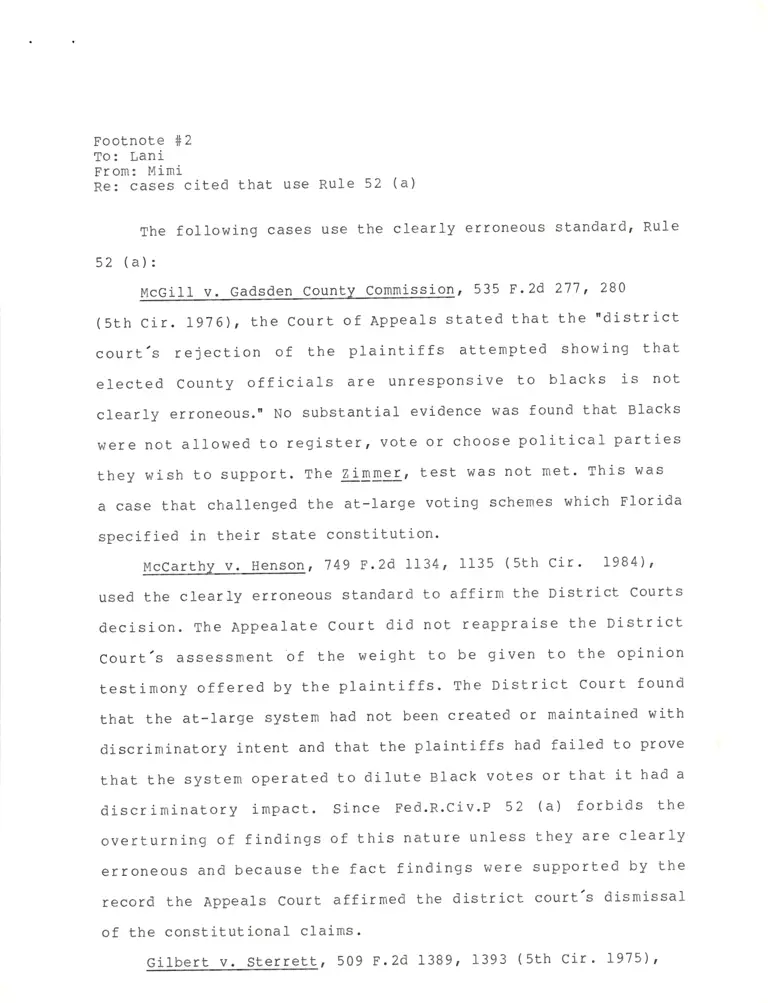
To: Lani
From: Mimi
Re: cases cited that use Rule 52 (a)

The following cases use the clearly erroneous standard, Rule

52 (a):

McGilI v. Gadsden county commission, 535 F.2d 277 , 280

(5th Cir. Ig76), the Court of Appeals stated that the "district

court's rejection of the plaintiffs attempted showing that

elected county officials are unresponsive to blacks is not

clearly erroneous.' No substantial evidence was found that Blacks

were not atlowed to register, vote or choose political parties

they wish to support. The Zimger, test was not met. rhis was

a case that challenged the at-large voting schemes which Florida

specified in their state constitution.

McCarthy v. Henson, 749 P.2d 1134, 1135 (5th Cir. 1984),

used the clearly erroneous standard to affirm the District Courts

decision. The Appealate Court did not reappraise the District

Court's assessment of the weight to be given to the opinion

testimony offered by the plaintiffs. The District Court found

that the at-Iarge system had not been created or maintained with

discriminatory intent and that the plaintiffs had failed to prove

that the system operated to dilute Black votes or that it had a

discriminatory impact. since Fed.R.Civ.p 52 (a) forbids the

overturning of findings of this nature unless they are clearly

erroneous and because the fact findings were supported by the

record the Appeals Court affirmed the district court's dismissal

of the constitutional claims.

Gilbert v. sterrett, 509 F.2d I389, 1393 (sth Cir. L975) t


uSes the clearty erroneous standard to affirm that the

commissionerS'court was not constitutionally required to

reapportion the commissioners' districts in L973 based on the

projected 1985 polulation statistics. A minority group is not

constitutionaaly entitled to an apportionment structure designed

to maximmize its political advantage, and, under such rule a

minority group is not entitled to another redistricting so that a

majority of voters in at least one district would be Black.

While it was held that none of the findings of fact should be set

aside as clearly erroneous, there was however, some question as

to the sufficiency of the findings.

"When findings of fact are made in actions tried by the
court without a jury, the sufficiency of evidence to
support the findings may therafter be raised whether or
not the party raising the question has made the district
court an objection to such findings or has made a motion
to amend them or a motion for judgement.n Gilbert, supra.

Robinson v. Commissioners Court, Anderson Countyr 505 F.2d

674, 679 (5th Cir. L974), the Court of appeals held that the

existing apportionment plan constituted a constitutionally

impermissible dilution of the Black vote and the new plan which

recognized the Black community as well as physical boundaries and

which held population variance to less than I t was a proper

exercise of the court's equity powers. Thus the Appeals Court

affirmed in part, dismissed the appeal of the County Party

Chairmen as moot and ordered the posponment order vacated. The

Appeals Court f ound no reason to re ject as clearly er r,).'reoJsl tire

District Court's determination that the County Commiss ioners'

apportionment was designeo precisely to dilute the Black vote.

Cited in the government's brief, in Hendrix v. Joseph,


559 F.2d L265, L268 (5th cir. L977), the Appeals Court vacated

the District Court's findings and remanded It held that the

District court's findings of fact were insufficient to permit

determination of whether the at-large election system was used to

unconstitutionally dilute the Black vote. When the Appeals Court

addressed itself to each of the factors through which a

plaintiff might show vote dilution it utilized the clearly
erroneous standard.

Buchanan v. City of Jackson , 708 P.2d 1066, 1070 (6th

Cir. 1983), the Appeals Court vacated and remanded. They held

that absent any allegation of actual interference in voting or

registration processes, the challenge to the at-1arge voting
procedure for elect ing the city's three-member board of
commissioners failed to state a claim under the Fifteenth

Amendment. fn light of the necessity for appropriate inquiry into
discriminatory intent in the city's at-1arge voting procedure for

electing a three member board of commissioners, the voting
dilution action would be remanded for further consideration of

such circumstantial direct evidence of discriminatory intent as

may be available and on remand the parties challenging the voting

procedure would be given an opportunity to amend their complaint

to state a claim under the amended Voting Rights Act, Section 2.

nmphasizing the deference to be accorded the District Court's

findings of fact, particularly regarding issues of intent, the

majority held that the District Judge's determination that the

electoral system in Burke County was being maintained for
discriminatory purposes was not clearly erroneous.


United States v. Marengo County Com'n, 731 F.2d 1546, 1552-

I153 (11th Cir.1984), vacated in partr r€versed in part and

remanded back to the District Court. The Appeals Court in an

opinion delivered by Judge Wisdom, found that the District

Court's findings on unresponsiveness were clearly erroneous. The

Court of Appeals held that the amendment to the Voting Rights Act

proscribing any practice imposed in a manner which results in

denial of the right to vote on account of race does not conflict

with or contract any right protected by the Constitution and

nothing in the Constitution either explicitly or implicitly
prohibits a results standard for voting rights violations. A1so,

evidence was insufficient to sustain the District Court's

findings that napathyn not the at-1arge election system at issue

was responsible for the lack of Black success at the poI1s and

despite the Court of Appeals' determination that evidence before

the District Court established a clear violation of the voting

rights act, judgement would not be entered in favor of
plaintiffs, but the cause would be remanded to al1ow the parties

to update the record and supplement the record with evidence thaL

might tend to affect the court of appeals findings of

discriminatory results.

United States v. Da1las Countv Com'n, 739 F.2d L529, 1541

(lIth Cir. 1984), the Court of Appeals held that the District

Court was clearly erroneous on 2 of 5 principle factors to be

considered, i.e. polarized voting and the structure of the

election system. After reviewing the entire recordr the Court of

appeals concluded the the District Court's findings that the

Commission was response to the needs of Blacks was not clearly


erroneous. The Appeals Court affirmed in part, vacated in part

reversed in part and remanded. On remand the District Court was

to reconsider the factors of lingering effects of past

discrimination and the District court also erred in finding that

the enactment of the Alabama statute was motivated by the

Democrats' desire to regain power.

Lee County Branch of NAACP v. City of Opelika, 748 F.2d

1413, I480 (11th Cir. 1984), the appeals Court vacates and

remands back to the District Court. In using the clearly

erroneous standard it acknowledges that the Zimmer factors carry

different weights under the results test than they do under the

intent test. They were therefore unable to reviewr orr the record

before them, the District Court's interpretation or application

of the new Iega1 standard embodied in Section 2. Nor, did the

court's second opinion satisfy the requirements of 52 (a), which

requires the court to find the nfacts specially and state

separtely its conclusions of 1aw thereon in all actions tried

upon the facts without a jury. n

McMarthy v. Henson, 749 F.2d 1134, 1135 (5th Cir. I984),

the Court of Appeals affirmed the district Court and held that
opinion testimony of polarized voting alone did not suffice to

show discriminatory impact of the at-1arge scheme in violation of

the fourteenth and fifteenth amendments and the District Court's

findings that the at-1arge system had not been created or

maintained with discriminatory intent and that there was a

failure of proof that the system operated to dilute Black votes

or that it had a discriminatory impact were not clearly


erroneous; and the same findings effectively established that

there was no right of action under the Voting rights act.

Velasquez v. City of Abilene Tex., 725 F.2d 1017, L020-I021

(5th cir. 1984), cited in the government's brief affirmed in part

and remanded for further findings of fact and 1aw. The Appeals

Court acknowledges that it has no doubt that a finding of

discriminatory effect or result under the Voting Rights Act

amendments of L982 is governed by the clearly erroneous standard

and that vote dilution cases are not a mixture of fact and 1aw.

The clearly erroneous standard is applicable in both

constitutional and statutory voting dilution cases. The appeals

court held that although the trial court in resolving the claim

that the Voting rights act was violated was not required to

recount and discuss every bit of evidence offered to it, it was

required to discuss all the substantial evidence contrary to its
opinion and because both constitutional and statutory claims of

the plaintiffs involved extraordinary fact-oriented issues and

because the District Court failed to take note of the substantial

contrary evidence presented by plaintiffs, there was failure to

make detailed findings of fact as required by ru1e. racial
discrimination need only be one purpose and not even the primary

purpose of an official act in order for there to be a violation
of the Fourteenth Amendment to occur; and the recent Section 2

amendment of the Voting Rights Act were meant to reinstate the

results test, as against the contention that the amendment did

not eliminate the intent requirement but instead merely

eliminated the need to find direct evidence of discriminatory
intent .


Jones v. City of Lubback, 727 F.2d 364, 37L, 380 (5th

Cir. I984), another case cited in the brief of the government,

where the Court of Appeals held that finding that the charter

commission adopted an at-Iarge system to exclude Black electoral
participation was clearly erroneous. The Court of appeals

reversed in part and affirmed in part. The Court of appeals held

that the section of the Voting Rights Act prohibiting electoral
practices and procedures that create discriminatory results was

not susceptible to attack as vague and even if susceptible was

not void for vagueness; such a section did not exceed Congress'

authority under the doctrine of separation of powers. The Court

also held that under the totality of circumstances, the city's

at-Iarge system deprived minority citizens of access to the

political process and was not in error, and the trial court did

not abuse its discretion in adopting the districting plan drawing

six single-member districts to replace the invalidated at-1arge

syst em.