Radical Redistricting or Real Representation: North Carolina’s Battle for Congressional District 12

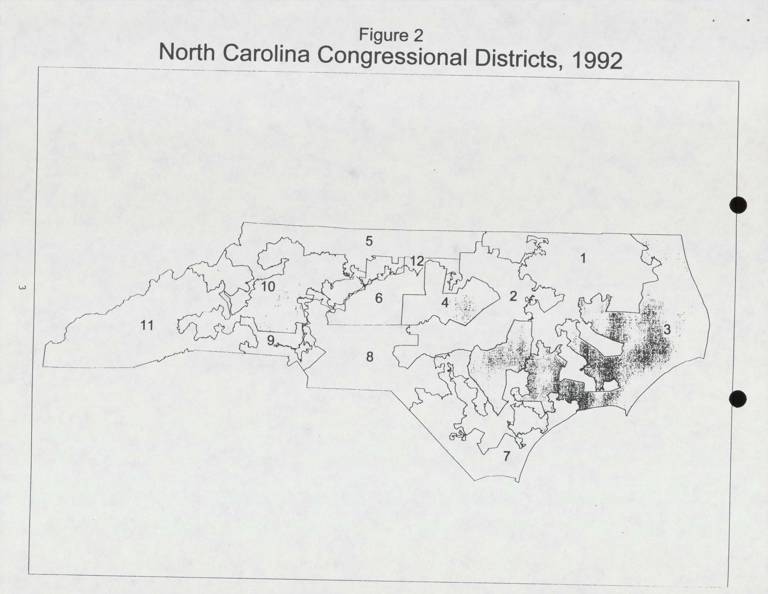
A map of North Carolina’s congressional districts in 1992. Source: LDF Archives, Thurgood Marshall Institute.
Gerrymandering to Secure Power
In the years following the decennial census, politicians often vie for electoral district maps that afford them greater power. Such efforts can lead to partisan gerrymandering—the practice of drawing maps that give a particular political party an advantage in elections. This strategy is especially common in states where one party controls both the legislature and the governor’s office, allowing them to overrule the opposing party’s attempts to halt gerrymandered maps.
Analysts warn that partisan gerrymandering is occurring ahead of the 2026 midterm elections, which will determine control of the U.S. House of Representatives. For example, the Mexican American Legal Defense and Educational Fund (MALDEF) challenged the congressional map passed by the Texas Legislature in a special legislative session on August 23, 2025. The proposed map would increase the number of Democratic voters in districts that already favor Democrats, thereby creating more majority-Republican districts. MALDEF and other plaintiffs asked the U.S. District Court for the Western District of Texas to block the enactment of the map, which they consider to be both partisan and an example of racial gerrymandering.
What is congressional redistricting?
The U.S. Constitution requires that seats in the U.S. House of Representatives be allocated based on population, with at least one representative per state. Each decade, the U.S. Census Bureau records demographic, economic, and population data and reports the information to Congress. Based on these data, the 435 seats in the House of Representatives are apportioned among the states, with the aim of creating a body that reflects the American people. Following this calculation, each state that is allotted more than one member in the House of Representatives must undergo redistricting to create new electoral districts with approximately equal numbers of constituents. State legislatures typically create and enact maps that outline these districts, but in some cases, states defer to nonpartisan or bipartisan commissions that determine district boundaries.
Historically, policymakers have often used gerrymandering to curtail the impact of voters of color on election outcomes. This racial gerrymandering has limited Black voters’ influence in electoral processes in the South in particular. Legislators typically use two strategies, “packing” and “cracking,” to achieve this end. Packing occurs when constituents of the same race are heavily concentrated in a few electoral districts, which minimizes their impact on congressional election results. For example, in 1882, South Carolina state legislators drew a congressional map that concentrated a high percentage of the state’s eligible Black voters in one district, effectively disempowering Black voters by guaranteeing that every other district was majority white. When voters with the same preferences are placed in a small number of districts, they are able to elect fewer of their preferred candidates. Conversely, when voters with the same preferences are separated by arbitrary congressional boundaries, or “cracked,” their voting power is diminished.

“Packing” refers to placing people of color into the same district, in larger numbers than necessary to elect candidates of their choice, to prevent them from exercising greater political power in surrounding districts.

"Cracking” refers to splitting communities of color into different districts to prevent them from exercising greater political power.
The Impact of the Voting Rights Act
The Voting Rights Act of 1965 (VRA) outlawed racially discriminatory election practices like the use of literacy tests and poll taxes, in an effort to ensure that eligible Black voters would not be prevented from casting their ballots. Across the nation and particularly in Southern states, the VRA’s passage was instrumental in increasing the number of Black elected officials. Notably, in the year of its passage, there were fewer than 100 Black elected officials total across all 11 states that had belonged to the Confederacy (Alabama, Arkansas, Florida, Georgia, Louisiana, Mississippi, North Carolina, South Carolina, Tennessee, Texas, and Virginia). By 1993, that number had risen to nearly 5,000.
1998
Public Court Documents
Brief Amicus Curiae of American Civil Liberties Union in Support of Appellants
This increase in Black political representation was largely thanks to the VRA’s effectiveness in protecting Black voters at the polls and providing an incentive for states to draw congressional maps with majority-minority districts. Critically, in 1982, an amendment to the VRA clarified that no voting measure “shall be imposed or applied by any State or political subdivision in a manner which results in a denial or abridgement of the right of any citizen of the United States to vote on account of race or color.” This meant that a redistricting plan that had a discriminatory effect on voters of color violated the VRA. Further, as Professor John D. Eyre, Ph.D., summarized, “Discrimination [could] be established by such measures as the extent to which elections are racially polarized, the success rate of minorities in getting elected, and the extent to which racially restrictive devices are used.”
Inspired by the VRA’s clarification, North Carolina’s General Assembly created a new, majority-Black electoral district in 1991. However, this district was subsequently challenged as an act of racial gerrymandering, setting off a cascade of litigation that culminated in 2001.
The Decade-Long Fight for a Majority-Black Electoral District
1991: North Carolina’s General Assembly enacts a congressional map with two majority-Black districts.
March 1992: Plaintiffs file Shaw v. Barr, a suit against the U.S. Attorney General and the state arguing that the North Carolina General Assembly’s plan was a racial gerrymander.
August 7, 1992: The U.S. District Court for the Eastern District of North Carolina dismisses the plaintiffs’ suit in Shaw v. Barr, holding that the question of the plan’s constitutionality was beyond its jurisdiction.
June 28, 1993: In Shaw v. Reno, the U.S. Supreme Court rules in favor of the plaintiffs, returning the question of the plan’s constitutionality to the U.S. District Court for the Eastern District of North Carolina for consideration.
August 22, 1994: In Shaw v. Hunt, the District Court rules that the General Assembly’s plan was constitutional even though it classified voters by race.
June 13, 1996: After voters from Congressional District 12 appeal the District Court’s decision in Shaw v. Hunt, the U.S. Supreme Court rules that the North Carolina plan violates the Equal Protection Clause.
1997: The North Carolina General Assembly redraws the congressional district map to comply with the U.S. Supreme Court’s ruling in Shaw v. Hunt.
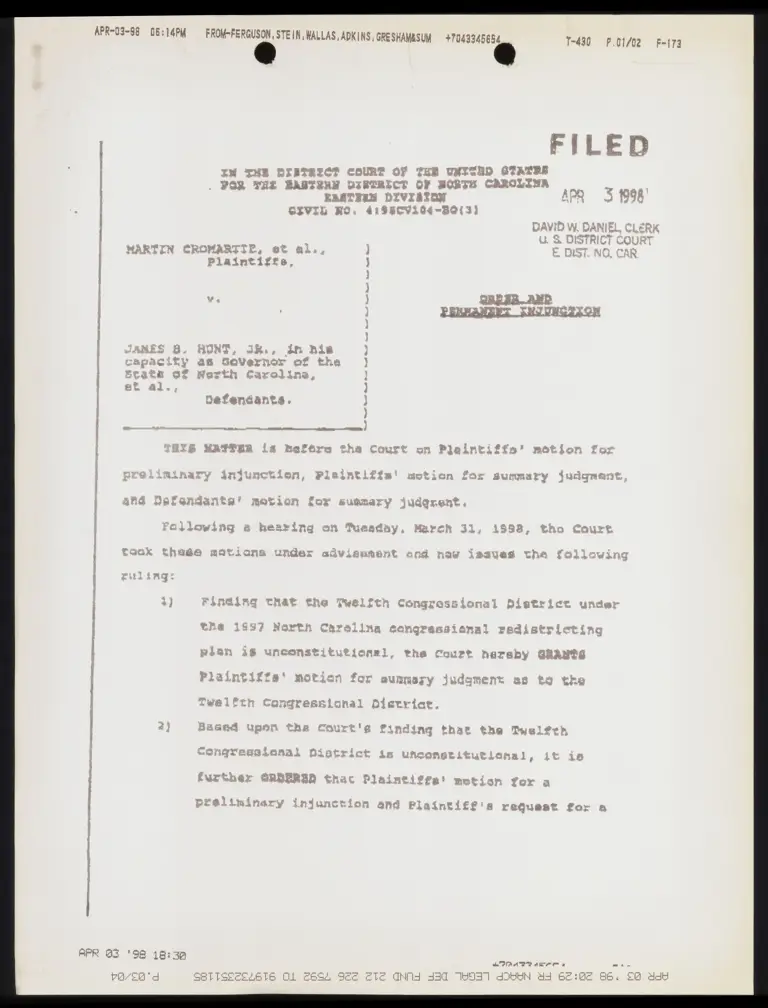
April 1998: The District Court rules that the new Congressional District 12 is unconstitutional and enjoins its use in elections.
April 18, 2001: After North Carolina appeals to the U.S. Supreme Court, arguing that the 1997 map is not an unconstitutional racial gerrymander, the Court agrees, ruling five-to-four in favor of the state.
North Carolina’s 1991 Redistricting
The dispute began after the 1990 census resulted in North Carolina gaining a 12th congressional seat due to population growth. In 1991, North Carolina Democrats designed a redistricting plan that divided the state into 12 congressional districts. Notably, their plan placed Democratic incumbents in separate districts, ensuring that they would not have to run against one another and risk splitting votes from their base. This type of partisan gerrymandering, which the North Carolina Republicans contested, was expected. More notably, the map reconfigured old electoral districts to create a new District One that was majority Black. Given Black voters’ tendency to favor Democratic candidates and candidates of color, these changes were likely to secure votes for the Democratic Party and increase Black representation.
The new district included multiple counties that were subjected to preclearance requirements under the VRA because of their history of disenfranchising Black voters. The VRA mandates that “any voting qualification or prerequisite to voting, or standard, practice, or procedure with respect to voting” cannot be changed in such counties without either approval from the U.S. District Court for the District of Columbia or preclearance from the U.S. Department of Justice (DOJ). The North Carolina General Assembly chose to submit the plan to the DOJ. However, the DOJ rejected the proposed map after ascertaining that it violated the VRA by failing “to give effect to [B]lack and Native American voting strength” in the southeastern part of the state.
The North Carolina General Assembly returned to the drawing board and drafted a new map that included a second majority-Black district. The new District 12 spanned 160 miles and stretched across 10 counties along Interstate 85. Republicans, including Governor James Martin, objected. Martin questioned District 12’s configuration, saying it resembled a “rampaging bull elephant headed west.”
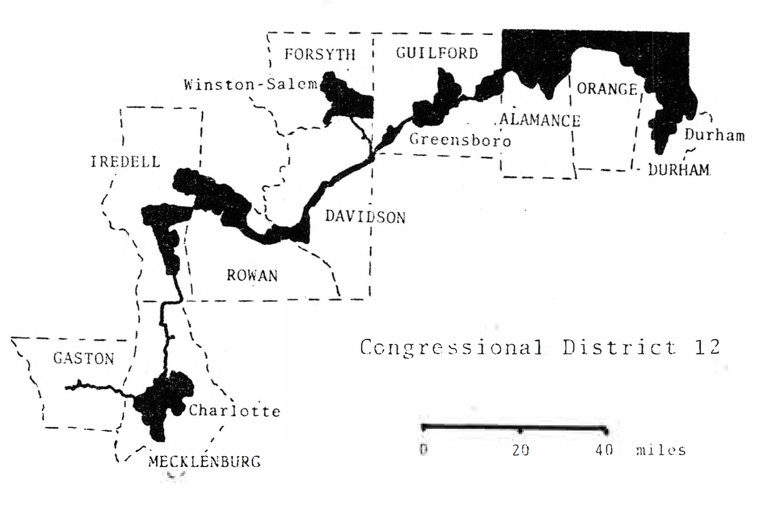
A map of the 12th Congressional District of North Carolina in 1992.
Source: John D. Eyre, "Congressional Redistricting in North Carolina, 1991-92," The North Carolina Geographer Vol. 2 55 (1993).
Even so, the DOJ approved the new map in February 1992, and North Carolina enacted it ahead of the November 1992 elections. The election results were positive for Democrats: Incumbents won their previous districts, and the Democrats won a new seat in District 12. Black candidates won seats in District One and District 12, adding Black representatives to North Carolina’s congressional delegation for the first time in the 20th century.
Shaw v. Barr
At the same time, the new map was facing fierce opposition. In March 1992, five white voters who lived in District One filed a suit against the U.S. Attorney General, the Assistant Attorney General for the Civil Rights Division, and North Carolina state officials, claiming that the General Assembly’s plan was a racial gerrymander that violated their civil rights. In Shaw v. Barr (808 F. Supp. 461), they argued that Districts One and 12 “concentrated a majority of [B]lack voters arbitrarily without regard to considerations such as compactness, contiguousness, geographical boundaries, or political subdivisions, in order to create congressional districts along racial lines and to assure the election of two [B]lack representatives.” The three-judge panel of the U.S. District Court for the Eastern District of North Carolina dismissed the suit, holding that it lacked the authority to adjudicate on the matter. Further, the panel denied two key arguments made by the white voters: first, that the creation of majority-Black districts was an inherently discriminatory act; and second, that white voters were proportionally underrepresented by the General Assembly’s plan.
Shaw v. Reno
Dissatisfied with this ruling, the white voters appealed to the U.S. Supreme Court. In the June 28, 1993, decision in Shaw v. Reno (509 U.S. 630), the Supreme Court acknowledged racial gerrymandering as a constitutional wrong for the first time in the nation’s history, holding that the white voters were owed relief under the Equal Protection Clause of the 14th Amendment to the U.S. Constitution and returning the matter to the District Court for reconsideration. In a five-to-four decision, the Supreme Court held “that appellants have stated a claim under the Equal Protection Clause by alleging that the North Carolina General Assembly adopted a reapportionment scheme so irrational on its face that it can be understood only as an effort to segregate voters into separate voting districts because of their race, and that the separation lacks sufficient justification.” Ironically, the Court’s first acknowledgment of racial gerrymandering was related to a challenge to a map that would support Black voters’ ability to elect candidates of their choice, rather than the Court addressing the long history of congressional maps drawn to dilute Black voting power. North Carolina’s General Assembly was left with a conflicting charge: to draw a congressional map that protected Black voters’ rights, and also to avoid delineating congressional districts based on race.
Shaw v. Hunt
Considering the matter for a second time, the District Court ruled that the North Carolina General Assembly had a compelling interest in creating majority-Black congressional districts to comply with the VRA. As evidence of the dilution of Black voting power, the District Court noted that there had not been a single Black representative sent to the U.S. Congress from North Carolina between 1901 and 1992. A group of voters from District 12 then appealed to the U.S. Supreme Court in Shaw v. Hunt (517 U.S. 899). Adopting the Court’s analysis in Shaw v. Reno, they also filed a complaint in a separate matter, Cromartie v. Hunt, asking the U.S. District Court for the Eastern District of North Carolina to enjoin the use of the redistricting plan for the upcoming congressional elections. In their complaint and motion for a preliminary and permanent injunction, filed on July 3, 1996, they claimed that the General Assembly was a “participant in creating a racially discriminatory voting process for the election of members of Congress from North Carolina.”
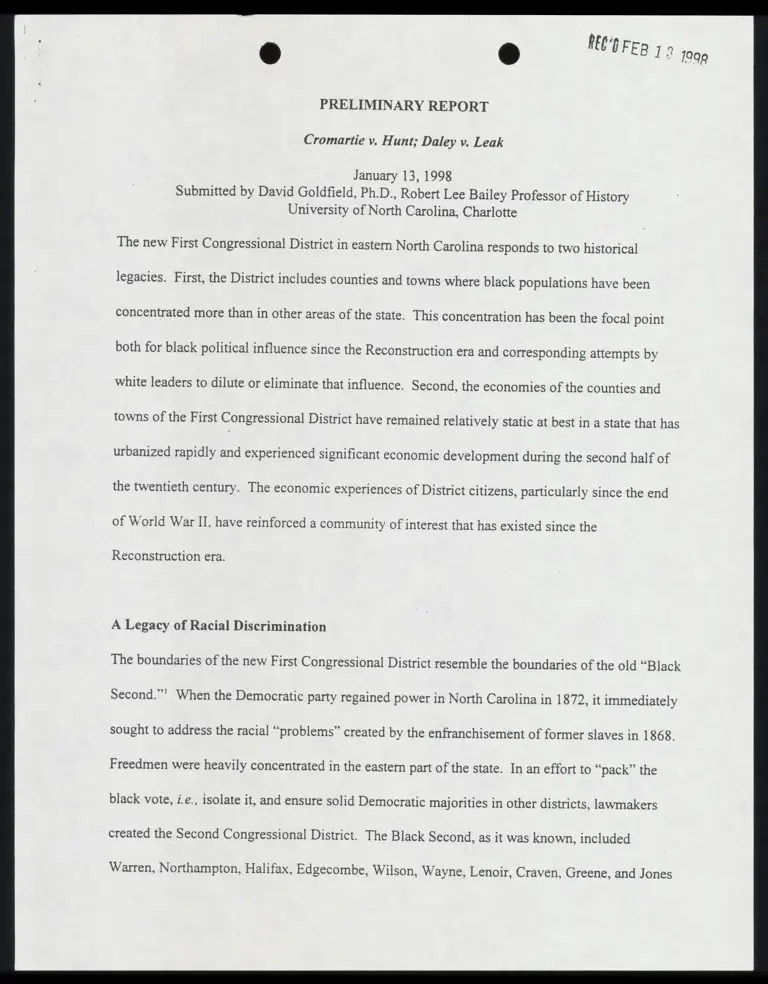
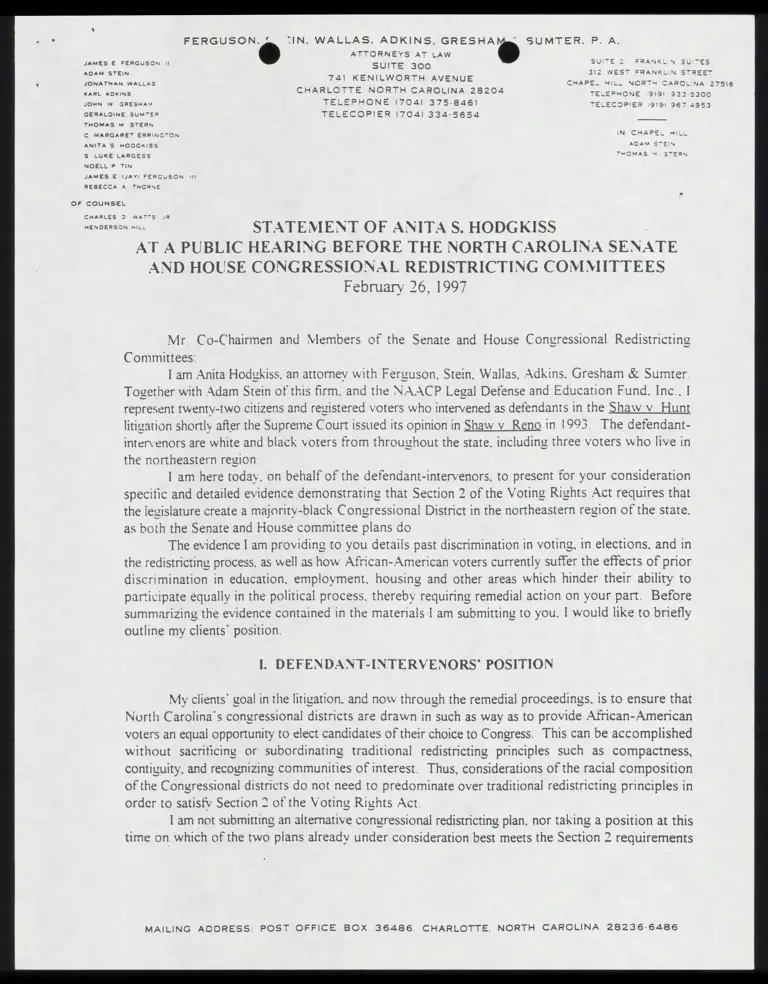
Conversely, state officials, joined by a group of Black and white voters from Districts One and 12, placed the history of the disenfranchisement of Black voters at the center of their defense of North Carolina’s majority-Black districts. A report submitted by University of North Carolina Professor of History David Goldfield, Ph.D., noted, “The historical record demonstrates a consistent pattern of voting rights exclusion and dilution with respect to [B]lack voting power,” which needed to be addressed. Further, during a February 26, 1997, public hearing before the North Carolina Senate and the House Congressional Redistricting Committees, lawyer Anita Hodgkiss argued that “it is necessary to draw a majority-[B]lack district in the northeastern region of North Carolina to avoid violating” the VRA.
1998
Public Court Documents
Preliminary Report on Cromartie v. Hunt and Daley v. Leak by Goldfield and Lee
1997
Public Court Documents
Statement of Anita S. Hodgkiss Before the North Carolina Senate and House Congressional Redistricting Committees
The U.S. Supreme Court disagreed. In the five-to-four opinion delivered by Chief Justice William Rehnquist on June 13, 1996, the Court held in Shaw v. Hunt that the state’s plan went too far in its efforts to comply with the VRA, arguing that the redistricting plan was not narrowly tailored to address the history of Black voter suppression in North Carolina.
The 1997 Redistricting
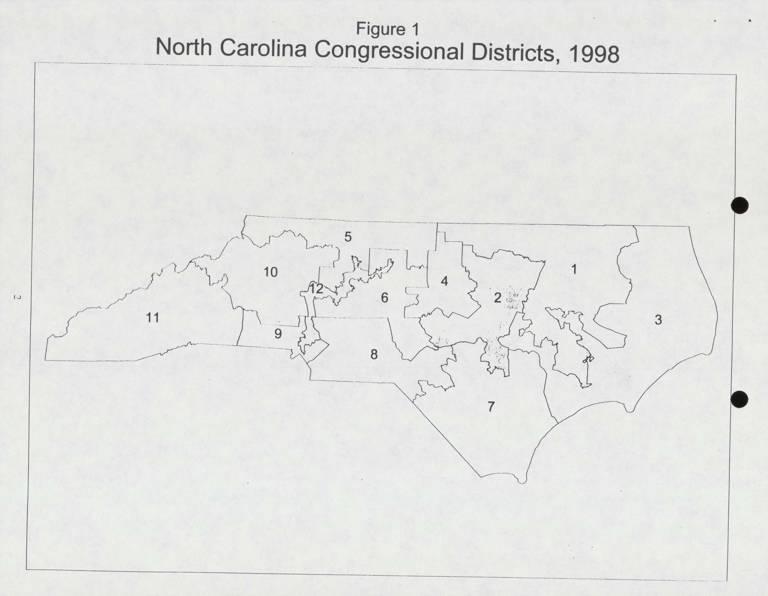
In 1997, the North Carolina General Assembly redrew the state’s congressional districts to comply with the Supreme Court’s decision in Shaw v. Hunt. The new map had districts of approximately equal population size and increased compactness, but it was again challenged in the courts. Despite these changes and the powerful arguments deployed in support of majority-Black districts, the U.S. District Court for the Eastern District of North Carolina found District 12 to be unconstitutional and enjoined the state from using the map for congressional elections.
Easley v. Cromartie
North Carolina promptly appealed to the Supreme Court, arguing that merely providing evidence that the state was race-conscious in its redistricting process was not sufficient to prove that the 1997 map was an unconstitutional racial gerrymander. This argument was supported by lawyers from the Legal Defense Fund (LDF), who joined the matter as co-counsel representing a group of Black and white voters from District 12 who intervened as interested parties. In their reply brief, LDF lawyers highlighted the Court’s prior finding that “a [state] may engage in constitutional political gerrymandering, even if it so happens that the most loyal Democrats happen to be [B]lack Democrats.”

The Supreme Court relied on this reasoning in their April 2001 decision, agreeing that the plaintiffs had not proven that District 12 was racially gerrymandered. After a decade, the battle was finally won for a congressional district map that recognized the interests of North Carolina’s Black communities.
The Role of Race in Redistricting Today
Despite the historic ruling in Easley v. Cromartie, which affirmed the constitutionality of majority-Black congressional districts, challenges to the place of race in redistricting continue to threaten Black political participation today.
These issues were recently raised in Louisiana v. Callais, which was argued in front of the U.S. Supreme Court by LDF President and Director-Counsel Janai Nelson in October 2025. The matter began in 2022, when LDF and co-counsel, working on behalf of a group of Black voters from Louisiana, challenged an electoral map drawn by Louisiana lawmakers. The suit alleged that the map violated Section Two of the VRA by creating five majority-white districts and just one majority-Black district in a state where Black residents make up one-third of the population. After years of litigation, the U.S. District Court for the Middle District of Louisiana agreed, and it required the Louisiana State Legislature to create and pass a map that complied with the VRA’s charge to protect Black voters. In 2024, Louisiana lawmakers did just that, passing a congressional map with two majority-Black districts. Shortly after the map was passed, a group of “non-African American voters” challenged the new map as a racial gerrymander, raising the same arguments used to attack majority-Black districts in North Carolina decades before.
On April 29, 2026, the Supreme Court ruled that the Louisiana map was an “unconstitutional racial gerrymander,” dealing a major blow to Section Two of the VRA. The Court’s decision in Louisiana v. Callais is a significant setback for democracy, as its narrow reading of Section Two disables one of the most powerful voting protections for communities of color. Just as in Easley v. Cromartie, this litigation is larger than the redistricting practices of one state: It jeopardizes the protections the VRA offers voters across the nation.
For more information, listen to LDF Associate Director-Counsel Sam Spital discuss Louisiana v. Callais on the Strict Scrutiny podcast:
References
Our latest stories
-
Elizabeth Horton Sheff: From Community Activism to the Courts
September 08, 2026
How community activist Elizabeth Horton Sheff led in the fight for education equity in Hartford, Connecticut.

-
The Racist Origins of “Student Pushout”
July 30, 2026
Understanding the history of exclusionary school discipline and the racial disparities that persist today.

-
The Newark Agreement: Establishing a Template for Community-Centered Fair Housing Advocacy
June 26, 2026
How negotiations over a new medical school in Newark, New Jersey, empowered Black activists and helped the Legal Defense Fund create a model for future community-centered fair housing advocacy.
