
Black demonstrators face armed federal soldiers in Newark, New Jersey, on July 17, 1967, during protests that erupted following a police operation. (Photo by AFP via Getty Images)
The Newark Agreement: Establishing a Template for Community-Centered Fair Housing Advocacy
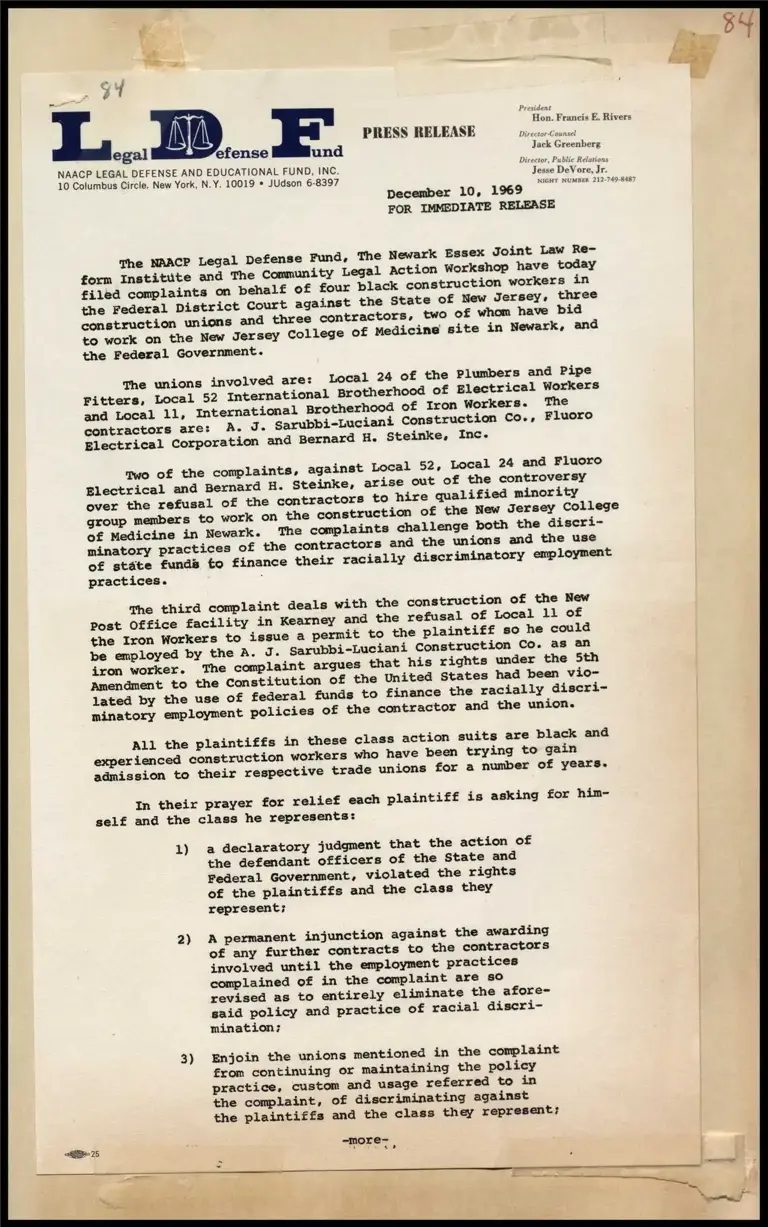
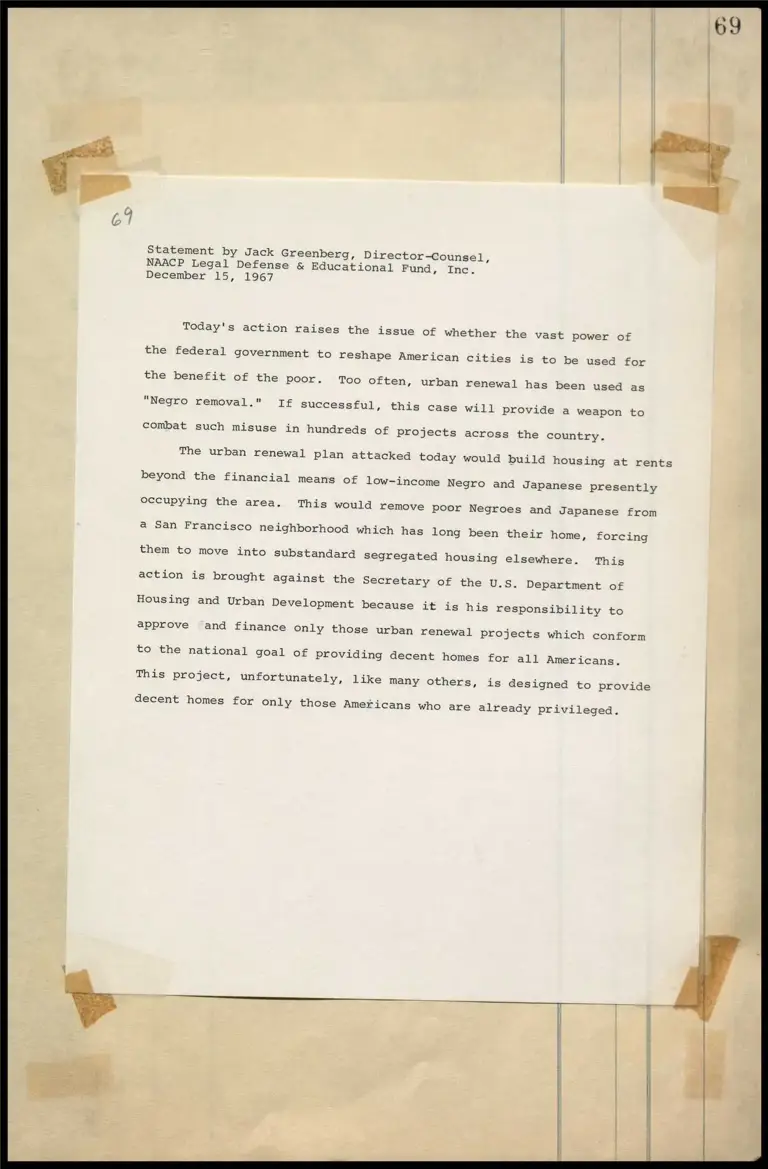
In 1967, Newark, New Jersey, resident Louise Epperson knew that if Mayor Hugh Addonizio had his way, he would demolish her house and the homes of thousands of low-income people to build a medical school. The mayor had one of the federal government’s newest agencies—the U.S. Department of Housing and Urban Development (HUD)—on his side. President Lyndon Johnson had established HUD two years before to fight poverty and address urban decay. Through HUD’s Model Cities Program, the federal government apportioned funds to localities like Newark to improve run-down housing in poor areas. However, the city government’s desire to prioritize an extreme form of federally financed and approved urban renewal at the expense of Newark’s poorest residents exposed a disconnect between Johnson’s national civil rights goals and the populations he aimed to help. The ensuing fight in Newark empowered Black activists and helped the Legal Defense Fund (LDF) create a model for future community-centered advocacy for fair and affordable housing, employment opportunities, and health care access.
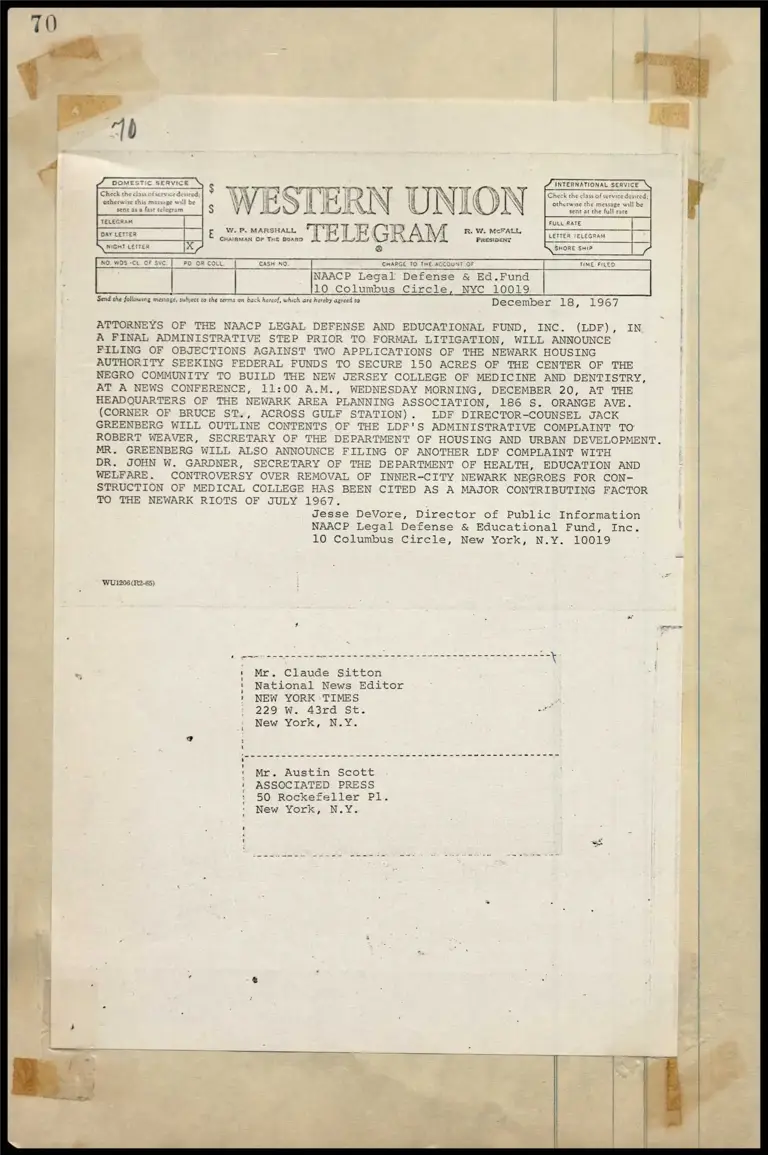
Greenberg on Newark Medical School (Telegram)
“Renewal” and Resistance in Newark
In the 1960s, Newark bore a litany of unfortunate distinctions: According to Newark’s Model Cities application, it had the highest percentage of substandard housing, the most crime per 100,000 residents, one of the highest unemployment rates, and the greatest per capita tax burden among major U.S. cities. When Addonizio and his team learned that the state wanted to move the New Jersey College of Medicine and Dentistry (NJCMD) from Jersey City to a larger location, they saw an opportunity to revitalize and rebrand Newark. The relocation team, represented by NJCMD President Dr. Robert Cadmus, originally considered a suburban location. Instead, Addonizio sold them on moving to Newark, promising NJCMD’s leadership the resources, autonomy, and acreage they wanted. The Newark Housing Authority soon filed applications with HUD to secure federal funds for development projects in the city, including relocating NJCMD to what it called “the heart of a central slum area.” The more than 150 acres that Addonizio’s administration had promised to NJCMD were primarily located in the Central Ward, which was home to public housing and a large portion of Newark’s residents of color.
When Epperson, a Black homeowner in the Central Ward, read about the planned project in the newspaper, she worried that it would displace thousands of her Black and Puerto Rican neighbors. The Newark Housing Authority said it would provide homes for uprooted people, but this seemed unlikely given that there was already a housing shortage.
Epperson worked quickly to inform her Central Ward neighbors about the coming displacement. She called her neighbors and scheduled a community meeting at her 12th Avenue home, and together they created the Committee Against Negro and Puerto Rican Removal. Epperson and other activists pushed the city to hold public hearings—legally required information sessions for agencies wanting to appropriate private land for urban renewal projects. Epperson also attempted to contact Cadmus, the head of the medical school, in hopes that he would listen to a representative of the community. She left messages with his secretary for over a month but received no response.
Years later, Epperson recalled a meeting she had around this time with Addonizio. He dismissed her group’s concerns and said that the activists could not stop a project that would bring significant government resources to Newark.
“You people can holler until doomsday,” Addonizio reportedly told her. “I’m sick and tired of eating crumbs from the table and intend to sit down to a full course meal.”
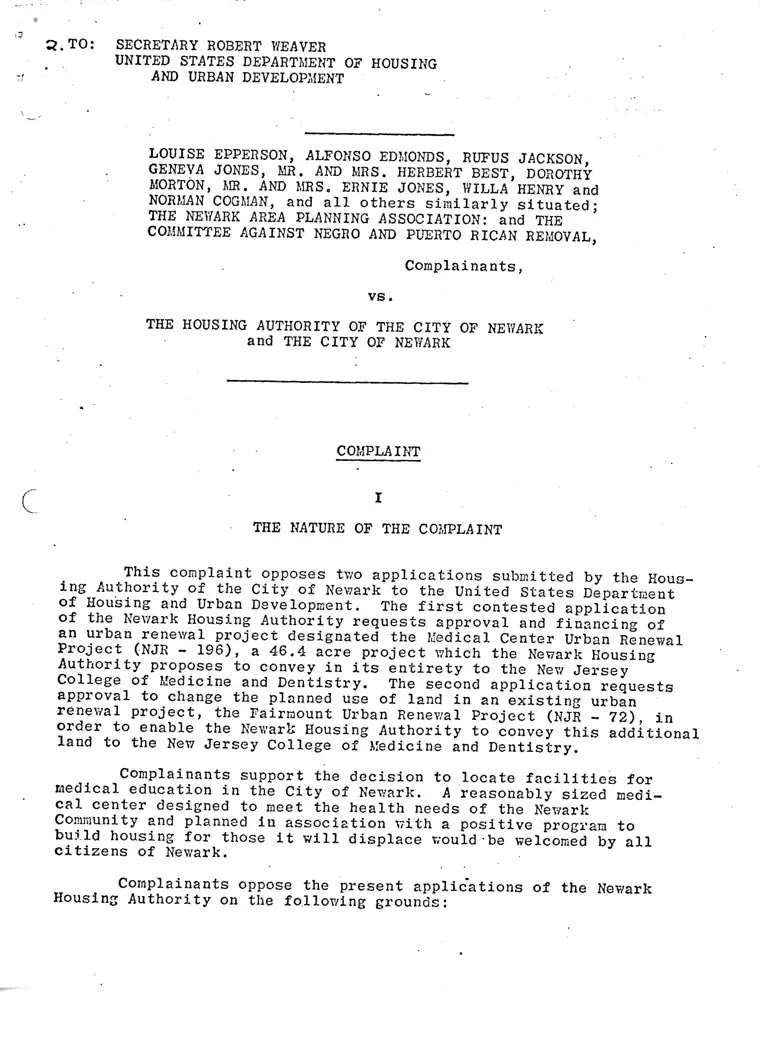
Louise Epperson, et al v. the Housing Authority of the City of Newark and the City of Newark
Epperson replied that the community activists would keep fighting the NJCMD project. She faced retaliation for her tenacity, later recalling that Addonizio’s administration responded with “rampant” sabotage “to divide and disrupt the efforts of the community groups.” The mayor’s allies reportedly tore up public awareness flyers, broke car windows, disconnected telephones, put sugar in the gas tank of Epperson’s car, and closed the activists’ meeting places. They also tried to silence Epperson by offering an inflated rate for her house, which she declined.
Around this time, Epperson also connected with a Yale Law School student from Virginia named Junius Williams. Williams had moved to Newark in 1965 to join the Newark Community Union Project, a multi-racial activist group that often partnered with the local chapter of the Congress of Racial Equality (CORE) to promote social justice initiatives. In June 1967, Epperson, Williams, and others brought their concerns to a series of public hearings, but the representatives of the city government and the Newark Housing Authority did not listen. It seemed they had made up their minds about urban renewal, and their plans would proceed regardless of how many people they harmed.
Writing in his 2014 memoir, Unfinished Agenda: Urban Politics in the Era of Black Power, Williams described urban renewal as a political tactic designed to disperse communities and “keep the mostly Black population on the run,” therefore curtailing their collective power. This was particularly relevant in the late 1960s, as Black people in Newark sought to organize. In 1966, a grassroots program called the United Community Corporation (UCC) helped fund the mayoral campaign of a young Black man named Kenneth Gibson. Positioned to organize Newark’s majority-Black community, the UCC fought for better housing code enforcement and for job training that would allow workers of color to compete for high-paying union jobs in the construction industry. Gibson joined the race six weeks before the election and won enough votes to force a run-off. Addonizio ultimately won a second mayoral term, but Gibson’s candidacy frustrated him. As the young Black politician sought to run again in the 1970 election, Addonizio lobbied the federal government to divert funding from the UCC to the Model Cities Program.
Harry Wheeler, a Newark teacher who co-chaired the Committee Against Negro and Puerto Rican Removal, speculated that the mayor’s real purpose for the medical school project was to “disperse the Negro’s political power” by driving people of color out of the Central Ward.
Addonizio downplayed any racial tensions in Newark. Born to an Italian immigrant family in the Central Ward in 1914, he equated the challenges he had faced to those experienced by the neighborhood’s residents of color. In 1970, The New York Times quoted him as saying, “In a sense, all of us come from the ghetto. Some make it and some don’t.”
Addonizio, who had supported civil rights legislation while serving in the U.S. Congress from 1949 to 1962, aligned himself with Johnson’s progressivism. But some politicians in poor cities like Newark used federal funds that were earmarked to fight poverty to instead further their own agendas. It was no secret that Addonizio aspired to be elected to a higher political office. If he could secure HUD resources to raze the homes of poor residents and install a state-of-the-art medical college, he could claim credit on the campaign trail for urban revitalization.
But Addonizio apparently underestimated Epperson and her fellow activists, especially as the fear of displacement exacerbated racial tensions in Newark. Williams, who was committed to nonviolence, worried about what he heard on the streets. “For weeks, Black people had been saying the community was ready to explode,” he recalled in a 2017 essay. “Racial polarization was entrenched. … The increasingly angry Black community raised a growing chorus of demands for better opportunities.”
Partnering with LDF
To organize nonviolent opposition to the medical school project, Williams worked with the Student Nonviolent Coordinating Committee to start a new organization: the Newark Area Planning Association (NAPA). He also studied HUD documents and noted that there was less than a 2% vacancy rate in Newark. He therefore determined that city authorities had no clear relocation plan for the residents who would be displaced by the medical school. Williams contacted Professor Pat Goeters at Yale School of Architecture and asked him and his students to design an alternate plan for the medical school. They determined that NJCMD could exist comfortably on as few as 17 acres, rather than the 150 acres originally proposed.
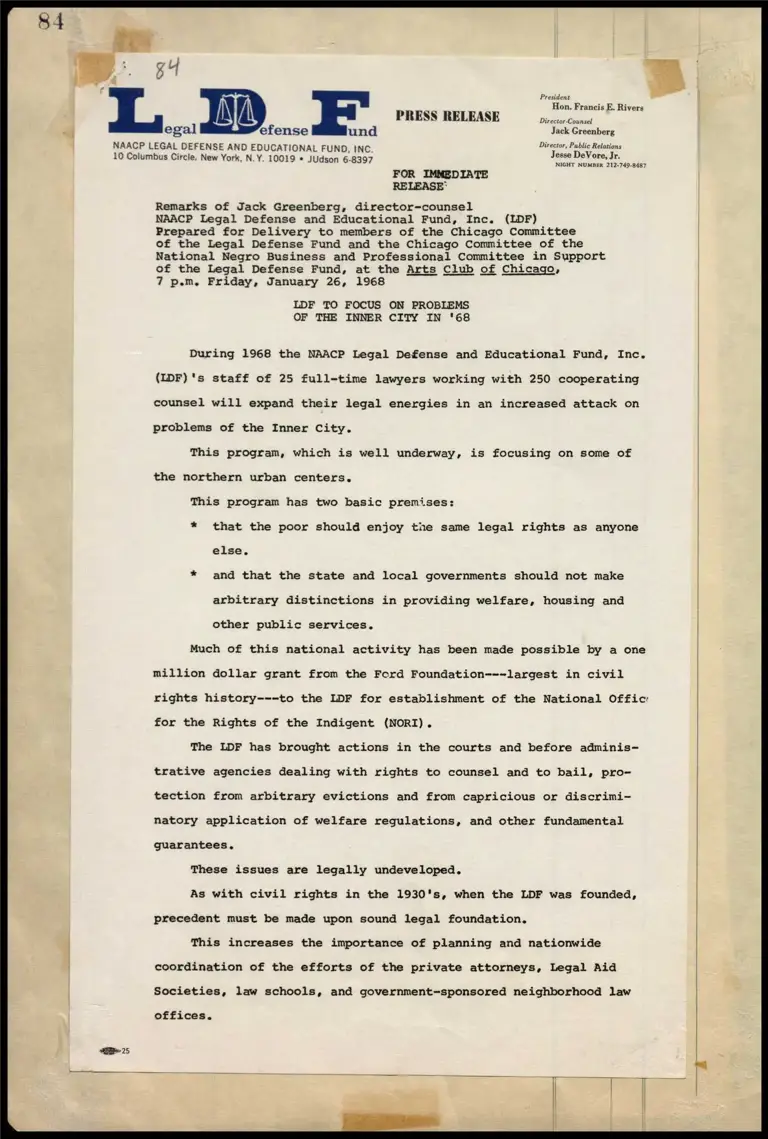
Williams brought his findings and the new plan to LDF, where attorney Michael Davidson called the situation “a classic Negro removal case.” Earlier in 1967, LDF had launched a new campaign to establish legal precedents on housing issues. The organization had been instrumental in getting Congress to pass the Civil Rights Act of 1964, but that legislation—which outlawed discrimination in workplaces and segregation in public spaces and federally funded programs—did not explicitly protect people from housing discrimination in the private market.
“There was nothing written in federal housing laws as to how one begins such a campaign,” Davidson reflected in an interview on June 30, 2025. It was challenging to prove that state or local agencies intentionally discriminated against communities of color when adopting urban renewal and highway location programs, including with federal approval and funds. “Housing was a difficult one to crack,” Davidson said in the 2025 interview. LDF attorneys had to think creatively to find an opening for their legal arguments.
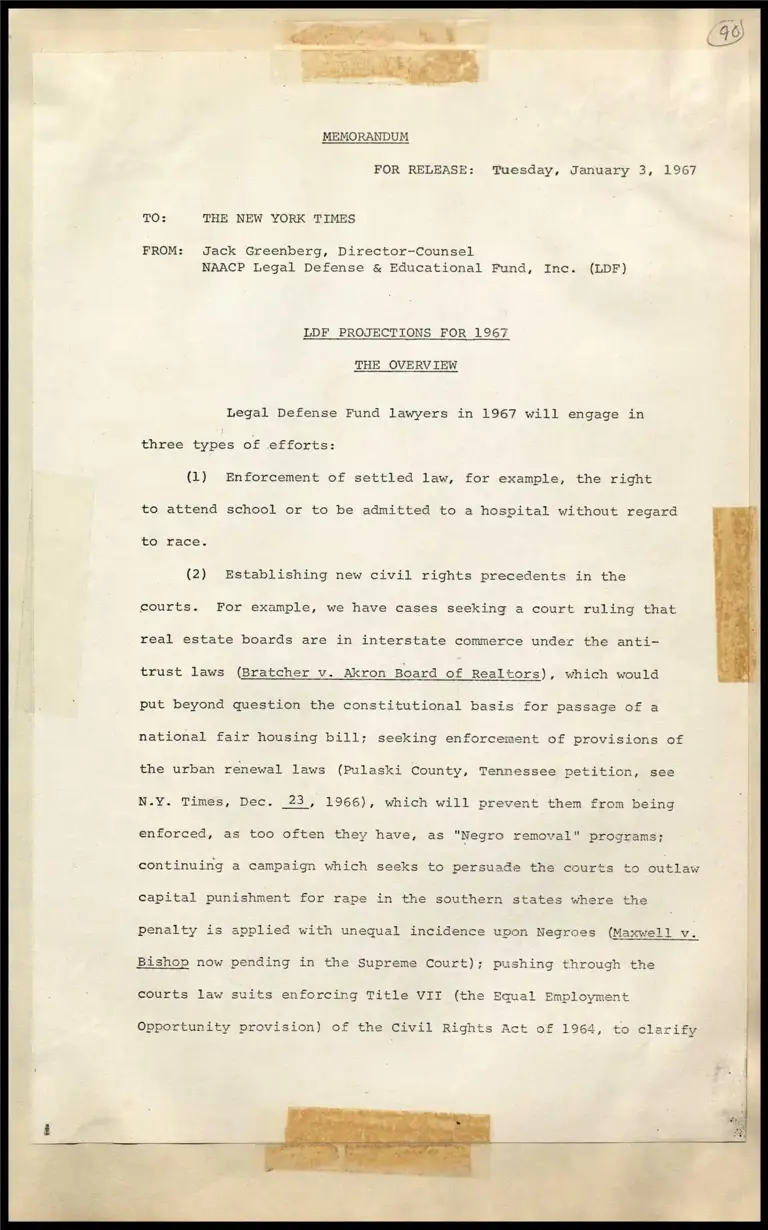
Memo on Projections for 1967
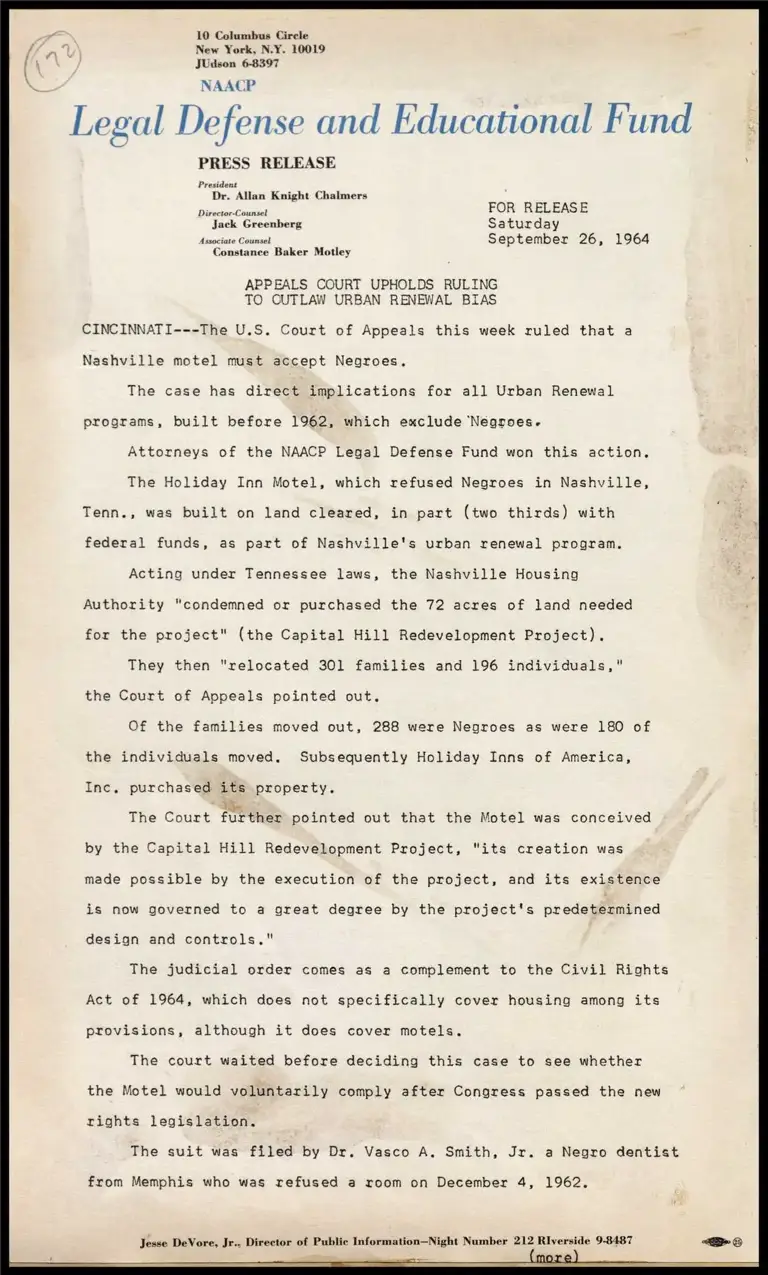
In the mid-1960s, LDF argued that real estate, as a form of interstate commerce, had to abide by antitrust laws. Cases in Tennessee and Ohio informed LDF’s strategy on housing discrimination and urban renewal. In Tennessee, LDF challenged state officials’ decision to extend Interstate 40 through a predominantly Black community in North Nashville, which would harm workers and businesses. In Ohio, LDF filed an antitrust action against the Akron Board of Realtors for refusing to sell or rent homes in certain neighborhoods to Black people. LDF initially lost both cases (although it successfully appealed Bratcher v. Akron Area Board of Realtors), but its work brought the use of antitrust laws in fair housing cases to the attention of the U.S. Department of Justice. Through these cases, LDF also developed a better understanding of how to amass evidence of discriminatory intent related to housing and urban renewal.
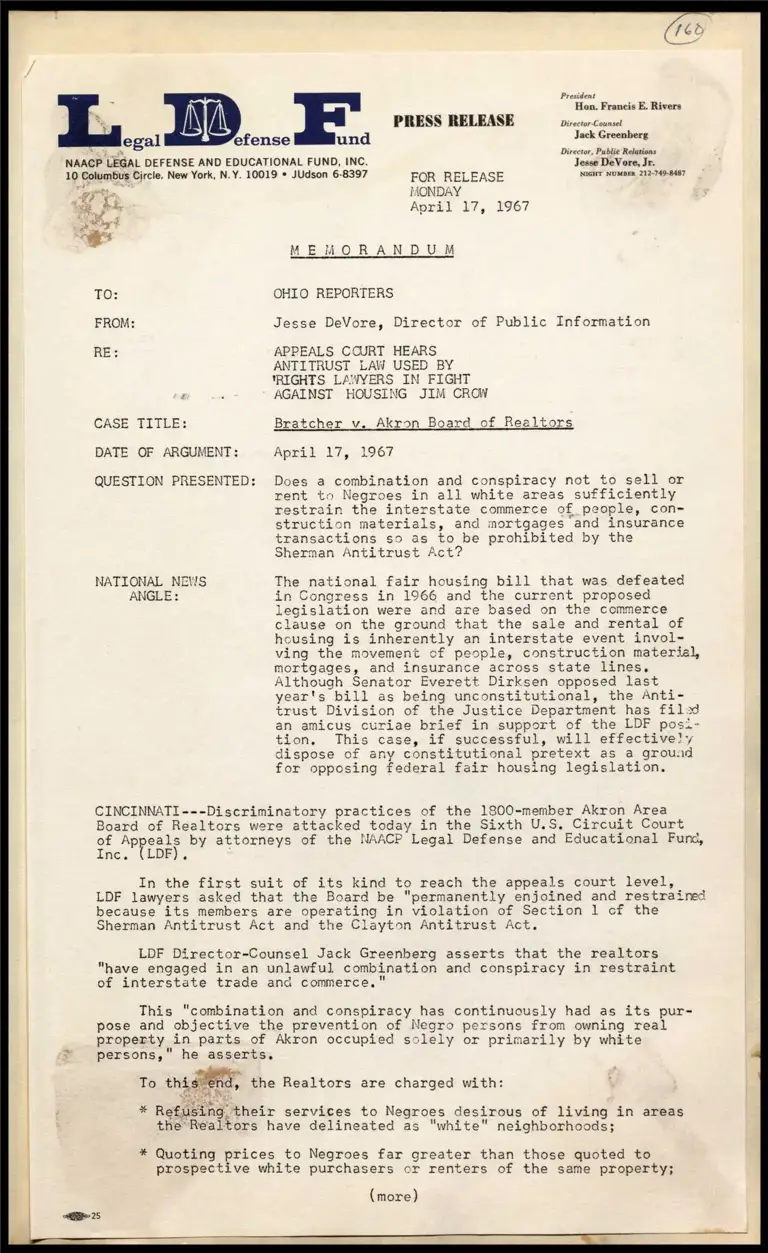
Memorandum on Bratcher v. Akron Board of Realtors
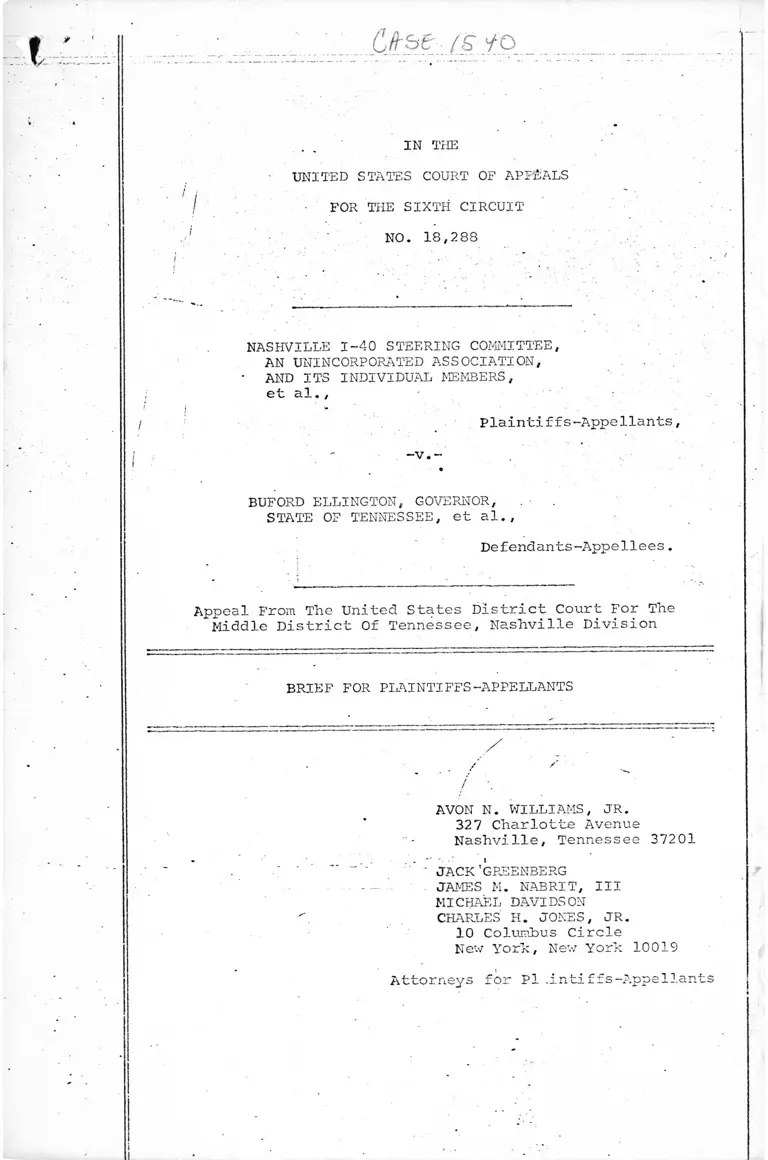
Nashville I-40 Steering Committee v. Ellington Brief for Plaintiffs-Appellants
In Newark, Davidson agreed with the local activists that the medical school plan would disrupt Black neighborhoods. He and his team decided to follow the strategy that had worked for LDF in arguing other civil rights violations: “Go to an administrative agency, set forth grievances,” and use any adverse determination as a basis for litigation, Davidson recalled in the 2025 interview. By exhausting administrative remedies, LDF could proceed in court, if necessary.
But first, the LDF attorneys had to acknowledge what they did not know and listen to the community residents as well as urban planners who understood the facts on the ground. Davidson said in the 2025 interview that it was important to “work with the community and bring in experts.” An urban planner named Yale Rabin offered critical guidance. Rabin educated the LDF lawyers on how to analyze city reports and data on housing availability, code enforcement, and demographic information. This equipped Davidson to then represent community groups and explain the impacts and shortcomings of the city’s plan for the medical school.
Rabin’s analysis of the NJCMD project, along with the analysis by the architect and planning faculty and students at Yale, revealed that Newark did not have enough alternative housing to accommodate those who would be displaced.

Relocation Housing in Newark, NJ: Summary of Findings
In the 2025 interview, Davidson called LDF’s strategy of consulting experts, commissioning studies, and amassing data “a prudent way of proceeding.” But in-depth research takes time, and Newark’s residents of color felt restless as they endured persistent poverty, crooked landlords, and police brutality while dreading the coming displacement that would further disempower them.
The Newark Rebellion
On July 12, 1967, tensions boiled over. That evening, Williams was driving home to Newark after a Black power conference in Philadelphia, Pennsylvania, when he heard on the radio that Newark authorities had ordered a curfew following a confrontation between police and city residents. Earlier, police had arrested a Black taxi driver named John Smith for an alleged traffic violation and taken him to the Fourth Precinct police station across from the Hayes Homes, a high-rise housing project in the Central Ward. Hayes residents watched as police treated Smith roughly and forced him inside. Word quickly spread that the white officers had beaten Smith, and crowds gathered outside the police station. When a Molotov cocktail hit the building, officers rushed outside in riot gear.
The ensuing “Newark Rebellion” lasted for four days. Roving groups of people began breaking into businesses, especially targeting white-owned businesses that were known to exploit Black communities in Newark. Police officers and civilians clashed. As violence increased, the New Jersey State Police and the National Guard arrived on July 14 after Addonizio contacted the governor.
By the time the rebellion ended on July 17, law enforcement officers had killed 22 people and arrested nearly 1,500 people, and over 1,000 Newark residents were injured. In one incident, after supposedly hearing reports of sniper fire, officers sprayed bullets into the Hayes Homes, killing Eloise Spellman, a mother of 11 children, and two other women. Not one police officer or National Guardsman faced prosecution.
“The affidavits of witnesses to police violence documented a pattern of death and destruction on the part of the police that far surpassed the damage to property and theft done by those in rebellion,” Williams wrote in 2017. “This was an uprising conducted by people who didn’t understand the price they would pay. The city was a battlefield; the front line was everywhere.”
Negotiations Begin
News reports suggested that a major factor in the rebellion was frustration over the medical school project. As the hot summer moved toward fall, Epperson noticed a change in how the project leaders treated her requests to meet. “After the riots broke out, then everybody wanted to talk to me,” she said.
According to Williams, “The power structure was scared.”
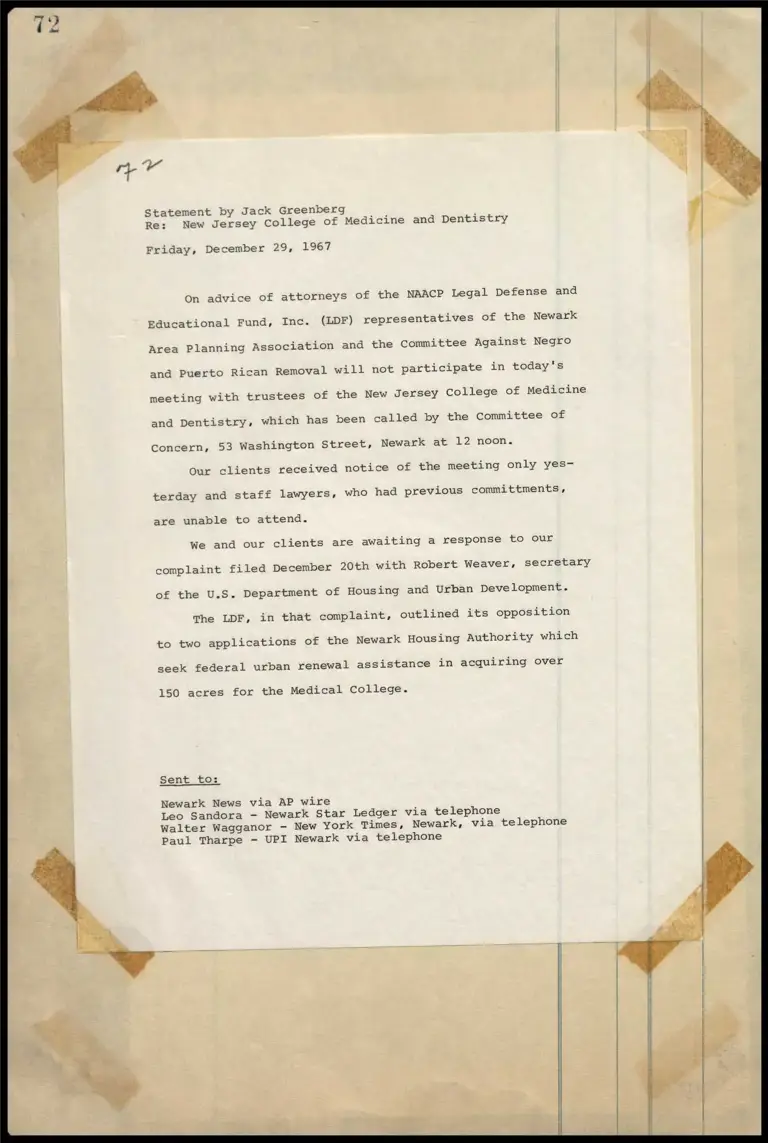
By December 1967, LDF had decided to file administrative complaints with HUD and the U.S. Department of Health, Education, and Welfare (HEW) in an attempt to stop the NJCMD project, partly on the grounds that the Newark Housing Authority had failed to provide adequate relocation housing.
“The U.S. Supreme Court had already determined urban renewal was constitutional, so we had to show that the program as administered in Newark was outside the statutory or regulatory boundaries as prescribed in law and policy,” Williams wrote in Unfinished Agenda: Urban Politics in the Era of Black Power. The activists closely examined the Newark plan and found a key weakness: “There was no place to put displaced people.”
Johnson’s “War on Poverty” and the creation of HUD represented notable gains for civil rights, and LDF attorneys were interested in “not being adversaries but being allies in this process,” Davidson recalled in his 2024 interview for the LDF Oral History Project. To that end, LDF’s complaints stated that the 11 individuals and two community groups (NAPA and the Committee Against Negro and Puerto Rican Removal) opposing the NJCMD project would welcome “a reasonably sized medical center designed to meet the health needs of the Newark community and planned in association with a positive program to build housing for those it will displace.” LDF described the complaints as “a final administrative step prior to formal litigation.”
The HUD and HEW undersecretaries responded by sending a letter to New Jersey Governor Richard Hughes in January 1968. By the time the letter arrived, bulldozers sent by the Newark Housing Authority had already leveled some properties in the Central Ward. However, the project now had to stop. The letter explained that in order to receive federal funding and approval for the medical school project, the state must meet community participation requirements and address a series of issues in discussions with community groups. For example, school and government officials would need to make significant adjustments to the size of the site and their plan for relocating displaced residents. They would also need to specify the number of construction job opportunities for people of color, the types of health and education services that would be offered at the new facility, and the number of jobs for local residents at the college. Furthermore, they would need to create plans to recruit people of color for medical training and provide for upgrades to a city hospital that served poor patients.
Hughes reacted quickly. He invited Williams and others to meet with him and assigned Commissioner of the NJ Department of Community Affairs Dr. Paul Ylvisaker and State Chancellor of Higher Education Ralph Dungan to facilitate negotiations. Davidson, Williams, Epperson, and other activists prepared to enter a series of negotiations related to the issues spelled out in the undersecretaries’ letter.
Williams said it was clear that the city, the Newark Housing Authority, and the medical school were brought “kicking and screaming to the bargaining table.” For the negotiations, a series of six “site hearings” in February and March 1968, his strategy was to “drive a wedge between different levels of government in the power structure” so that the federal and state governments supported the community activists’ demands while the city government was isolated.
The July 1967 rebellion had empowered the community activists by giving them seats at the negotiating table. On one side sat Williams, Epperson, Wheeler, and other community members, as well as Davidson. On the other side sat officials such as Executive Director of the Newark Housing Authority Lou Danzig and NJCMD President Cadmus.
For the first time, Danzig had to publicly answer questions about his decision-making, including the commitments he had made to developers and his plans for relocating thousands of Central Ward residents. Danzig repeatedly offered noncommittal, general answers and bristled defensively when pushed for specific information.
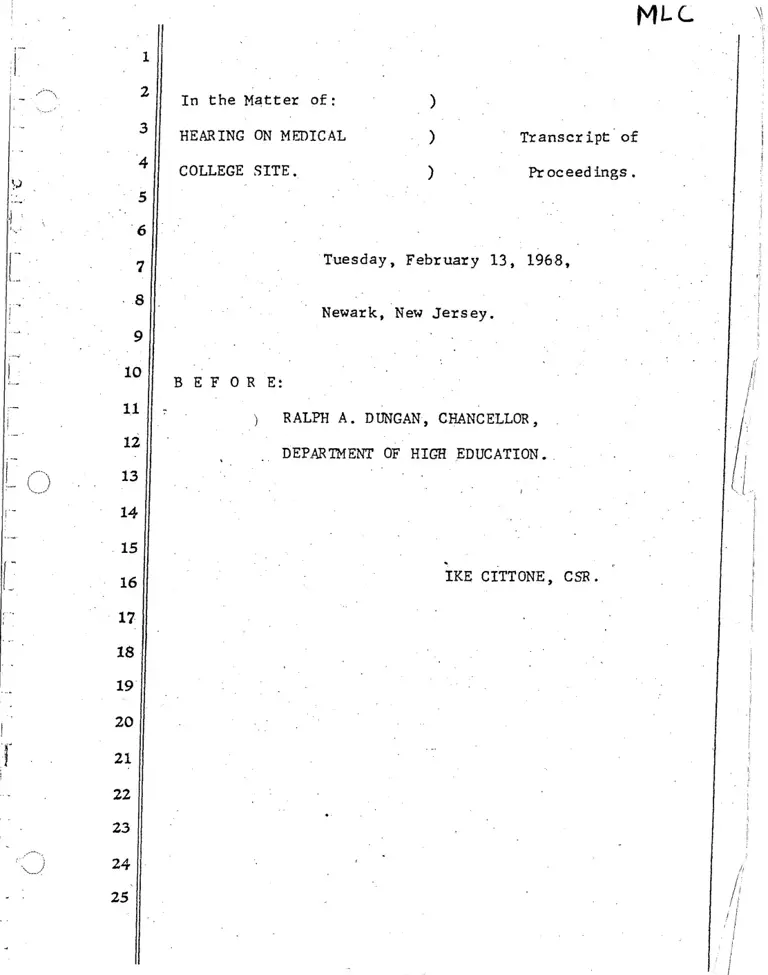
Explore the hearing transcripts
The second hearing, on February 17, was especially tense. Williams expressed the community activists’ frustration with the officials’ evasiveness and failure to provide detailed information. He called the negotiations “a very good lesson in political science for us all, that there is never anybody to blame.” He continued, “We come from the community and we ask a specific question. You, who are supposedly representing the powers that be, always say, ‘Let’s be reasonable.’ We make a specific request, then the people who are supposed to be representing the power structure say, ‘It is not our fault that such and such exists.’”
By this point, officials from the school and the city had apparently turned against one another. Cadmus, the head of NJCMD, blamed the lack of clear communication on Danzig and said that the housing official did not know what he was talking about.
Danzig shot back, “This whole issue would never have arisen if [the medical school] had stayed out of my business, which is land and its use in the urban scene, about which Dr. Cadmus knows nothing.” Later, he complained about the community activists’ insistence on specific information about relocation plans: “If we are going to prolong these meetings and get on into next summer and lose the medical school—if that’s what the objective is—I don’t know when we are going to resolve these things.”
During the hearings, Epperson refused to let Danzig or any other officials dodge their responsibility to the thousands of people like her who faced displacement. She said the issue was simple: Government officials must clearly address the need for adequate housing. During the February 13 hearing, she underscored the power held by the officials in the room and said, “This should be something that you could sit here and put something concrete to me and bring my neighbors housing.”
LDF and NAPA estimated that the city needed to identify at least 54 acres on which new housing could be constructed for the displaced residents. Williams said to Danzig at the February 17 hearing, “I think at this point the burden of proof is on you or someone in a similar situation to come up with some more land.”
As Epperson, Williams, and their fellow activists repeated their concerns and requested specific information during each hearing, Newark officials realized that the negotiations would drag on unless they provided clear answers and concessions.
The Newark Agreement
On March 15, 1968, the parties reached the Newark Agreement, which included specific plans to address each of the issues outlined in the letter from HUD and HEW. It shrunk the medical school’s footprint from 150 acres to 57.9 acres and earmarked 63 acres of vacant land where community nonprofits would build more than 900 housing units. The medical school committed to hiring and training Black and Puerto Rican workers, and community members could participate in a Health Review Council to monitor the quality of health care. NJCMD also agreed to take over the operations of Martland Hospital, a city-owned hospital serving Newark’s poor residents.
The Newark Agreement also helped sustain and empower the Central Ward’s Black voting bloc. In 1970, Gibson defeated Addonizio in the mayoral race, becoming the first Black mayor of a major Northeast U.S. city.
Upon completion in 1976, the NJCMD campus in Newark held a medical school, a dental school, a community mental health center, a teaching hospital, and a level-one trauma center. Now part of Rutgers University, the institution has long had the largest enrollment of students of color of any medical school in the country (except for two historically Black medical schools). Martland was replaced with a brand-new facility in 1979 and was renamed University Hospital in 1981.
Davidson’s later work in Selma, Alabama, reflected a similar model, featuring resident-defined priorities, planning expertise, administrative and litigation pressure, negotiated housing remedies, and formal structures for community participation. Today, the Newark Agreement still offers a template for community-centered advocacy for fair and affordable housing, employment opportunities, health care access, and other community-defined goals. Davidson reflected in the 2025 interview that “often one gets further ahead through agreements and negotiations” as an alternative to litigation. Such negotiations can result in an outcome that benefits all parties, with “an incentive to everyone to see things through.”

For more information on civil rights history in Newark, visit The North: Rise Up Newark, produced by Junius Williams.
Related archival items
-
Oral History
Michael Davidson Interview Transcript
-
-
-
-
-
-
References
Our latest stories
-
Elizabeth Horton Sheff: From Community Activism to the Courts
September 08, 2026
How community activist Elizabeth Horton Sheff led in the fight for education equity in Hartford, Connecticut.

-
The Racist Origins of “Student Pushout”
July 30, 2026
Understanding the history of exclusionary school discipline and the racial disparities that persist today.

-
Radical Redistricting or Real Representation: North Carolina’s Battle for Congressional District 12
June 23, 2026
The decade-long fight for a majority-Black electoral district in North Carolina, and ongoing challenges to the Voting Rights Act.
