Elizabeth Horton Sheff: From Community Activism to the Courts

Elizabeth Horton Sheff and her son, Milo, in 1989. Source: The Hartford Courant
Growing up in the 1950s, Elizabeth Horton Sheff lived, played, and learned in the multicultural Charter Oak Terrace public housing community in Hartford, Connecticut. Her mother always spoke about their neighbors with care and defined people by their personal qualities, rather than their race. Sheff recalled this powerful childhood lesson during a 2024 interview for the Legal Defense Fund Oral History Project.
“In our community, I was fortunate enough to live with people of all different racial backgrounds,” she said. “So, I got to know people. And the one thing I attribute to my mother that has helped me over the years is that she never said that ‘Ms. Bansavich is white.’ She never gave a racial tag to people. So, Ms. Bansavich was ‘Ms. Bansavich.’ She made the best spaghetti sauce ever. I used to sit on her step, and she would let me taste it as it cooked all day. The Baileys lived up on the hill, and they were West Indian. The Rocks were Asian. The Riveras were Hispanic. So I grew up with all kinds of people, and that helped me understand that people are people.”
This instruction to embrace differences shaped Sheff’s worldview and fostered her curiosity about diverse cultures. Feeling that the Hartford public school education system was failing her, Sheff decided to educate herself. During her senior year of high school, Sheff would spend the money she earned at her part-time job to buy train tickets to New York City to “people watch.” Sheff also spent time in Hartford Superior Court learning about our justice system and studied exhibits at the Wadsworth Atheneum Museum of Art in Hartford.
Drawing from her early appreciation of the value of diversity and equity, Sheff became a community organizer in her adult life. She rallied Hartford and the State of Connecticut around issues concerning the environment, housing, and education, such as helping launch her city’s first recycling program and an innovative public housing program for grandparents. From these accomplishments to her advocacy for education equity through the landmark Legal Defense Fund (LDF) case Sheff v. O’Neill, she has long served as an outspoken champion for justice.
A Community Activist
Before focusing her advocacy on education equity, Sheff served her northwest Hartford public housing community as the Vice President of the tenant association. Through this work, she promoted discussion between residents and the Hartford Housing Authority and had her first experience pioneering an innovative community program. Sheff was inspired to use her position to protect the environment, so she worked with the Housing Authority to hire her neighbors to help with the city’s first recycling pilot in the early 1980s, at a time when environmental initiatives were scarce.
“We would talk with our fellow residents about the need to recycle and how we are damaging our Earth with all this packaging and all this plastic and all these cans,” Sheff recalled.
Sheff then expanded her reach by serving on the Hartford City Council. During her tenure, she identified an often-overlooked group of community members who needed support: grandparents raising their grandchildren. She worked with the City Council, the municipal government, and the U.S. Department of Housing and Urban Development to create dedicated affordable housing for grandparents who had legal custody of their grandchildren, called Generations.
“The best part of all of that is that I worked with the architects and the grandparents raising grandchildren to help design those units,” she said. For example, the grandparents suggested having a hole in the wall between the kitchen and the living room so they could see the children. “It was an experience working to develop, and it’s still active today. It’s still there,” Sheff recalled.
Her son, Milo, accompanied her throughout her activist work, gaining a sense of civic responsibility as he attended demonstrations and community meetings. Sheff shared, “I’m a social justice activist, so he went with me to all of these meetings. He was there. He stood beside me when we did a candlelight vigil for persons affected with HIV/AIDS, way back when those out there thought that people who were experiencing that were some kind of lepers. He was with me. He used to go to the tenants’ meetings, marches on Washington. He was kind of used to it. I think he thought that that’s how every child grew up.”
These experiences eventually led to the family’s involvement in a case that would transform public education in Hartford.
The State of Hartford Public Schools Post-Brown
Sheff, who was only 2 years old when the U.S. Supreme Court issued its 1954 ruling in Brown v. Board of Education, attended an integrated public elementary school. However, the integration in Hartford was fleeting.
“It was different for my baby sisters, Deborah and Geraldine, because by the time they got rolling into the public school, K through 12, the community had become more segregated,” Sheff said.
In the years following the Brown decision, Hartford’s schools became segregated largely due to economic marginalization, urban planning, and various forms of housing discrimination. While there was no law or official school policy that separated Hartford schoolchildren by race, these environmental factors kept many students out of integrated classrooms.
This segregation continued to plague Hartford public schools for decades. During the late 1980s and 1990s, when Sheff’s children attended school, an estimated 90% of students enrolled in public schools in Hartford were students of color. Beyond this racial segregation, activists said that Hartford public schools enrolled “far more students from poor families, single-parent families, and families with limited English proficiency” than public schools in the surrounding suburban areas. Despite the Connecticut Constitution’s guarantee of a right to equal education, Hartford’s public schools failed to provide students with adequate educational opportunities. Tests administered by the Connecticut State Department of Education showed that most Hartford students had not mastered “essential grade-level skills.”
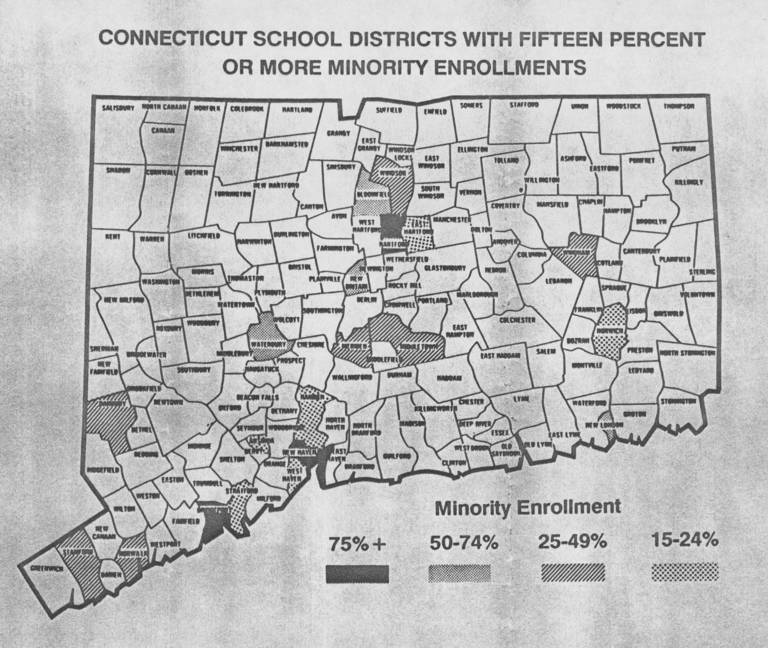
A map of Connecticut school districts with 15% or more minority enrollments, from the Connecticut Education Association Desegregation Taskforce. Source: LDF Archives
Connecticut’s Right to Education
In 1965, Connecticut voters approved a new state Constitution, which increased political representation for the state’s populous cities by adopting the principle of “one person, one vote.” Under the former state Constitution, ratified in 1818, each township received equal representation in the legislature regardless of its population. The 1965 Connecticut Constitutional Convention also set the stage for another push for equity: Delegate Simon Bernstein, a Hartford lawyer, saw it as an opportunity to codify a right to education, which the 1818 Constitution lacked. However, his fellow delegates were singularly focused on reforming the state’s system of representation. After multiple requests to the convention chairman to consider his proposal and threats to alert the media, Bernstein was finally heard. With just five minutes to draft the amendment, Bernstein wrote, “There shall always be free public elementary and secondary schools in the state. The general assembly shall implement this principle by appropriate legislation.” The delegates passed his amendment, which remains part of the Connecticut Constitution today.
Initiating Sheff v. O’Neill
Sheff’s involvement in the fight for education equity began in 1989, at a community meeting to discuss the state of education in Hartford. The meeting was hosted by LDF, the American Civil Liberties Union, the Puerto Rican Legal Defense and Education Fund, professors from the University of Connecticut School of Law, and local attorneys such as Wesley Horton.
Sheff agreed to attend the meeting as a favor to her neighbor, whose daughter participated in a program that allowed students in Hartford to attend schools in the surrounding suburbs. Curious about how a movement to integrate schools would affect Hartford students, Sheff attended and took notes.
She described the meeting as “eye-opening.” While her children were not experiencing gaps in their education, she learned that 74% of eighth grade students in Hartford needed remedial reading assistance in 1989. Sheff recalled her shock: “For me, that wasn’t 74% of students failing—I see that as the system failing 74% of our kids. Startling, startling. I mean, I was really taken aback. How could this be?”
Sheff was inspired to become more involved in the coalition’s education equity work. From the outset, she believed that integration was a key component of improving education quality.
“We’re talking about quality, integrated schools,” she explained. “When people talk about ‘quality,’ they don’t necessarily talk about integration. And for me, quality has to include integration. It has to include the ability to attend school with persons who are not like you, to learn from and teach about not only culture, but about commonality of humanity.”
This conviction led Sheff and Milo to join the movement for education equity in Hartford. LDF lawyers chose them as one of the 10 families who would be plaintiffs in their lawsuit. Sheff said that her work as a social justice activist primed her and Milo to participate in the litigation as the lead plaintiffs.
“Struggle in the Street, Struggle in the Court”: Collaborating with LDF
On April 27, 1989, LDF lawyers filed Sheff v. O’Neill on behalf of Milo, Sheff, and other Hartford and suburban parents and their children. Unlike many other cases where LDF lawyers targeted school segregation that was mandated by law, in Sheff, they argued that Hartford’s de facto segregation violated children’s rights under the state Constitution. In Sheff, LDF lawyers and co-counsel affirmed that it was the State of Connecticut’s responsibility to ensure equal educational opportunity for all students.
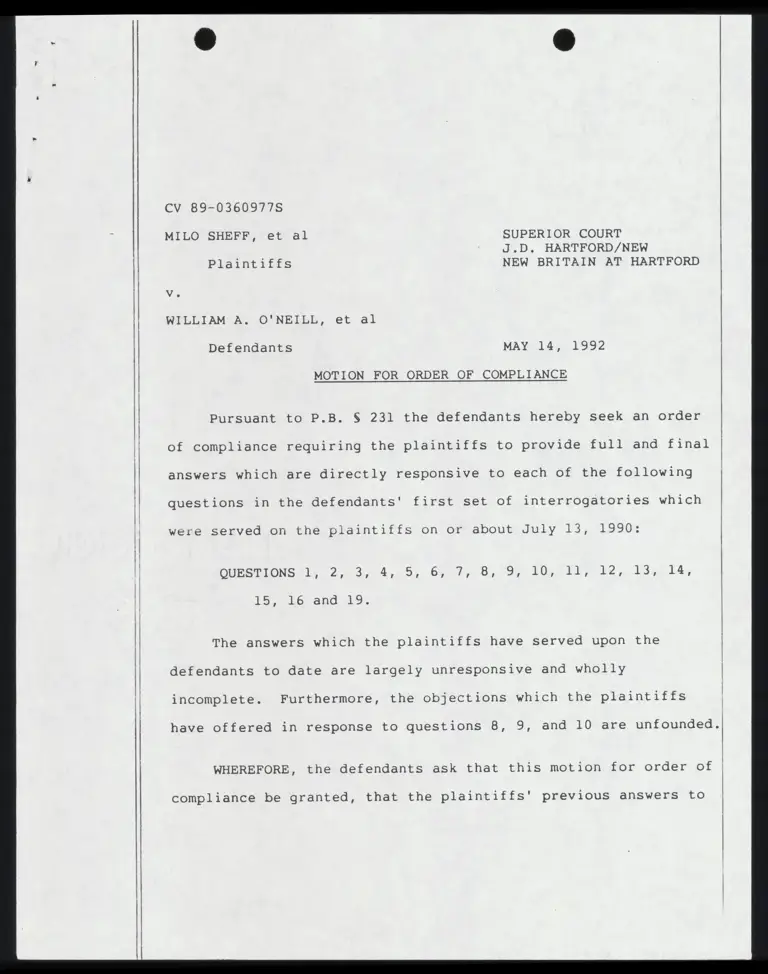
Motion for Order of Compliance; Order; Memorandum in Support of Defendants' Motion for Order of Compliance
Given her background in community organizing, Sheff was instrumental in informing other families about this fight for education equity. Alongside her fellow plaintiffs, she canvassed neighbors and organized meetings to explain the necessity of pushing for integrated schools.
“A lot of folks out there, like me, when I first got the lightbulb turned on, they had no clue that things were that bad because it wasn’t affecting them. It wasn’t impacting them,” she said. “We opened the eyes of a lot of people, and they remain open.”
Sheff was also an advocate in her partnership with lawyers on the case. She worked closely with LDF lawyer Jack Boger in the early stages of the litigation to bridge the gap between the attorneys and the plaintiffs.
“I think that’s really important when you talk about joining civil rights advocacy with legal advocacy: You have to listen to one another,” she said. “And I’ve made it my point over these three-plus decades to make sure that what we’re doing on the ground in our social justice work does not have negative ramifications for the case. And I’ve worked real hard to get them to understand that what you do or propose in the courtroom doesn’t crush what we’re doing in the community or how the community feels about it.”
Setbacks and Successes
For the Sheff plaintiffs and attorneys, the right to education outlined in the state Constitution implied a right to equal educational opportunity. In the plaintiffs’ 1989 mission statement, they argued, “For all children, segregated education is inferior education, because [it] deprives them of the opportunity to associate with and learn from children representing different racial, ethnic, and economic backgrounds.”
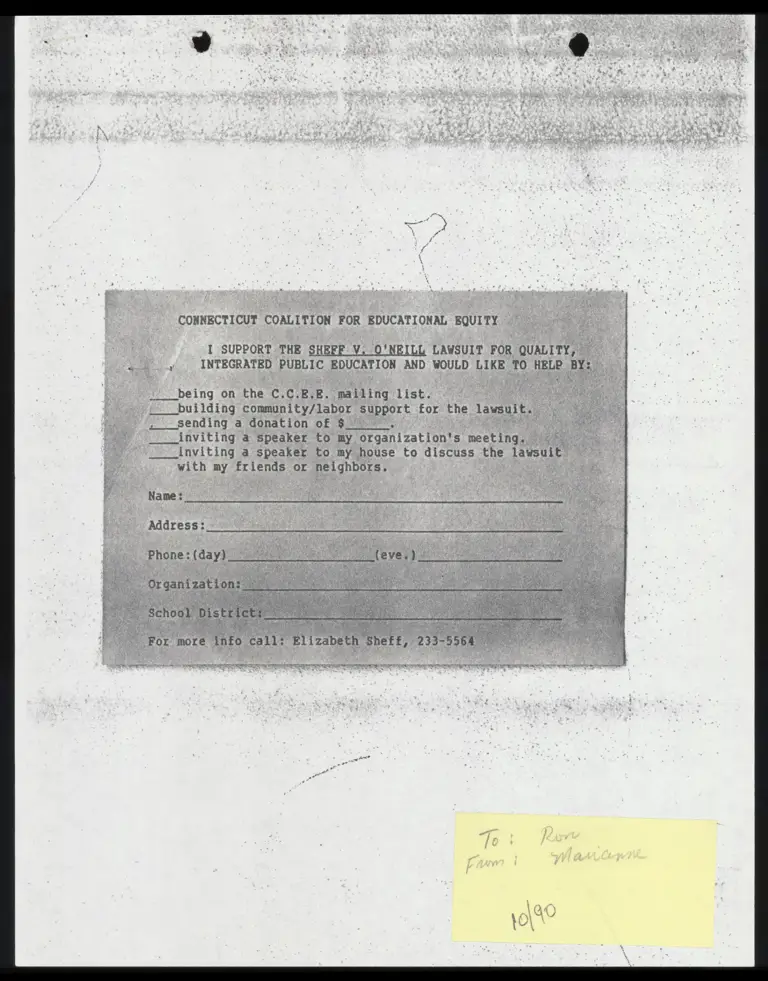
Plaintiffs’ Mission Statement Summary
However, in April 1995, the Connecticut Superior Court ruled that unequal educational conditions were not caused by State action. The ruling marked both a blow to the case and a painful lesson for Sheff’s son. Sheff said she remembers awaiting the Superior Court’s decision and watching the “childhood light” go out of Milo’s eyes when they learned the judge had ruled against them. Discouraged but determined to be heard, Milo organized a walkout from Hartford high schools to protest the ruling.
“My son, Milo, organized—now this is back before there was TikTok and Instagram and all of that—they organized, by word of mouth, a walkout from Hartford High, Weaver High, and Bulkeley High,” Sheff recalled. “This is the kids. These are the students. It’s not on social media. We had a walkout, and those kids walked out of those three high schools, and we walked to the Capitol building. When we got there, with all them little Brown children, girl, I mean, the stir was tremendous.”
The LDF lawyers and their co-counsel also continued to advocate for the community. They appealed the case to the Connecticut Supreme Court, which in July 1996 ruled that Hartford schools’ segregation violated the State’s constitutional obligation to provide all children with equal educational opportunity. The Court further concluded that school districting based on town and city boundary lines is unconstitutional, citing a statute that bound school districts by town lines as a key factor in the high concentrations of students of color in certain towns and Hartford. The Court ordered the State to immediately remedy the racial isolation experienced in the schools around Hartford.
Despite this favorable ruling, the Court left it up to the legislature to develop solutions and a timeline. The plaintiffs and lawyers continued to advocate in the community and in the courts for the development of practical plans to integrate public schools in Hartford and beyond. In 2003, they reached a settlement agreement with the State that called for eight integrated magnet schools to be built in Hartford within four years. LDF lawyers and co-counsel continued to follow up on this intervention, reaching subsequent settlement agreements in 2008, 2013, and 2016. The agreements expanded Hartford students’ access to regional magnet schools and to Open Choice, an interdistrict transfer program that helps students attend integrated schools. In 2020, a court-approved settlement agreement increased the number of seats available to Hartford students in diverse educational settings and also committed state resources to the development of a long-term plan to ensure that Hartford students can access voluntary school choice programs and magnet schools.
The Continued Struggle for Education Equity in Connecticut
As a result of Sheff v. O’Neill, almost 20,000 Hartford-area students now attend either a magnet school or a suburban school through the Open Choice program, and nearly half of Hartford students of color attend racially and economically integrated schools.
Beyond these numbers, Sheff has been overjoyed to see the lives of students improve as a result of the case. She remains actively involved as the Co-Chair of the Sheff Movement coalition, which works to increase public awareness about the lawsuit and the resulting interdistrict school integration programs. Describing her visits to schools in Hartford and the surrounding suburbs, she said, “It is such a beautiful sight to see all of these kids, from all colors and all religions, and you can see it. You can see it. And that to me is just a blessing. And I think to myself, ‘Well, I had something to do with this, right?’”
To hear more from Sheff about the continued fight for education equity, listen to the Thurgood Marshall Institute’s Justice Above All podcast.
Notes
Our latest stories
-
Gabrielle Kirk McDonald: A Legal Pioneer at Home and Abroad
October 13, 2026
Learn about Gabrielle Kirk McDonald’s extraordinary life, from her experiences during the Civil Rights Movement, to her groundbreaking work at LDF and on the federal bench, and ultimately to her international judicial leadership at The Hague.

-
The Racist Origins of “Student Pushout”
July 30, 2026
Understanding the history of exclusionary school discipline and the racial disparities that persist today.

-
The Newark Agreement: Establishing a Template for Community-Centered Fair Housing Advocacy
June 26, 2026
How negotiations over a new medical school in Newark, New Jersey, empowered Black activists and helped the Legal Defense Fund create a model for future community-centered fair housing advocacy.
