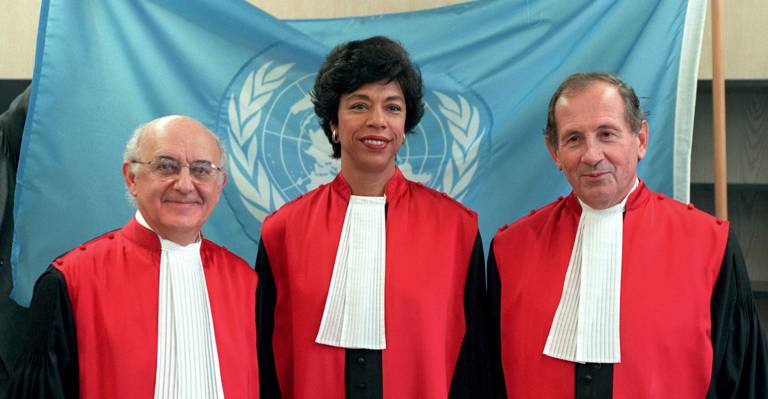
Gabrielle Kirk McDonald (center) stands with Antonio Cassese (left) and Claude Jorda (right) of the International Criminal Tribunal for the Former Yugoslavia in November 1999. (Photo by Raphael GAILLARDE/Gamma-Rapho via Getty Images)
Gabrielle Kirk McDonald: A Legal Pioneer at Home and Abroad
In 1963, in the throes of the Civil Rights Movement, a wide-eyed, earnest, and inquisitive college student named Gabrielle Kirk (later Gabrielle Kirk McDonald) stood among a group of attendees at a lecture series commemorating the 100th anniversary of President Abraham Lincoln’s signing of the Emancipation Proclamation.
Held at The New School, a private university in New York City’s Greenwich Village neighborhood, the event featured a slate of notable guest speakers who delved into the historical roots of American racism, the post-Civil War rise of state-sanctioned Jim Crow segregation in the South, and how the ingrained disenfranchisement of Black people fueled the grassroots protests of the Civil Rights Movement.
Cutting through the daunting discussions of the ruthless oppression and suffering of Black people flowed a ray of hope that resonated with McDonald’s penchant for taking action rather than remaining passive. At the event were professors from Howard University School of Law in Washington, D.C. Known as a leading center of Black intellectual thought, Howard Law produced a roster of distinguished alumni—most notably Legal Defense Fund (LDF) founder and later Supreme Court Justice Thurgood Marshall, who won several landmark civil rights cases such as Brown v. Board of Education in 1954.
Impressed with the professors’ multifaceted, nuanced legal strategies to dismantle pervasive discriminatory laws and social norms that limited the access of people of color to jobs, promotions, and housing, McDonald convinced herself that she too needed to study law at Howard. It was a decision that would reset the trajectory of her life, shaping her future in ways she could not have foreseen, to become a pioneering civil rights lawyer and jurist in her own right.
“As a Black youth, you see things and you can perhaps think, maybe they should be different, or you think that you want to change them,” McDonald said in a 2024 interview for the Legal Defense Fund Oral History Project. “And I think I got that attitude from my mother. As I said, she was fiery and there was none of this ‘Woe is me’ or ‘Woe is you.’ It’s ‘Get it together and do something. Don’t be a bystander.’”
Growing Up in the North
McDonald was born in 1942 in Saint Paul, Minnesota, the first child of Frances R. Kirk, an aspiring stage actress, and James G. Kirk Jr., a railroad dining car waiter. Soon after the birth of their second child, James G. Kirk III, her parents divorced. McDonald and her brother moved to New York with their mother, who secured a role as an understudy in the first all-Black performance of the Broadway play “Anna Lucasta.”
When her stage career did not pan out, McDonald’s mother directed her energies elsewhere, including as an advocate against housing discrimination—an issue that touched them personally.
McDonald said that her mother, whose parents were Swedish and Black, was light-skinned and could have passed for white but chose to live as a Black woman. She found an apartment for her family in the Riverdale neighborhood of the Bronx. However, when a young Gabrielle showed up, the property manager told them that they needed to move out because Black families were not allowed to live there.
McDonald’s mother, who was a diminutive figure physically but fiery in personality, was adamant about respecting people of all races. McDonald remembered that once as a child, she repeated to her mother a schoolyard joke about Asians. Her mother would not have any of it.
“She gave me a lecture then and there, and this was before Riverdale, that we don’t do that,” McDonald said. “And we never did in my family—never. We never used derogatory terms for people.”
After the incident in Riverdale, her mother decided that Gabrielle, who was about 8 years old at the time, would be sent to live with her grandparents in Minnesota. McDonald did not know why her mom was sending her away but assumed she had done something wrong to anger her mother. Distressed by the news, she decided to run away and even convinced her best friend in the neighborhood to go with her. She put on several layers of shirts, packed a red satchel, and left without a destination in mind. She and her friend were picked up by police and returned to their parents. It was not until many years later that she realized the true reason why her mother had sent her to Minnesota.
Studying at Howard Law
After the New School lecture, when McDonald began her law studies at Howard in 1963, she found that the massive workload and high level of competition fueled a personal fear of flunking out. As tough as it was dealing with the stress, she recognized the unique opportunity to be taught by a number of legal descendants of Marshall, who had graduated at the top of his class at Howard Law in 1933.
Until law school, McDonald had spent the majority of her years integrating predominantly white schools, where the curriculum provided little information of the Black experience in the United States. But at Howard, a private, historically Black research institution, McDonald felt a deep sense of belonging and purpose. Among her classmates, she was known as “Miss NAACP” for her vocal support of the Civil Rights Movement.
The law school’s strong tradition as a training ground for civil rights lawyers centered on the mantra of its former Dean Charles Hamilton Houston, who said, “A lawyer’s either a social engineer or a parasite on society.” Houston, as McDonald understood him, viewed the legal profession not as a means to a comfortable life with job security, but as a way to achieve racial equality.
Howard Law’s administrators and professors pushed their students to cultivate critical thinking and complex problem-solving skills along with deep legal knowledge because they knew the barriers the graduates would face in a legal profession dominated by white men.
McDonald achieved the top grade in constitutional law, which was the civil rights course at the time. The course was taught by the revered scholar Patricia Roberts Harris, who took part in nonviolent, sit-in protests in Washington, D.C., restaurants in the 1940s and later became the first Black woman to hold a presidential cabinet position. McDonald’s award for the highest grade in the course was a history book by prominent civil rights lawyer, newspaper publisher, and journalist Loren Miller titled The Petitioners: The Story of the Supreme Court of the United States and the Negro. Miller, who had written many of the legal briefs in the Supreme Court case Brown v. Board of Education, concluded in his research that there developed early in the country’s history a “guardian-ward” relationship fostered by the Court that regularly rejected the basic civil rights of people of color in favor of the economic interests of business owners.
McDonald saw many of the era’s key civil rights lawyers structure and refine their legal arguments during moot court at the law school. That was also when she first learned of LDF, which was founded as the legal arm of the NAACP by Marshall in 1940 and became an independent organization in 1957.
The Legal Defense Fund Years
For many years, LDF’s office in New York consisted of about a half dozen staff attorneys. All of that changed after the passage of the sweeping Civil Rights Act of 1964, which outlawed racial segregation and discrimination in public places, schools, and employment.
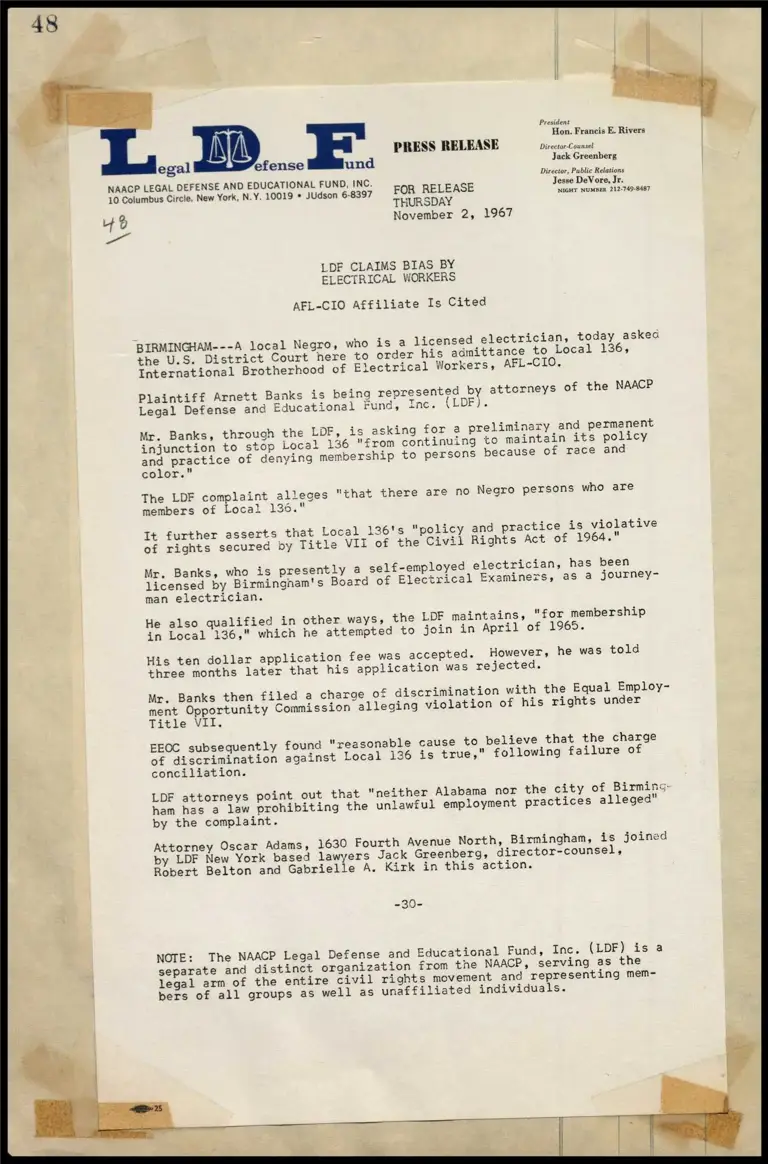
McDonald, who graduated first in her class at Howard Law, applied to work at LDF in 1966 as the landmark Civil Rights Act led to a surge of discrimination lawsuits. She also applied for a job at IBM but really set her sights on civil rights law. LDF hired McDonald and assigned her to its burgeoning employment litigation campaign led by veteran attorney Robert Belton.
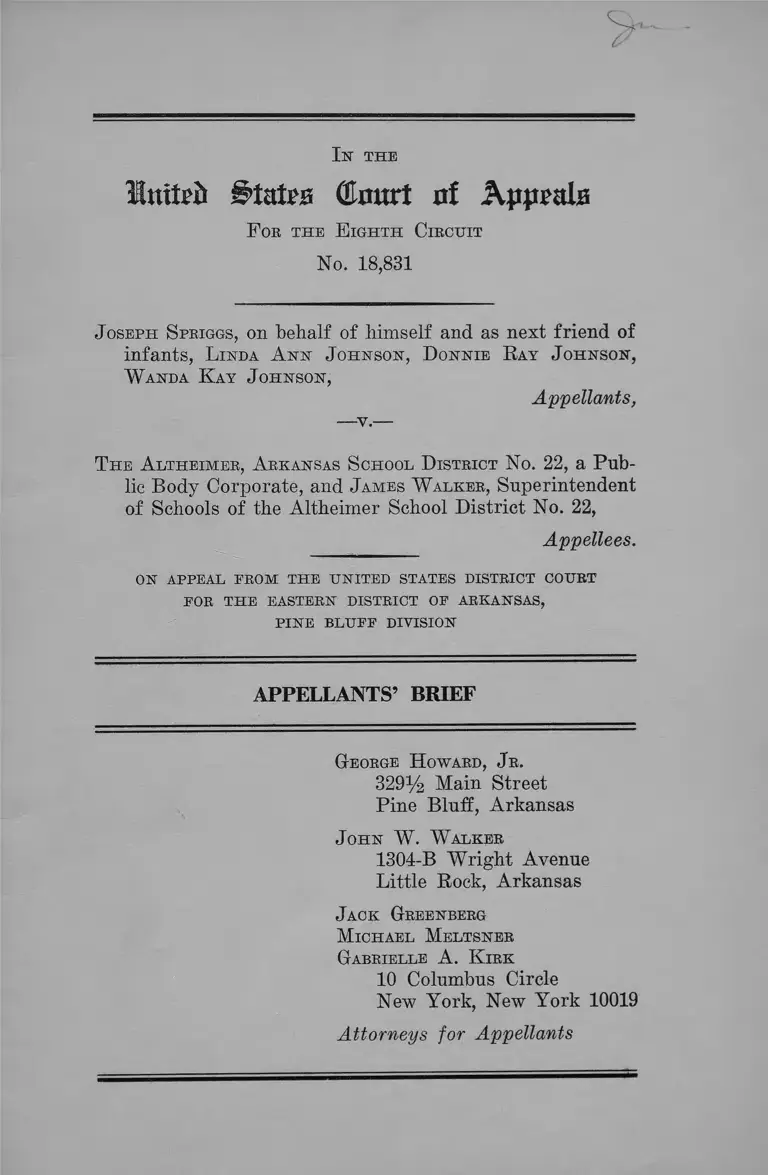
Despite her assignment, the first civil rights case McDonald argued was a school discrimination case: Spriggs v. Altheimer School District in the U.S. Court of Appeals for the Eighth Circuit. She represented Black students who were charged tuition to attend a public, majority-white school.
Her caseload soon focused on helping people alleging employment discrimination in New York, Georgia, Louisiana, Alabama, Texas, and elsewhere. She often partnered with local cooperating attorneys in those states while also traversing the new legal landscape for discriminatory work practices. She was on a work trip, visiting the Atlanta, Georgia, home of attorney Howard Moore, when she watched the television news reports of the assassination of Martin Luther King Jr. on April 4, 1968.
McDonald, who spent most of her life in the North, listened to the stories told by local attorneys reared in the South as they shared recollections of racist abuse, violence, and police harassment. Those conversations emboldened her to work harder.
One of her most pressing assignments at LDF was challenging how workers of color fared under employee seniority systems that companies utilized for job security, promotions, and compensation. “Facially neutral” seniority systems with no intent to discriminate were considered legal under Title VII of the Civil Rights Act.
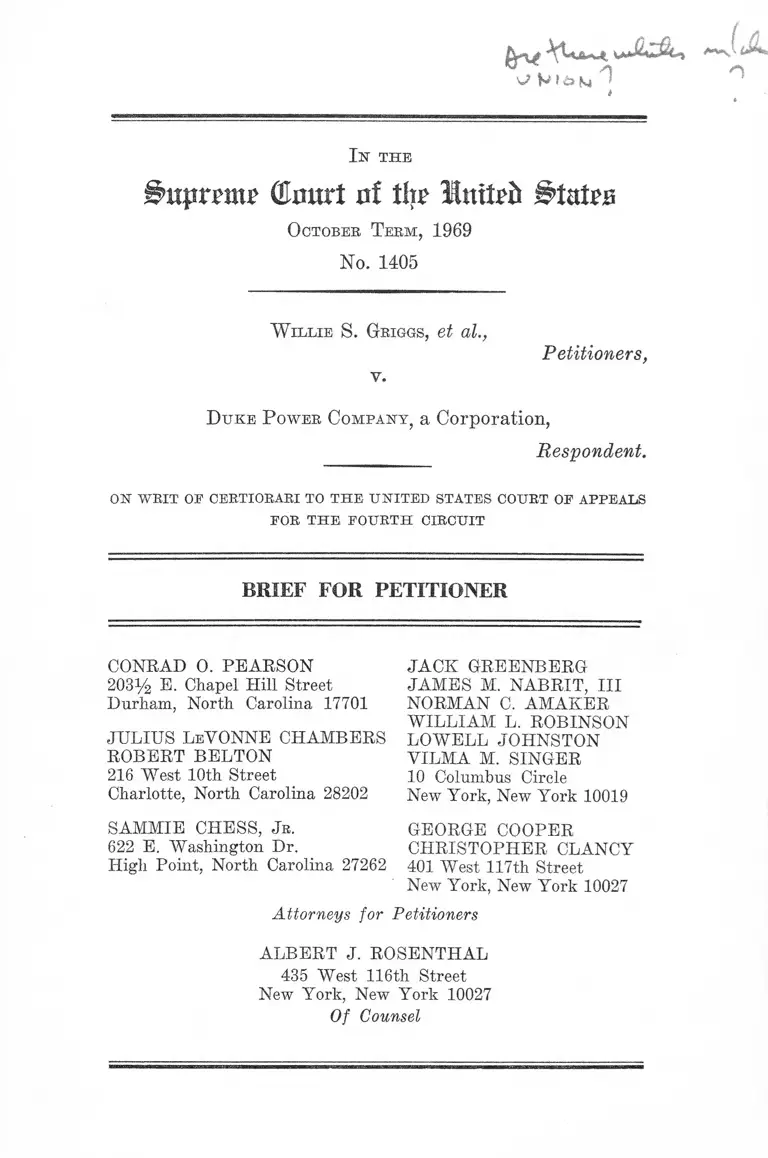
McDonald, part of the vanguard of employment law, looked into complaints that the rules and procedures of some seniority systems kept Black employees essentially confined to certain departments, doing the dirtiest, worst-paid jobs with little chance of advancement. Her work helped to develop legal arguments that served as a template for other precedent-setting employment discrimination lawsuits, including the 1971 Supreme Court case Griggs v. Duke Power Co. Unfortunately, a few years after this case, the Supreme Court held in Teamsters v. United States and American Tobacco Co. v. Patterson that seniority systems like those in Griggs were lawful under Title VII. In overturning Griggs, the Court found that employers can only be held liable for intentional discrimination.
Griggs v. Duke Power Co.
In 1971, the Supreme Court issued a unanimous ruling in Griggs v. Duke Power, which transformed our nation’s workplaces. As a result of LDF’s advocacy, the Supreme Court embraced a powerful legal tool now known as the “disparate impact” framework.
By mid-1969, she left LDF to enter private practice. She married Mark McDonald, a Houston lawyer, and moved with him to Texas, where she continued to work on racial discrimination in the workplace at the firm McDonald & McDonald. At one point, she had 40 civil rights cases pending.
Judge Gabrielle Kirk McDonald
One day in 1978, she received an unexpected phone call from the office of U.S. Senator Lloyd Bentsen of Texas. The voice on the line asked McDonald if she would be interested in an appointment to the U.S. District Court for the Southern District of Texas. President Jimmy Carter had just signed the Omnibus Judgeship Act of 1978, which created 152 new federal judgeships. He sought a number of women and people of color to fill some of those posts.
“I was 35 at the time, Black, and a woman—come on, you know,” McDonald recalled in the 2024 interview. “It would be pie in the sky for me to ever have thought that I would become a federal judge.”
Despite being skeptical at the outset, she agreed to the nomination, mainly out of a sense of duty to help diversify the judiciary. She was appointed to the bench on May 11, 1979, and became the first Black woman to serve as a federal judge in the entire South.
She served with several judges who evidently never had the experience of working with a Black woman who was also much younger than they were. There were moments during her years as a federal judge when she had to navigate racist and sexist comments from colleagues. At the courthouse, near a conference room for the jurists, one of the two restrooms displayed a paper sign that read, “Judge McDonald’s bathroom.”
Nevertheless, with gavel in hand, she was focused on conducting fair proceedings with integrity and greater public accessibility than was found in many other courtrooms. In the back of her mind, she held memories of the bias of Southern federal judges she saw when she was a young civil rights lawyer and pledged not to be anything like them.
When McDonald presided over a lawsuit filed by the Vietnamese Fishermen’s Association against the Knights of the Ku Klux Klan over shrimping in the Gulf of Mexico, she received threats including four fake one-way tickets to Africa sent to her office. She took to carrying a small handgun in her purse for self-protection.
In 1988, nine years into her tenure, McDonald announced her retirement from the bench. She returned to private practice but also devoted her time to lecturing and teaching, mainly at the Thurgood Marshall School of Law at Texas Southern University and St. Mary’s University School of Law in San Antonio. She also joined Judicial Arbitration and Mediation Services (JAMS) in Houston, utilizing her experience as a civil rights lawyer to facilitate mutually acceptable settlements between disputing parties.
International Justice
In 1993, the United Nations Security Council created the International Criminal Tribunal for the Former Yugoslavia to prosecute war crimes in southeastern Europe. Ethnic cleansing following the breakup of the Communist country eventually led to an estimated 140,000 people killed, mass deportations, and widespread sexual assaults in nearly 10 years of fighting beginning in 1991.
McDonald’s name was forwarded as a potential candidate for one of the 11 judgeships on the tribunal by a former LDF colleague, Conrad Harper, who at the time was serving as a legal advisor to the State Department. Madeleine Albright, then the U.S. Ambassador to the United Nations, was a big proponent of forming the tribunal as a way to document the atrocities, give victims a voice, hold people accountable, and deter future crimes. When the U.N. General Assembly voted for the judges, McDonald received the most votes.
McDonald arrived at The Hague in 1993. She and the other judges (from Costa Rica, Malaysia, Australia, and elsewhere) quickly set out to draft rules to create an international criminal justice system from scratch. They had to decide everything from criminal codes and procedures to the construction of a detention center, and even what color robes the jurists would wear in court.
McDonald was selected by her peers to serve as president of the tribunal. In 1995, she presided over the first full trial of the court, in which Duško Tadić, a Bosnian Serb, was sentenced to 20 years in prison for crimes against humanity.
Her experience also led to a stint as an American arbitrator on the Iran-United States Claims Tribunal at The Hague starting in 2001.
From feeling the first spark in the lecture hall in 1963 to deciding international cases at historic tribunals, McDonald’s legacy of advancing civil rights and justice has spanned decades and nations.
References
Our latest stories
-
Elizabeth Horton Sheff: From Community Activism to the Courts
September 08, 2026
How community activist Elizabeth Horton Sheff led in the fight for education equity in Hartford, Connecticut.

-
The Racist Origins of “Student Pushout”
July 30, 2026
Understanding the history of exclusionary school discipline and the racial disparities that persist today.

-
The Newark Agreement: Establishing a Template for Community-Centered Fair Housing Advocacy
June 26, 2026
How negotiations over a new medical school in Newark, New Jersey, empowered Black activists and helped the Legal Defense Fund create a model for future community-centered fair housing advocacy.
